
Bitcoin Halving 2024: The Fourth Halving, Mining Rewards and the Future of Bitcoin Mining
At 00:09:27 UTC on April 20, 2024, Bitcoin reached block height 840,000. For people watching the network, it was a moment that had been anticipated for years.
The block was mined by ViaBTC, one of Bitcoin's established mining pools. It contained 3,050 transactions and marked the fourth halving in Bitcoin's history.
From that block onward, the subsidy paid to miners for discovering a valid block fell from 6.25 BTC to 3.125 BTC.
The reduction happened automatically. There was no central authority issuing an instruction, no company deciding when the event should occur, and no requirement for miners to approve it.
Bitcoin's existing consensus rules determined the outcome.
For the mining industry, however, the implications were substantial.
Mining companies had spent months preparing for a world in which the network would distribute half as many newly created bitcoins per block. Some invested in more efficient ASIC machines. Others concentrated on electricity contracts, operational costs, and financial reserves.
What happened during the halving itself added another unexpected chapter to the story.
Transaction fees in the historic block reached approximately 37.63 BTC, more than twelve times the new 3.125 BTC subsidy.
It was an extraordinary demonstration of how Bitcoin's fee market could influence miner revenue.
Understanding the 2024 halving requires examining both sides of the event: Bitcoin's predictable monetary rules and the increasingly complex economics of operating a mining business.
1. What Is Bitcoin Halving?
Bitcoin halving is a scheduled reduction in the amount of newly created Bitcoin awarded to miners.
The Bitcoin protocol reduces the block subsidy after every 210,000 blocks.
Because the network targets an average block interval of approximately ten minutes, these events occur roughly every four years.
The exact calendar date is not fixed in advance. It depends on when the relevant block height is reached.
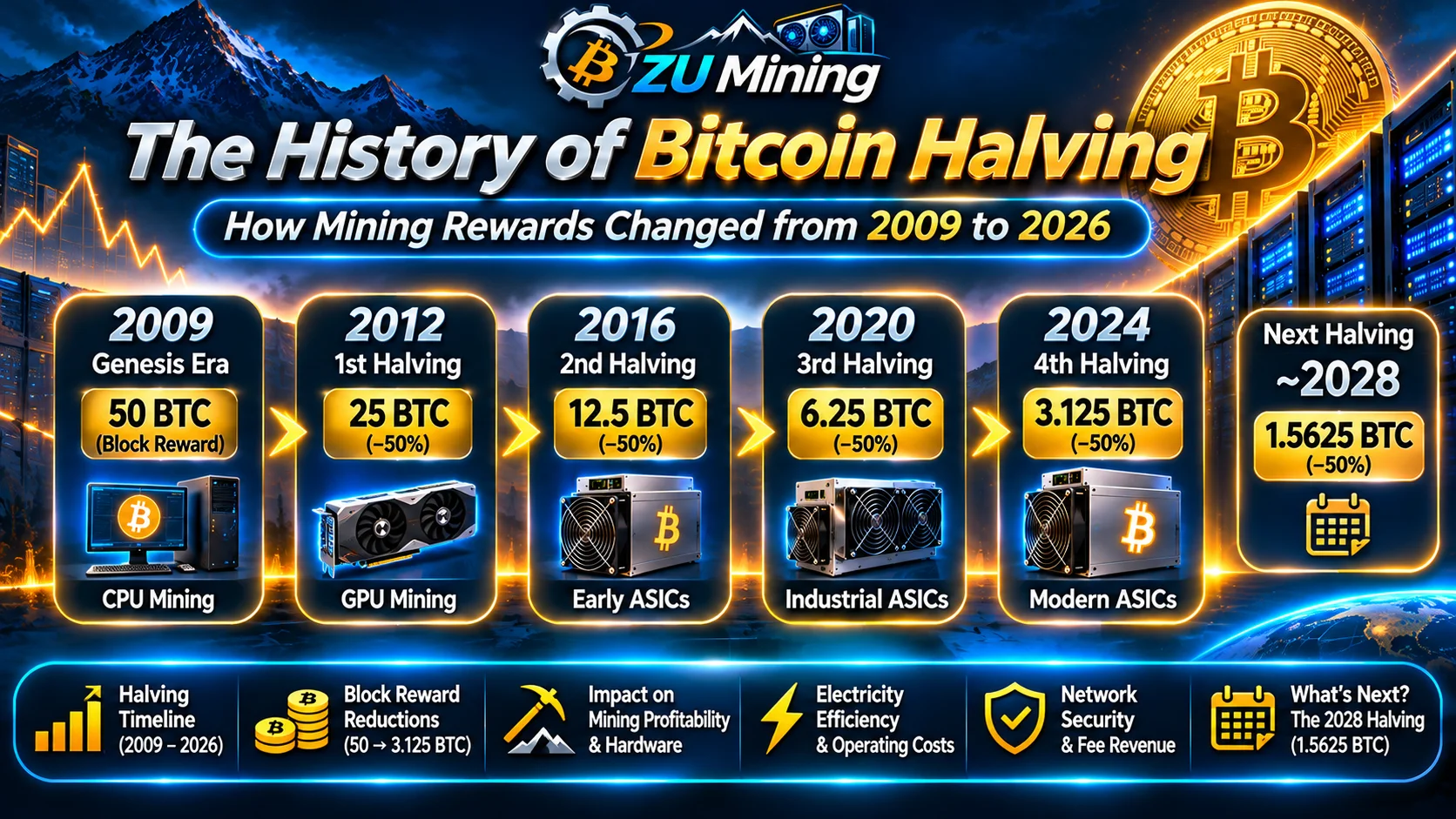
When Bitcoin launched in January 2009, the block subsidy was 50 BTC.
After successive halvings, it gradually declined.
The purpose of this system is to create a predictable issuance schedule rather than allowing new Bitcoin to be produced at an unrestricted rate.
Bitcoin's four completed halvings through 2024
| Halving | Date | Block Height | New Subsidy |
|---|---|---|---|
| First | November 28, 2012 | 210,000 | 25 BTC |
| Second | July 9, 2016 | 420,000 | 12.5 BTC |
| Third | May 11, 2020 | 630,000 | 6.25 BTC |
| Fourth | April 20, 2024 | 840,000 | 3.125 BTC |
The 2024 event began Bitcoin's fifth subsidy era.
This new era continues until block height 1,050,000, when the next halving is expected to reduce the subsidy to 1.5625 BTC.
The next event is projected to occur around 2028, although its exact date will depend on block production.
2. The Historic Block 840,000
The fourth halving took place at block height 840,000.
Blockchain records identify ViaBTC as the mining pool that discovered the block.
The block was recorded at 00:09:27 UTC on April 20, 2024.
Its significance extended beyond the reduction in Bitcoin issuance.
It also became one of the most discussed blocks in the network's history because of unusually high transaction fees.
What the block contained
According to blockchain explorer records:
Block height: 840,000.
Mining pool: ViaBTC.
Timestamp: April 20, 2024, at 00:09:27 UTC.
Transactions: 3,050.
New block subsidy: 3.125 BTC.
Transaction fees: approximately 37.6256 BTC.
Total miner reward: approximately 40.7506 BTC.
The total reward was unusually large because users were competing intensely for transaction space.
The block can be inspected through the Bitcoin blockchain explorer.
Why the total reward exceeded 40 BTC
Bitcoin miners receive two types of revenue when they successfully produce a block.
The first is the block subsidy, which consists of newly issued Bitcoin.
The second is transaction fees paid by users.
The relationship is straightforward:
Total Miner Reward = Block Subsidy + Transaction Fees
For block 840,000:
3.125 BTC + 37.6256 BTC = 40.7506 BTC
The transaction fees were therefore much larger than the subsidy.
However, this exceptional block should not be treated as representative of normal mining revenue.
Transaction fees vary considerably depending on network activity.
3. Why the 2024 Halving Was So Important
Bitcoin's fourth halving arrived after several years of significant changes in the mining industry.
During the 2021 bull market, companies had expanded facilities and purchased large quantities of ASIC hardware.
The 2022 crypto winter then exposed financial weaknesses across parts of the industry.
In 2023, Bitcoin's price recovered and network hashrate expanded rapidly.
By early 2024, miners were operating in a highly competitive environment.
The halving introduced another challenge: fewer newly issued bitcoins were available to reward the same global mining competition.
The immediate economic effect
Before the halving, a successful block generated 6.25 BTC in newly issued Bitcoin.
Afterward, it generated 3.125 BTC.
The subsidy component declined by exactly 50%.
The network did not automatically reduce electricity bills, equipment costs, or financial obligations.
Consequently, mining companies needed to reassess their operating economics.
Why this did not mean every miner's revenue fell exactly 50%
The block subsidy is only one part of mining revenue.
Transaction fees also contribute.
Furthermore, Bitcoin's price, network difficulty, and each miner's share of total hashrate can change.
For that reason, a 50% reduction in the subsidy does not necessarily produce an identical percentage decline in a company's dollar-denominated revenue.
The distinction is essential when evaluating mining profitability.
4. Bitcoin's Daily Issuance Falls
The halving changed the approximate quantity of new Bitcoin entering circulation each day.
Bitcoin produces about 144 blocks daily on average.
Before the fourth halving:
144 × 6.25 BTC = 900 BTC per day
After the fourth halving:
144 × 3.125 BTC = 450 BTC per day
The network's expected daily issuance therefore declined by approximately 450 BTC.
These figures are long-run averages rather than fixed daily totals.
Actual block production can vary.
Why reduced issuance matters
Bitcoin's monetary policy limits the total theoretical supply to approximately 21 million BTC.
Each halving reduces the pace at which the remaining supply enters circulation.
This makes Bitcoin's issuance schedule predictable.
However, the halving does not guarantee that Bitcoin's market price will rise.
Market prices depend on demand, liquidity, investor expectations, regulation, and many other factors.
The halving changes the supply of newly issued Bitcoin, not the behavior of buyers and sellers.
5. The Role of Proof-of-Work
Bitcoin uses a Proof-of-Work consensus mechanism.
Miners operate specialized computers that repeatedly perform SHA-256 hashing calculations.
Their objective is to discover a valid block hash that satisfies the network's current difficulty target.
When a miner finds a valid block, other nodes independently verify it.
If the block follows the network's consensus rules, it can be accepted into the blockchain.
Why miners cannot ignore the halving
The block subsidy is enforced by Bitcoin's consensus rules.
After block height 840,000, a miner attempting to claim the previous 6.25 BTC subsidy would create an invalid block.
Other validating nodes would reject it.
This is an important characteristic of Bitcoin's design.
The issuance schedule does not depend on trusting a particular mining company.
It depends on the rules independently enforced by the network's participants.
6. How the Halving Affected Mining Profitability
Mining profitability depends on the relationship between revenue and operating costs.
A simplified calculation is:
Net Operating Profit = Mining Revenue − Electricity Costs − Other Operating Expenses
Revenue depends on expected Bitcoin production, Bitcoin's price, and transaction fees.
Expenses depend on electricity, hosting, maintenance, cooling, and other business requirements.
The 2024 halving directly reduced the subsidy component of expected Bitcoin production.
A hypothetical mining example
Imagine a mining operation earning 0.10 BTC per day from the block subsidy before the halving.
Assume its share of network hashrate remains unchanged.
After the halving, its expected subsidy earnings would decline to approximately 0.05 BTC per day.
At a hypothetical Bitcoin price of $60,000:
Before halving:
0.10 × $60,000 = $6,000 per day
After halving:
0.05 × $60,000 = $3,000 per day
This example excludes transaction fees and assumes unchanged network competition.
It illustrates the economic pressure created by a lower subsidy.
Why electricity costs become more important
Suppose the operation spends $2,500 daily on electricity.
Before the halving, $6,000 in revenue would leave $3,500 before other expenses.
After the halving, $3,000 in revenue would leave only $500 before other expenses.
The facility would still consume approximately the same amount of electricity.
Its operating margin would be substantially smaller.
This explains why electricity efficiency became a major focus for miners preparing for April 2024.
7. The Difference Between Revenue and Profit
A mining machine can generate Bitcoin while losing money.
This happens when the value of expected mining rewards is lower than the relevant operating expenses.
A miner's gross revenue should never be confused with net profit.
Costs that miners must consider
Electricity is often one of the largest expenses, but it is not the only one.
Mining businesses may also pay for:
Hardware purchases.
Hosting services.
Cooling equipment.
Electrical infrastructure.
Mining pool fees.
Maintenance and repairs.
Internet connectivity.
Facility rent.
Financing and administrative expenses.
Some expenses vary with machine operation, while others remain payable even when equipment is switched off.
A realistic profitability assessment should distinguish between these categories.
Readers can explore the ZU Mining profitability tools to examine mining revenue and operating expenses.
8. ASIC Mining Efficiency Becomes Critical
ASIC miners are specialized computers designed to perform mining calculations efficiently.
For Bitcoin, these devices are optimized for SHA-256 hashing.
During the years leading to the fourth halving, manufacturers introduced increasingly efficient ASIC generations.
Energy efficiency is commonly measured in joules per terahash, abbreviated J/TH.
Lower values indicate that a machine consumes less electricity for each unit of hashing work.
Comparing two hypothetical ASIC miners
Consider Machine A:
Hashrate: 100 TH/s
Power consumption: 3,000 watts
Efficiency:
3,000 ÷ 100 = 30 J/TH
Now consider Machine B:
Hashrate: 200 TH/s
Power consumption: 3,500 watts
Efficiency:
3,500 ÷ 200 = 17.5 J/TH
Machine B consumes more electricity overall, but it delivers twice the hashrate.
Its energy consumption per terahash is substantially lower.
Why efficiency mattered after April 2024
When expected subsidy revenue falls, inefficient machines can become less economical.
A mining operation with expensive electricity may need more efficient hardware to remain competitive.
However, buying newer equipment is not automatically profitable.
Purchase price, installation costs, electricity rates, and future network difficulty must all be considered.
The ZU Mining Hardware Directory provides a starting point for researching mining equipment.
9. Mining Difficulty and Network Competition
Bitcoin adjusts mining difficulty every 2,016 blocks.
This mechanism aims to maintain an average block interval of approximately ten minutes.
When more computational power joins the network, difficulty generally increases after adjustment.
When substantial hashrate leaves, difficulty can eventually decline.
What happens when inefficient miners shut down?
After a halving, some mining machines may no longer generate enough revenue to cover electricity costs.
Operators may switch off those machines.
If enough hashrate leaves the network, subsequent difficulty adjustments can make mining somewhat easier for remaining participants.
However, difficulty does not instantly change when machines shut down.
The adjustment occurs according to Bitcoin's established schedule.
Why difficulty does not guarantee profitability
Lower difficulty can improve expected Bitcoin earnings for a fixed amount of hashrate.
Nevertheless, profitability still depends on Bitcoin's price, transaction fees, and operating costs.
A difficulty reduction cannot guarantee that every remaining miner will become profitable.
10. Runes Launches During the Halving
One of the most unusual aspects of the fourth halving was the launch of the Runes protocol.
Runes was introduced by Casey Rodarmor, who had previously developed the Ordinals protocol.
The new system was designed to support fungible tokens on Bitcoin using a different approach from BRC-20 inscriptions.
Its launch was coordinated with the fourth halving.
Why Runes attracted attention
Users were eager to create and interact with early Runes assets.
This increased demand for transaction space around block 840,000.
Because Bitcoin blocks have limited capacity, users competed by offering transaction fees.
The resulting fee spike contributed to the unusually large reward received by the mining pool that discovered the halving block.
Why this mattered to miners
The halving reduced the block subsidy, but the same event temporarily produced exceptional transaction fee revenue.
This highlighted the growing importance of the fee market.
However, the initial excitement surrounding Runes did not mean that similarly high transaction fees would continue indefinitely.
Demand for block space changes over time.
Mining companies therefore needed to distinguish temporary fee spikes from sustainable revenue expectations.
11. Transaction Fees and Bitcoin's Long-Term Security
Bitcoin miners are compensated through newly issued Bitcoin and transaction fees.
Over successive halvings, the subsidy becomes smaller.
Eventually, new issuance is expected to become negligible and then cease under Bitcoin's issuance rules.
At that point, transaction fees would be the remaining direct block reward.
Why the fee market matters
Mining requires resources.
Operators purchase hardware, consume electricity, maintain facilities, and manage operational risks.
They need sufficient revenue to justify contributing computational power.
Transaction fees are therefore an important part of Bitcoin's long-term security economics.
What block 840,000 demonstrated
The historic halving block contained approximately 37.63 BTC in fees.
That was far more than the 3.125 BTC subsidy.
The event demonstrated that transaction demand could sometimes produce substantial miner compensation.
However, it did not prove that transaction fees would consistently replace declining subsidies.
Whether the long-term fee market can support a desired level of network security remains an important subject of research and debate.
12. Mining Pools After the Halving
Mining pools remained important for operators that wanted more regular payouts.
A mining pool combines the computational work of participating miners.
When the pool discovers a block, rewards are distributed according to its payout rules.
Why payout methods matter
Common payout systems include FPPS, PPS+, and PPLNS.
These models differ in how mining rewards and transaction fees are allocated.
During periods of high transaction fees, the details become particularly relevant.
A pool's fee policy can affect the revenue received by participating miners.
What miners should evaluate
When comparing mining pools, operators should consider:
Payout structure.
Pool fees.
Transaction fee distribution.
Minimum payout requirements.
Server reliability.
Security practices.
Operational transparency.
The ZU Mining Pools Directory can help readers research available mining services.
13. The Importance of Electricity Pricing
Electricity remained one of the most important factors in mining economics after the fourth halving.
A machine's power consumption can be estimated using its wattage.
Consider an ASIC miner consuming 3,500 watts.
That equals 3.5 kilowatts.
Operating continuously for 24 hours requires:
3.5 × 24 = 84 kWh
At $0.05 per kWh:
84 × $0.05 = $4.20 daily
At $0.10 per kWh:
84 × $0.10 = $8.40 daily
At $0.15 per kWh:
84 × $0.15 = $12.60 daily
Over a 30-day period, the corresponding electricity costs would be $126, $252, and $378.
These calculations exclude cooling, electrical losses, maintenance, and other expenses.
Why electricity contracts matter
Industrial mining companies may negotiate electricity arrangements that differ significantly from ordinary residential tariffs.
Some operators can reduce consumption during periods of high electricity demand.
Others may participate in demand-response programs where permitted.
The financial value of these arrangements depends on local market conditions and contract terms.
The fourth halving made careful energy management even more important.
14. Cooling Technology and Operational Efficiency
Mining hardware generates substantial heat.
Maintaining suitable operating temperatures is essential for reliable performance.
Large mining facilities use different cooling methods depending on their infrastructure and equipment.
Air cooling
Air-cooled systems rely on fans and ventilation.
They can be relatively straightforward to deploy, but their performance depends on ambient temperatures and airflow design.
Hydro cooling
Hydro-cooled mining systems use liquid-based heat transfer to remove heat from compatible equipment.
These systems require appropriate pumps, plumbing, and heat exchange infrastructure.
Immersion cooling
Immersion cooling places compatible mining hardware in specially designed dielectric fluids.
The fluid transfers heat away from electronic components.
This method can support dense equipment deployments but requires additional engineering expertise.
Why cooling matters financially
Poor thermal management can contribute to equipment instability, downtime, and maintenance expenses.
Efficient cooling can improve operational reliability.
However, cooling systems themselves consume energy and require investment.
The best approach depends on the complete facility design.
15. How Mining Companies Prepared for Lower Rewards
The fourth halving was predictable years in advance.
Mining companies therefore had time to prepare.
Some operators upgraded ASIC hardware.
Others concentrated on reducing debt, securing electricity capacity, and improving operational efficiency.
Hardware replacement
Replacing inefficient equipment can improve energy efficiency.
However, new machines require capital.
Companies must compare expected savings with purchase and deployment costs.
Financial planning
Businesses with substantial financial obligations can become vulnerable when mining revenue declines.
Maintaining liquidity may provide flexibility during difficult market conditions.
Operational improvements
Reducing unnecessary downtime can help mining facilities capture more of their expected revenue.
Preventive maintenance, equipment monitoring, and reliable network connections can support operational performance.
Revenue diversification
Some infrastructure operators explored additional services, including data center hosting and other computing workloads.
However, diversification requires suitable equipment, customers, and technical capabilities.
Bitcoin ASIC miners cannot simply be repurposed as general-purpose AI computing hardware.
16. Did the Halving Automatically Increase Bitcoin's Price?
The halving reduced Bitcoin's new issuance.
It did not guarantee a price increase.
Bitcoin's market price is determined through trading activity and the interaction of supply and demand.
Many factors can influence that process.
These include investor expectations, economic conditions, market liquidity, regulatory developments, and institutional participation.
Historical patterns require caution
Bitcoin's earlier halvings were followed by periods of significant price appreciation.
However, historical performance does not establish a guaranteed relationship.
Each market cycle occurs under different conditions.
The 2024 halving took place in an environment that included the introduction of U.S. spot Bitcoin exchange-traded products earlier that year.
That made the market context different from previous halving periods.
Why miners should avoid relying on price predictions
A mining business may remain exposed to significant financial risk even if its owners expect Bitcoin's price to rise.
Equipment and electricity expenses are real obligations.
Future market prices are uncertain.
Mining decisions should therefore account for unfavorable scenarios rather than depending entirely on optimistic forecasts.
17. The Fourth Halving and Bitcoin's Supply Schedule
Bitcoin's theoretical maximum supply is approximately 21 million BTC.
The halving schedule is central to how that limit is approached.
Each subsidy era creates fewer new bitcoins than the preceding one.
The mathematical pattern
Bitcoin began with a subsidy of 50 BTC per block.
After the first halving, the subsidy became 25 BTC.
Then it became 12.5 BTC, 6.25 BTC, and 3.125 BTC.
The sequence continues through successive halvings.
Because the subsidy is reduced repeatedly, the total issuance approaches a finite limit.
What happens in the distant future?
Bitcoin's block subsidy is expected to become zero around the year 2140.
The exact timing depends on block production.
At that stage, miners would rely on transaction fees rather than newly issued Bitcoin.
This is one reason researchers continue studying the relationship between transaction demand, mining incentives, and network security.
18. A Practical Post-Halving Mining Scenario
Consider a hypothetical facility operating 1,000 ASIC miners.
Each machine produces 200 TH/s and consumes 3,500 watts.
Total hashrate:
1,000 × 200 TH/s = 200,000 TH/s
That equals 200 PH/s.
Total machine power consumption:
1,000 × 3.5 kW = 3,500 kW
That equals 3.5 megawatts.
Daily energy consumption:
3,500 × 24 = 84,000 kWh
At $0.06 per kWh:
84,000 × $0.06 = $5,040 daily
At $0.10 per kWh:
84,000 × $0.10 = $8,400 daily
The facility would spend $3,360 more per day at the higher electricity rate.
Over 30 days, that difference would reach $100,800.
These calculations include machine electricity consumption only.
They exclude cooling, facility losses, maintenance, and financing.
What the example illustrates
A mining facility can operate substantial hashrate while facing very different financial outcomes depending on its electricity costs.
After the halving, controlling those expenses became especially important.
A complete analysis would also need expected BTC production, transaction fees, network difficulty, and equipment costs.
19. The Immediate Aftermath of the Halving
The fourth halving did not stop the Bitcoin network.
Blocks continued to be produced.
Mining pools continued operating, and transactions continued to be confirmed.
However, the revenue environment changed.
The subsidy was permanently lower under the existing consensus rules.
Meanwhile, the unusually high transaction fees surrounding the halving were temporary.
As demand for block space changed, fee levels also changed.
What miners learned
The event demonstrated that mining revenue can be affected by multiple forces simultaneously.
A lower subsidy can reduce expected earnings.
Higher transaction fees can temporarily offset part of that reduction.
Changes in difficulty can influence how rewards are distributed across the network.
Bitcoin's market price determines the fiat value of the BTC earned.
Electricity and infrastructure costs determine how much revenue remains after expenses.
No single variable provides a complete picture.
20. What the 2024 Halving Meant for Bitcoin Mining's Future
The fourth halving marked another stage in the development of Bitcoin mining.
The industry had evolved considerably since the network's launch in 2009.
Early participants mined Bitcoin using ordinary computers.
Over time, GPU mining, FPGA technology, and specialized ASIC hardware transformed the industry.
By 2024, mining had become a global infrastructure business requiring significant technical and financial resources.
The halving reinforced several long-term trends.
Greater emphasis on energy efficiency
Efficient equipment became increasingly important as subsidy revenue declined.
More attention to transaction fees
The unusual reward in block 840,000 demonstrated the potential significance of Bitcoin's fee market.
Stronger competition
Mining companies continued competing for a limited stream of block rewards.
More disciplined financial planning
Businesses needed to consider electricity prices, capital expenditure, liquidity, and future difficulty changes.
Continued technological development
ASIC manufacturers and mining infrastructure providers had incentives to improve performance and reduce operating costs.
These trends would shape the industry's development after 2024.
Conclusion
Bitcoin's fourth halving took place on April 20, 2024, at block height 840,000.
The event reduced the block subsidy from 6.25 BTC to 3.125 BTC and lowered expected daily issuance from approximately 900 BTC to 450 BTC.
For miners, the change created a significant economic challenge.
Equipment still consumed electricity, facilities still required maintenance, and companies still faced financial obligations.
The halving also produced an extraordinary moment in Bitcoin's history.
The first block of the new subsidy era contained approximately 37.63 BTC in transaction fees, far exceeding the newly issued Bitcoin reward.
That event demonstrated how transaction demand could influence mining revenue, while also highlighting the uncertainty surrounding future fee income.
The fourth halving was therefore both a milestone in Bitcoin's monetary policy and a turning point for mining economics.
It reinforced a lesson that had become increasingly important throughout the industry's history: successful mining depends on efficient technology, realistic financial planning, reliable infrastructure, and an understanding of how Bitcoin's network operates.
Frequently Asked Questions
When did the fourth Bitcoin halving happen?
The fourth halving occurred on April 20, 2024, at 00:09:27 UTC.
What block triggered the 2024 halving?
Bitcoin block 840,000 triggered the fourth halving.
What was the new mining subsidy?
The subsidy decreased from 6.25 BTC to 3.125 BTC per block.
Which mining pool discovered the halving block?
ViaBTC mined block 840,000.
Why did the halving block have unusually high fees?
Demand for transaction space increased around the launch of the Runes protocol, contributing to intense fee competition.
Did every miner's income fall exactly 50%?
No. The subsidy component was halved, but total mining revenue also depends on transaction fees, Bitcoin's price, network difficulty, and individual hashrate.
How much Bitcoin was issued daily after the halving?
Approximately 450 BTC per day on average, compared with approximately 900 BTC before the event.
Did the halving make Bitcoin mining unprofitable?
Not universally. Profitability depends on electricity costs, hardware efficiency, network conditions, and other expenses.
When is the next Bitcoin halving?
The next halving is expected around 2028 at block height 1,050,000.
What will happen when Bitcoin's subsidy reaches zero?
Miners would rely on transaction fees for direct block rewards. The long-term economic implications remain an important research topic.
Historical References and Further Reading
Bitcoin.org. Bitcoin Halving Countdown and Historical Halving Schedule. https://bitcoin.org/en/halving
Blockchain.com Explorer. Bitcoin Block 840,000. Original blockchain record showing the fourth halving, mining pool, transactions, and fees. https://www.blockchain.com/explorer/blocks/btc/840000
Blockstream. What Is the Bitcoin Halving? Explanation of Bitcoin's issuance schedule and consensus rules. https://help.blockstream.com/education/economics/bitcoin-economics/what-is-the-bitcoin-halving
Bitcoin Developer Documentation. Mining. Technical explanation of Proof-of-Work and difficulty adjustment. https://developer.bitcoin.org/devguide/mining.html
ViaBTC. After Bitcoin's Fourth Halving: What Are the Miners' Earnings Like Now? April 2024 analysis of mining revenue changes. https://www.viabtc.com/en/blog/Beginner-319?category=0
Cambridge Centre for Alternative Finance. Cambridge Bitcoin Electricity Consumption Index. https://ccaf.io/cbnsi/cbeci
Bitcoin Improvement Proposals. Bitcoin Protocol Specifications. https://github.com/bitcoin/bips
Editorial note: Mining calculations are illustrative and do not represent guaranteed financial outcomes. Bitcoin prices, transaction fees, difficulty, and operating costs change over time. Historical figures should be checked against original blockchain records and primary sources before publication.