
Bitcoin Mining in 2026: ASIC Innovation, Global Infrastructure and the Future of Mining
Updated November 9, 2026
Bitcoin mining in 2026 looks very different from the industry that existed only a few years ago. The machines are more efficient, facilities are larger, electricity management is more sophisticated, and some of the world's established mining companies are increasingly developing infrastructure for artificial intelligence.
Yet the most important story of 2026 is not simply technological progress. It is the growing tension between an increasingly competitive Bitcoin network and the economics of operating the machines that secure it.
During the first half of 2026, Bitcoin miners experienced a prolonged period of pressure on revenue per unit of computing power. Network hashrate declined from previous peaks, mining difficulty underwent substantial downward adjustments, and publicly traded operators reconsidered how they allocated capital.
By the third quarter, the network had begun stabilizing. Meanwhile, the global distribution of mining activity continued changing.
Understanding these developments requires looking beyond Bitcoin's market price. Hardware efficiency, electricity costs, network difficulty, data center capacity, and access to financing all play important roles.
1. Bitcoin Mining After the Fourth Halving
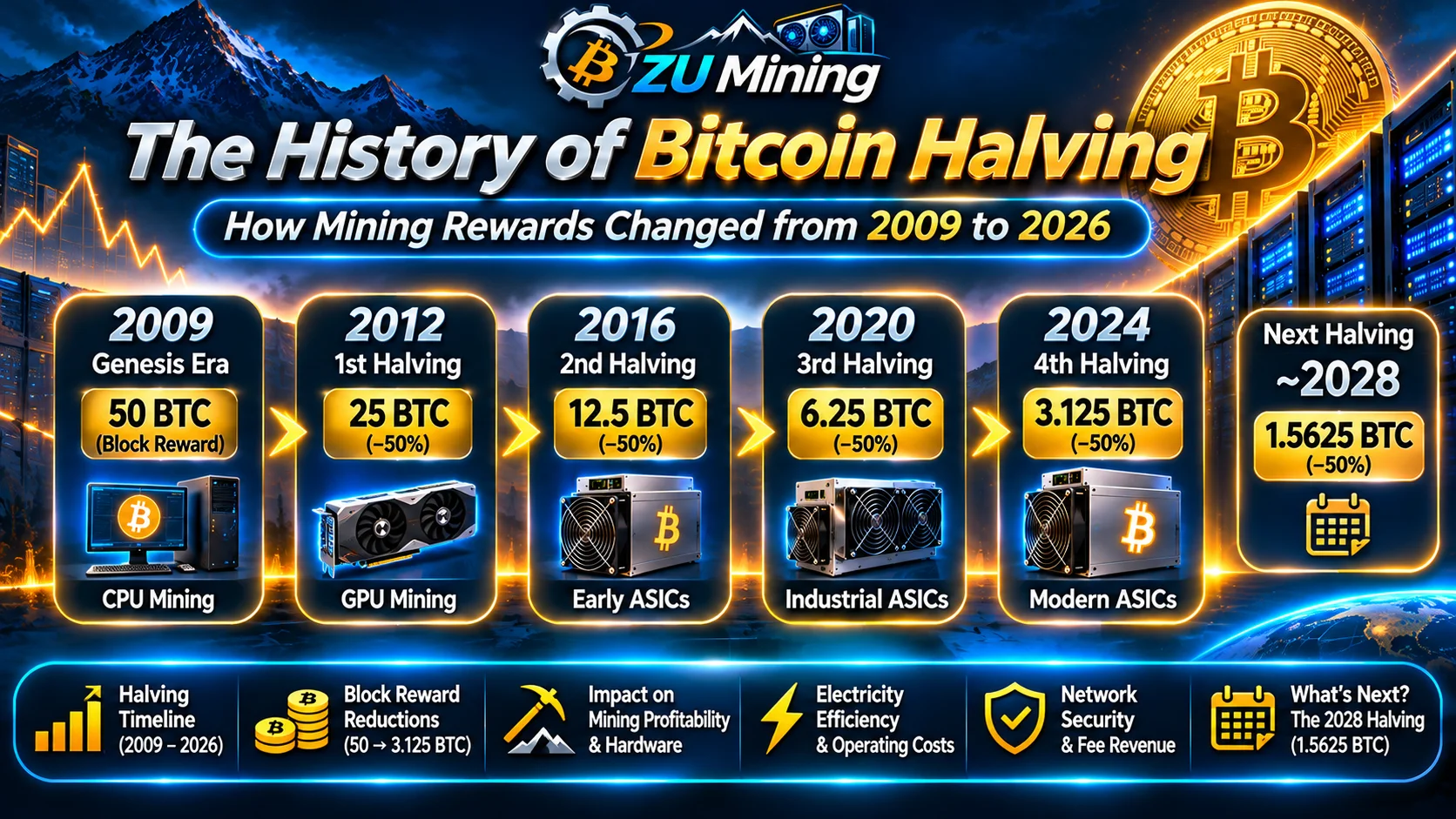
Bitcoin entered 2026 operating under the block subsidy established by its fourth halving.
That event occurred on April 20, 2024, at block height 840,000.
The subsidy declined from 6.25 BTC to 3.125 BTC per block.
It remained at 3.125 BTC throughout 2026.
Bitcoin's protocol targets an average block interval of approximately ten minutes. At that rate, the network issues around 144 blocks per day.
Multiplying 144 by 3.125 gives approximately 450 newly issued BTC per day.
Transaction fees provide additional compensation to miners, but those fees vary with demand for block space.
The smaller subsidy means that mining companies must compete for a limited amount of newly issued Bitcoin while continuing to pay for electricity, equipment, cooling, and maintenance.
The challenge becomes more demanding when the network's total hashrate increases.
A mining machine can operate perfectly and still earn less Bitcoin than it did previously because its share of the network has declined.
This relationship is fundamental to understanding the industry's developments in 2026.
2. The Network Entered 2026 Under Pressure
Bitcoin mining expanded significantly during 2025, reaching the zettahash era.
One zettahash per second equals 1,000 exahashes per second.
However, the beginning of 2026 showed that network computing power does not always move upward.
According to CoinShares' second-quarter 2026 mining report, estimated network hashrate fell from approximately 1,160 EH/s in early October 2025 to around 850 EH/s in early February 2026.
That represents a peak-to-trough decline of approximately 27%.
The reduction reflected difficult mining economics and periods when some operators found it more attractive to curtail or retire mining capacity.
A decline in network hashrate does not mean Bitcoin stops functioning.
Instead, the network continues processing blocks, and its difficulty adjustment mechanism responds to changes in the amount of computing power participating.
The episode demonstrated an important feature of Proof-of-Work mining: when revenue falls relative to operating costs, less competitive equipment may leave the network.
3. Mining Difficulty Adjustments Became a Major Story
Bitcoin adjusts mining difficulty every 2,016 blocks.
This mechanism is designed to keep the average time between blocks close to ten minutes.
When hashrate decreases, blocks may temporarily arrive more slowly.
At the next adjustment, difficulty can fall to reflect the reduced computing power.
Several significant downward adjustments occurred during 2026.
On June 14, difficulty declined approximately 10.09%, from 138.96 trillion to 124.93 trillion.
The adjustment occurred at block height 953,568.
It was among the largest negative adjustments in Bitcoin's history.
The June decline followed other substantial downward movements earlier in the year.
What a difficulty reduction means
A lower difficulty makes it statistically easier for the remaining network hashrate to find blocks.
For a miner whose equipment remains online, this can increase expected Bitcoin production per unit of computing power, assuming other conditions remain comparable.
However, lower difficulty does not guarantee profitability.
If Bitcoin's price declines significantly, the value of the coins earned may still be insufficient to cover operating expenses.
This is why mining difficulty and mining profitability must be analyzed together.
4. The Importance of Hashprice in 2026
Hashprice became one of the clearest indicators of financial pressure in the mining industry.
It measures the expected revenue generated by a unit of mining hashrate over a particular period.
A common measurement is US dollars per petahash per second per day.
CoinShares reported that the monthly average hashprice reached approximately $27.70 per PH/s per day in June 2026.
That was an exceptionally difficult revenue environment for many operators.
A simple example
Consider a mining facility producing 20 PH/s.
At a hypothetical hashprice of $30 per PH/s per day, its estimated gross daily revenue would be:
20 × $30 = $600
At $40 per PH/s per day:
20 × $40 = $800
The difference is $200 per day, even though the facility operates the same equipment.
Across a month, the change can be substantial.
These figures are illustrations, not a claim about the revenue earned by a particular facility.
Why hashprice matters more than headlines
Bitcoin's market price is only one part of mining economics.
Network difficulty, transaction fees, and the block subsidy also influence expected revenue.
A rising Bitcoin price can improve mining revenue, but increased competition may offset some of that benefit.
Operators therefore need to monitor revenue per unit of hashrate rather than relying exclusively on Bitcoin's price.
5. ASIC Innovation Continued Reshaping the Industry
Specialized ASIC hardware remained the foundation of Bitcoin mining in 2026.
ASIC stands for Application-Specific Integrated Circuit.
Unlike general-purpose computer processors, Bitcoin ASIC machines are designed to perform SHA-256 hashing efficiently.
The most important performance measurements include:
Hashrate, usually expressed in TH/s.
Power consumption, measured in watts.
Energy efficiency, expressed in J/TH.
Equipment reliability and operating temperature.
Purchase and maintenance costs.
Why joules per terahash matter
J/TH measures how much energy a machine requires to perform a unit of hashing work.
Lower values indicate greater energy efficiency.
For example, a machine operating at 20 J/TH requires twice as much energy per terahash as one operating at 10 J/TH.
That difference becomes significant at industrial scale.
The move toward sub-10 J/TH hardware
CoinShares' 2026 industry research identified the scaling of sub-10 J/TH mining hardware from manufacturers including Bitmain and Bitdeer as an important development.
Such equipment can improve operating economics where deployment costs and electricity conditions justify an upgrade.
However, manufacturer specifications should not be confused with guaranteed real-world performance.
Temperature, cooling systems, operating modes, firmware, and electrical conditions can affect actual results.
Readers researching different models can explore the ZU Mining Hardware Directory.
6. Why Better ASIC Machines Do Not Guarantee Better Profits
A common assumption is that purchasing the newest mining hardware automatically produces better financial results.
In practice, the calculation is more complicated.
A newer machine may consume less electricity for each terahash, but it also requires an initial investment.
The operator must consider how long it will take for operating savings to offset the purchase price.
An illustrative comparison
Suppose two machines produce the same 200 TH/s.
Machine A operates at 20 J/TH.
Machine B operates at 10 J/TH.
Machine A consumes:
200 × 20 = 4,000 watts
Machine B consumes:
200 × 10 = 2,000 watts
Over 24 hours, the energy difference is 48 kWh.
At $0.08 per kWh, Machine B saves approximately $3.84 per day in electricity.
That is about $115 over a 30-day period, assuming continuous operation.
But if upgrading requires a substantial capital investment, the savings must be compared against that expense.
The operator also needs to account for potential downtime, installation, maintenance, and changes in future mining revenue.
Hardware efficiency is important, but it is only one part of a responsible financial assessment.
7. Electricity Economics Remained Critical
Electricity is one of the largest recurring expenses in Bitcoin mining.
The Cambridge Digital Mining Industry Report, published in 2025, found that electricity accounted for more than 80% of cash-based operating expenses among surveyed miners.
The report's data reflected an earlier observation period, so it should not be interpreted as a fresh 2026 measurement.
Nevertheless, it provides valuable context for understanding why electricity costs remained central to mining decisions.
A practical electricity calculation
Consider a mining operation with a continuous electrical load of 500 kW.
Its daily energy consumption would be:
500 × 24 = 12,000 kWh
At $0.04 per kWh:
Daily electricity cost = $480
At $0.08 per kWh:
Daily electricity cost = $960
At $0.12 per kWh:
Daily electricity cost = $1,440
The difference between the lowest and highest rates is $960 per day.
Over a 30-day period, that difference reaches $28,800.
These calculations exclude cooling overhead, electrical losses, facility expenses, and other operating costs.
The example demonstrates why electricity contracts and infrastructure efficiency can be as important as the mining equipment itself.
8. Mining Companies Continued Moving Toward AI Infrastructure
One of the most consequential developments in 2026 was the expansion of mining companies into artificial intelligence and high-performance computing infrastructure.
Some Bitcoin mining operators already controlled large facilities, electrical substations, grid connections, and cooling systems.
These assets can also be valuable for data center development.
As demand for AI computing infrastructure expanded, certain mining companies began reallocating capital and electricity capacity toward new business opportunities.
Evidence of the transition
An August 2026 report citing BlocksBridge Consulting found that realized hashrate among a group of publicly traded Bitcoin miners declined from approximately 368.3 EH/s in the fourth quarter of 2025 to 319 EH/s in the second quarter of 2026.
That represented a reduction of approximately 13.4%.
The findings indicated that some public mining operators were reducing their Bitcoin mining exposure while developing AI and high-performance computing businesses.
However, this was not a universal industry trend.
Other companies continued expanding Bitcoin mining operations.
The industry was becoming more diverse in how it used electricity and computing infrastructure.
9. Bitcoin ASICs and AI GPUs Are Different Technologies
Bitcoin mining hardware and AI computing hardware perform fundamentally different tasks.
A Bitcoin ASIC is optimized for SHA-256 hashing.
AI computing typically relies on GPUs or other accelerators designed for parallel numerical operations.
A Bitcoin ASIC cannot simply be reprogrammed into a general-purpose AI accelerator.
What mining companies can potentially reuse
The valuable assets are often physical infrastructure rather than the mining machines themselves.
Depending on the facility, these may include:
Land and buildings.
High-capacity electrical connections.
Substations and power distribution equipment.
Some cooling infrastructure.
Security and operational facilities.
Experience managing large computing installations.
What may require major investment
AI data centers often need more sophisticated networking, redundancy, cooling, and service-level guarantees than conventional Bitcoin mining sites.
An existing mining building may require substantial reconstruction before it can support enterprise AI workloads.
Therefore, an AI infrastructure transition is not a simple equipment replacement.
It is a separate engineering and business undertaking.
10. The Financial Risks of AI Diversification
AI infrastructure offers potential opportunities, but it also introduces new risks.
Building an advanced data center requires substantial capital.
Construction schedules can be delayed.
Equipment and power infrastructure may become more expensive.
Commercial contracts may depend on customers meeting long-term financial obligations.
Some operators may need to borrow significant amounts to fund expansion.
Why contracts matter
A Bitcoin mining company earns revenue based on its participation in the network.
An AI hosting company may instead earn revenue through agreements with customers purchasing computing capacity or facility services.
Long-term contracts can improve revenue visibility.
However, contracts are only valuable if the facilities are completed, customers remain solvent, and operational requirements are met.
A changing investment environment
By late 2026, the transition toward AI infrastructure had become an important part of how investors evaluated certain mining companies.
The central question was no longer simply how much Bitcoin a company could mine.
It was also whether its electricity capacity and facilities could support profitable alternative computing businesses.
11. Global Mining Infrastructure Continued Shifting
Bitcoin mining is a global industry, but computing power is not distributed evenly.
Access to electricity, regulatory conditions, equipment availability, and infrastructure investment influence where mining facilities operate.
Hashrate Index's October 2026 Global Hashrate Heatmap estimated that the Bitcoin network finished the third quarter at approximately 941 EH/s.
That was almost unchanged from the previous quarter's estimated 940 EH/s.
The report described a pause in the network's earlier contraction.
United States
The report estimated approximately 335 EH/s of mining activity in the United States, representing about 35.6% of global hashrate.
The country remained the largest individual market in the estimate.
Russia
Russia's estimated hashrate reached approximately 170 EH/s, or 18.1% of the global total.
Emerging locations
The same research identified changing activity in countries including Pakistan, Venezuela, Indonesia, and Ethiopia.
Some regions experienced growth while others faced restrictions on electricity availability.
Interpreting geographic estimates
These figures are estimates, not a complete census of every mining machine.
Mining pools, network routing, private facilities, and data collection methods can affect geographic attribution.
The figures are useful for identifying trends but should not be treated as perfectly precise measurements.
12. Mining Infrastructure and Electricity Availability
The geographical changes of 2026 illustrated how strongly Bitcoin mining depends on electricity access.
A region may offer attractive electricity prices but lack the transmission capacity needed for large industrial operations.
Another location may have substantial energy production but impose restrictions on mining consumption.
Why grid access matters
Industrial mining facilities often require significant electrical capacity.
Obtaining that capacity can involve negotiations with utilities, infrastructure upgrades, and local approvals.
These processes can take time and require substantial investment.
Flexible electricity demand
Some mining facilities can reduce electricity consumption during periods of high demand or elevated prices.
This flexibility can be useful in certain electricity markets.
However, the economic and environmental effects depend on local grid conditions and the terms of electricity agreements.
Mining should not automatically be described as beneficial or harmful to a power grid without examining the specific circumstances.
13. Environmental Questions Remained Important
Bitcoin mining's electricity consumption continued to attract attention from researchers, policymakers, and the public.
The Cambridge Centre for Alternative Finance estimated annual Bitcoin mining electricity consumption at approximately 138 TWh in its 2025 report.
That estimate was based on an earlier measurement period and should not be presented as the network's exact consumption in November 2026.
The report also estimated that sustainable energy sources accounted for 52.4% of electricity consumption among the surveyed mining operations.
This included renewable energy and nuclear power.
Why estimates differ
Researchers use different methodologies to estimate mining electricity consumption and emissions.
Their calculations may depend on assumed hardware efficiency, geographic distribution, electricity sources, and operating conditions.
Consequently, estimates can vary significantly.
The importance of evidence
Claims about sustainable mining should be evaluated using reliable data.
A facility using renewable electricity may have a different environmental impact from one relying on fossil fuels.
The broader effects can also depend on whether the electricity would otherwise be used elsewhere and how the local grid operates.
Responsible analysis requires examining these factors rather than relying on simplified claims.
14. Mining Pools and Network Participation
Mining pools remained central to Bitcoin mining in 2026.
A mining pool coordinates the work of participating miners and distributes rewards according to its payout system.
Pooling allows miners to receive more regular payments than they would typically obtain by mining independently.
Common payout structures
FPPS generally pays miners based on expected block rewards and a modeled transaction fee component.
PPLNS distributes rewards based on eligible shares during a defined period.
Each method has different implications for payment predictability and variability.
What matters when evaluating a pool
Important considerations include payout terms, fees, operational reliability, transparency, and security.
A pool's advertised fee should not be the only factor considered.
Miners should also understand how the pool calculates rewards and handles transaction fees.
The ZU Mining Pools Directory provides a starting point for exploring available mining pools.
15. Mining Software and Operational Reliability
Modern mining operations depend on more than ASIC hardware.
Software and firmware influence monitoring, device management, performance reporting, and maintenance.
A large mining facility may operate hundreds or thousands of machines.
Without reliable monitoring, hardware problems can go unnoticed.
Important operational considerations
Operators commonly monitor:
Device availability.
Hashrate performance.
Power consumption.
Equipment temperature.
Hardware error rates.
Pool connectivity.
Maintenance requirements.
Firmware and security
Firmware updates can introduce performance improvements or fix technical problems.
However, software obtained from untrusted sources may create security risks.
Operators should verify official download sources and follow manufacturer guidance.
The ZU Mining Software Directory can help readers identify relevant mining software resources.
16. Why Bitcoin Mining Profitability Became Harder to Predict
Bitcoin mining profitability is influenced by several variables that change independently.
A miner may experience an increase in Bitcoin's price while simultaneously facing higher network difficulty.
Electricity prices can also fluctuate.
Equipment failures and maintenance expenses may reduce operating time.
Transaction fees can increase temporarily before returning to lower levels.
A simplified profitability model
Estimated mining operating margin can be expressed as:
Mining operating margin = Mining revenue minus electricity and other operating expenses.
A more complete financial analysis also considers equipment depreciation, financing, taxes, and capital expenditure.
Why a single daily estimate is insufficient
Mining profitability can change over weeks or months.
A machine that appears profitable today may become less competitive if network hashrate rises.
Conversely, a difficulty reduction can improve expected production for miners who remain online.
This uncertainty makes scenario analysis important.
The ZU Mining Calculator provides tools for exploring mining profitability assumptions.
17. A Practical ASIC Mining Economics Example
Consider a hypothetical ASIC miner producing 300 TH/s while consuming 3,600 watts.
Its energy efficiency is:
3,600 ÷ 300 = 12 J/TH
The machine's hashrate equals 0.3 PH/s.
Daily electricity consumption
3.6 kW × 24 hours = 86.4 kWh
Daily electricity costs
At $0.05 per kWh:
86.4 × $0.05 = $4.32
At $0.08 per kWh:
86.4 × $0.08 = $6.91
At $0.12 per kWh:
86.4 × $0.12 = $10.37
Revenue illustration
Suppose the prevailing hashprice is $35 per PH/s per day.
Estimated gross daily revenue would be:
0.3 × $35 = $10.50
At $0.05 per kWh, approximately $6.18 would remain after machine electricity.
At $0.08 per kWh, approximately $3.59 would remain.
At $0.12 per kWh, approximately $0.13 would remain.
These amounts are not net profit.
They exclude cooling, pool fees, maintenance, hardware depreciation, and other expenses.
The example illustrates how electricity costs can determine whether mining revenue is sufficient to support an operation.
It is not a forecast or a recommendation to purchase equipment.
18. Mining Companies Faced Difficult Capital Decisions
The financial pressures of 2026 required mining companies to evaluate how they used their available capital.
Some operators continued purchasing mining hardware.
Others reduced mining capacity.
Some invested in AI infrastructure.
Still others focused on managing debt and preserving liquidity.
The problem with expansion alone
Increasing total hashrate does not guarantee stronger financial performance.
Expansion requires equipment purchases, electricity capacity, and supporting infrastructure.
If revenue per unit of hashrate declines, the financial benefit may be smaller than expected.
The importance of capital discipline
Operators must evaluate whether investments can produce sufficient returns under different market conditions.
This includes considering equipment prices, operating costs, financing expenses, and the possibility of lower mining revenue.
The events of 2026 demonstrated that the largest mining operation is not necessarily the most financially resilient.
19. What the Third Quarter Revealed
After the sharp decline in hashrate during the first half of 2026, the third quarter showed signs of stabilization.
Hashrate Index estimated that global hashrate ended the quarter near 941 EH/s.
That represented little change from the preceding quarter.
However, stability in the global total did not mean mining activity remained unchanged everywhere.
Computing power continued shifting between countries and operators.
Some businesses expanded while others reduced capacity.
Why stabilization matters
A period of stable hashrate may indicate that the balance between mining revenue and operating costs has become less unfavorable for some participants.
However, it does not establish that the industry has entered a sustained recovery.
Future changes in Bitcoin's price, difficulty, electricity costs, and infrastructure investment can alter the situation.
The third-quarter data is best understood as evidence of a pause in contraction rather than proof of a permanent trend.
20. Bitcoin Mining and the Next Halving
Bitcoin's next scheduled halving is expected around 2028.
At block height 1,050,000, the subsidy is programmed to decline from 3.125 BTC to 1.5625 BTC.
The exact calendar date will depend on actual block production.
Why the next halving matters
The reduction will decrease newly issued Bitcoin per block.
Miners will continue receiving transaction fees in addition to the subsidy.
However, the future level of transaction fee revenue is uncertain.
Preparing for a changing industry
Mining companies may continue focusing on efficiency, electricity management, and infrastructure flexibility.
Some will remain dedicated Bitcoin miners.
Others may develop more diversified computing businesses.
The balance between these approaches will depend on economics rather than technology alone.
21. What Could Shape Bitcoin Mining Beyond 2026?
Several developments are likely to remain important after 2026.
More efficient hardware
ASIC manufacturers will continue competing to improve energy efficiency and performance.
However, future product specifications and commercial availability should not be assumed before they are confirmed.
Electricity infrastructure
Reliable access to affordable electricity will remain important.
Grid constraints and regional regulations may influence where facilities are developed.
AI and high-performance computing
The relationship between mining infrastructure and AI data centers may continue evolving.
The success of these projects will depend on engineering execution, financing, and customer demand.
Transaction fee economics
Bitcoin's declining subsidy will make transaction fee revenue increasingly important over the long term.
The development of the fee market remains uncertain.
Global competition
Mining activity may continue moving between regions as energy costs, regulations, and infrastructure conditions change.
No single geographic distribution should be assumed to remain permanent.
22. Lessons From Bitcoin Mining in 2026
The developments of 2026 provide several useful lessons.
First, Bitcoin's network hashrate can decline significantly when mining economics become unfavorable.
Second, the difficulty adjustment mechanism helps the network adapt to changing computing power.
Third, hardware efficiency matters, but equipment purchase costs and electricity prices are equally important.
Fourth, mining infrastructure has potential applications beyond Bitcoin, particularly in AI and high-performance computing.
Fifth, transitioning to alternative computing businesses introduces financial and operational risks of its own.
Finally, the long-term sustainability of mining businesses depends on careful management of capital, energy, equipment, and revenue uncertainty.
Conclusion
Bitcoin mining in 2026 illustrates the growing maturity and complexity of the Proof-of-Work industry.
The year began with substantial economic pressure, declining network hashrate, and difficult conditions for many mining operators.
Significant difficulty adjustments demonstrated how the Bitcoin network responds when computing power leaves.
Meanwhile, ASIC manufacturers continued pursuing improved energy efficiency, and some established mining companies expanded their involvement in AI and high-performance computing infrastructure.
By the third quarter, estimated global hashrate had stabilized, although the geographic distribution of mining activity continued changing.
The most important lesson is that Bitcoin mining is no longer simply a competition to operate the greatest number of machines.
It is also a competition involving electricity access, engineering, capital allocation, and infrastructure management.
As Bitcoin approaches its next halving, those factors will remain central to understanding the industry's future.
Frequently Asked Questions
What was the biggest challenge for Bitcoin miners in 2026?
One of the largest challenges was the pressure on mining revenue per unit of hashrate, particularly during the first half of the year.
Did Bitcoin's network hashrate decline in 2026?
Yes. Industry research documented a substantial decline from late-2025 levels before signs of stabilization appeared during the third quarter.
Why did Bitcoin mining difficulty fall?
Difficulty adjusted downward as network computing power declined. Bitcoin's protocol uses periodic adjustments to maintain its target average block interval.
What is the advantage of a more efficient ASIC miner?
A more efficient ASIC consumes less energy per unit of hashing work, potentially reducing electricity costs.
Can Bitcoin ASIC machines be used for AI computing?
Bitcoin ASICs are specialized for SHA-256 hashing and are generally unsuitable for general-purpose AI workloads.
Why are mining companies developing AI data centers?
Some companies already possess electricity connections, buildings, and other infrastructure that may be valuable for AI and high-performance computing services.
Which countries were important Bitcoin mining locations in 2026?
Industry estimates identified the United States and Russia as major mining locations, while computing power continued shifting among other countries.
Does lower mining difficulty guarantee profitability?
No. Profitability also depends on Bitcoin's price, electricity costs, equipment efficiency, transaction fees, and other operating expenses.
When is Bitcoin's next halving?
The next halving is expected around 2028 at block height 1,050,000. The exact date is not fixed.
What is the future of Bitcoin mining?
The industry's future will depend on hardware innovation, electricity economics, infrastructure investment, network incentives, and the ability of operators to adapt to changing market conditions.
References and Further Reading
CoinShares. Bitcoin Mining Report, Q2 2026. https://coinshares.com/insights/research-data/bitcoin-mining-report-q2-2026/
Hashrate Index. Global Hashrate Heatmap Update, Q4 2026. https://hashrateindex.com/blog/global-hashrate-heatmap-update-q4-2026-c/
Cambridge Centre for Alternative Finance. Cambridge Digital Mining Industry Report. https://www.jbs.cam.ac.uk/faculty-research/centres/alternative-finance/publications/cambridge-digital-mining-industry-report/
The Block. Bitcoin Mining Difficulty Drops 10% in June 2026. https://www.theblock.co/news/ecosystems/2026-06-14-bitcoin-mining-difficulty-drops-10-in-second-largest-negative-adjustment-of-2026-404702
Cointelegraph. Public Bitcoin Miners Cut Hashrate as AI Infrastructure Revenue Grows. https://cointelegraph.com/news/bitcoin-miners-hashrate-ai-data-centers-hpc
Bitcoin Developer Documentation. Mining. https://developer.bitcoin.org/devguide/mining.html
Editorial note: This article reflects information available through November 9, 2026. Historical hashrate and geographic figures are estimates, and illustrative mining calculations are not actual earnings or investment forecasts.