
Bitcoin Mining During the 2022 Crypto Winter: Why Miners Struggled to Survive
In November 2021, Bitcoin reached a record price of nearly $69,000. Mining companies were expanding, new facilities were under construction, and manufacturers were selling increasingly powerful ASIC machines. For many businesses, the future looked promising.
Twelve months later, the situation was dramatically different.
Bitcoin traded below $16,000 during November 2022. Electricity costs had risen in many regions, mining equipment had lost substantial resale value, and several publicly traded mining companies were facing serious financial pressure.
Some businesses sold Bitcoin reserves to cover operating expenses. Others delayed expansion projects, renegotiated debt, or shut down unprofitable machines.
In December 2022, Core Scientific, one of the industry's prominent publicly traded mining companies, filed for Chapter 11 bankruptcy protection in the United States.
The events of 2022 demonstrated that Bitcoin mining was no longer simply a technology business. It was a capital-intensive industry exposed to cryptocurrency prices, energy markets, debt financing, and operational risks.
This article examines why the 2022 crypto winter became such a difficult period for Bitcoin miners, how the crisis unfolded, and what lessons remain relevant for mining operations today.
1. The Mining Boom Before the Crash
The problems that emerged in 2022 had roots in the preceding cryptocurrency bull market.
During 2020 and 2021, Bitcoin's rising price encouraged mining companies to expand their operations.
Some operators purchased large quantities of ASIC hardware, while others invested in new facilities, electricity infrastructure, and long-term hosting agreements.
Publicly traded mining companies also attracted investors seeking exposure to the cryptocurrency industry.
For businesses that expected Bitcoin prices to remain high, expansion appeared attractive.
However, mining investments often require substantial upfront spending.
A company may order equipment months before it becomes operational. New facilities can require electrical infrastructure, construction, cooling systems, and network connections.
These expenses can become difficult to manage when expected mining revenue declines.
Why mining companies expanded aggressively
A higher Bitcoin price increases the fiat value of mining rewards, assuming the amount of Bitcoin earned remains unchanged.
For example, earning 0.1 BTC per day would represent $6,000 in gross revenue at a Bitcoin price of $60,000.
At $20,000 per BTC, the same 0.1 BTC would be worth $2,000.
The mining operation would still be producing the same quantity of Bitcoin, but its revenue measured in dollars would be substantially lower.
The problem becomes more serious when electricity bills, loan payments, and other expenses remain relatively fixed.
The danger of planning around peak prices
Mining companies must estimate future revenue before purchasing equipment.
Those estimates depend on variables that cannot be predicted reliably.
Bitcoin's price may change, network difficulty may increase, and electricity costs may rise.
A project that appears profitable during a bull market can become financially difficult when several conditions deteriorate at once.
That combination defined much of 2022.
2. Bitcoin's Price Collapse Changes Mining Economics
Bitcoin began 2022 trading near $47,000.
By June, its price had fallen below $20,000.
The market remained volatile throughout the year, and the collapse of the FTX cryptocurrency exchange in November contributed to another period of severe market stress.
Bitcoin eventually traded below $16,000 during that month.
The decline dramatically reduced the dollar value of mining rewards.
Mining rewards did not increase to compensate
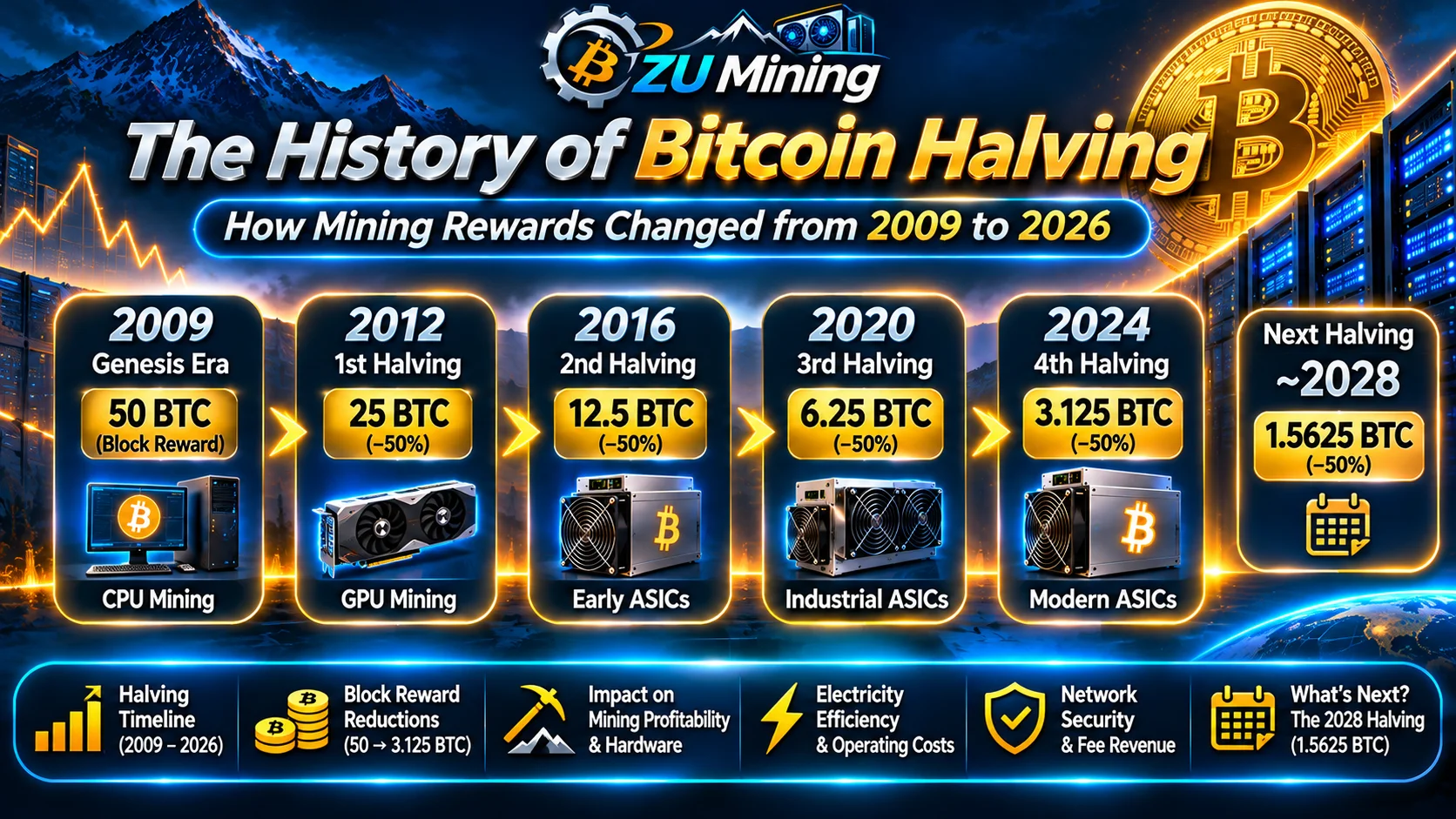
During 2022, Bitcoin's block subsidy remained 6.25 BTC per block.
That subsidy had been established by the May 2020 halving.
Miners could also earn transaction fees from transactions included in valid blocks.
However, the protocol did not increase the block subsidy when Bitcoin's market price declined.
A miner's expected Bitcoin earnings depended on its share of network hashrate, difficulty, block rewards, and transaction fees.
The dollar value of those earnings depended on the market price.
Consequently, falling Bitcoin prices could reduce revenue even if a mining operation continued performing the same amount of computational work.
Why the price decline was especially painful
Mining companies had expenses that were often denominated in fiat currencies.
Electricity suppliers generally expected payment regardless of Bitcoin's market performance.
Hardware loans, facility leases, and other obligations could also remain payable.
This created a mismatch between volatile cryptocurrency revenue and relatively inflexible operating expenses.
For companies carrying substantial debt, that mismatch became a major problem.
3. Rising Electricity Costs Add Another Layer of Pressure
The cryptocurrency market downturn was not the only challenge miners faced.
Energy markets experienced significant disruption during 2022.
Russia's invasion of Ukraine contributed to major changes in international energy markets, particularly in Europe.
Natural gas and electricity prices rose sharply in several regions.
The effects differed by country, electricity market, and individual contract.
For Bitcoin miners, higher electricity prices could significantly reduce operating margins.
Why electricity is so important
ASIC mining equipment consumes electricity continuously while operating.
A mining machine's power consumption can be estimated from its rated wattage, although actual consumption varies with operating conditions and settings.
Consider a hypothetical ASIC miner consuming 3,000 watts.
That equals 3 kilowatts.
Operating continuously for 24 hours requires:
3 kW × 24 hours = 72 kWh
At $0.05 per kWh, the daily electricity cost is:
72 × $0.05 = $3.60
At $0.12 per kWh, the daily cost becomes:
72 × $0.12 = $8.64
At $0.20 per kWh, it reaches:
72 × $0.20 = $14.40
The mining machine performs approximately the same computational work in these examples, but the electricity expense changes dramatically.
What happens at industrial scale?
Imagine a mining facility operating 2,000 machines, each consuming 3 kW.
Total electrical demand from the machines would be 6 megawatts.
Daily energy consumption would be:
6,000 kW × 24 hours = 144,000 kWh
At $0.05 per kWh, electricity would cost $7,200 per day.
At $0.12 per kWh, the cost would rise to $17,280 per day.
That is a difference of $10,080 every day.
Over a 30-day period, the difference would exceed $300,000.
These calculations exclude cooling, electrical losses, maintenance, and other expenses.
They illustrate why electricity contracts became especially important during the 2022 mining downturn.
4. Network Difficulty Made the Situation More Competitive
Mining companies faced another challenge: Bitcoin's network competition remained intense.
After China's 2021 mining crackdown, Bitcoin's hashrate recovered as equipment was relocated and new facilities became operational.
During 2022, network hashrate generally continued growing despite the declining Bitcoin price.
This created a difficult situation for individual miners.
More computational power was competing for block rewards while the dollar value of those rewards was falling.
Why more hashrate can reduce individual earnings
Bitcoin mining rewards are distributed through a competitive Proof-of-Work process.
An operator's expected share of rewards depends on its proportion of the network's total computational capacity.
Suppose a mining company controls 100 petahashes per second.
If the total network hashrate is 200 exahashes per second, its share is approximately 0.05%.
If the network increases to 300 exahashes per second while the company's own hashrate remains unchanged, its share falls to approximately 0.033%.
The company is operating the same machines, but its expected proportion of network rewards is smaller.
This example assumes comparable effective hashrate measurements and ignores short-term reward variability.
Difficulty adjustment and profitability
Bitcoin adjusts mining difficulty every 2,016 blocks.
The mechanism aims to maintain an average block interval of approximately ten minutes.
When additional computational power joins the network, difficulty tends to increase after adjustment.
For miners, increasing difficulty can reduce expected Bitcoin earnings per unit of hashrate.
The combination of lower Bitcoin prices and strong network competition made 2022 particularly challenging.
5. Hashprice Became an Important Mining Metric
During the downturn, mining companies paid increasing attention to hashprice.
Hashprice describes the expected mining revenue associated with a unit of hashrate over a given period.
It is commonly expressed in dollars per petahash per second per day.
Hashprice is influenced by Bitcoin's price, network difficulty, block subsidy, and transaction fees.
Why hashprice matters
Bitcoin's price alone does not tell miners how much revenue their equipment can generate.
Two periods with the same Bitcoin price may produce different mining revenue if network difficulty differs.
Hashprice helps summarize these conditions into a metric that can be compared with operating costs.
Revenue is not profit
Hashprice represents expected gross mining revenue, not net profitability.
Electricity, pool fees, hosting, maintenance, and other costs still need to be deducted.
A miner can have positive gross revenue while operating at a financial loss.
This distinction became particularly important during the crypto winter.
For practical calculations, readers can explore the ZU Mining profitability tools, which help evaluate mining revenue alongside operating expenses.
6. Core Scientific's Bankruptcy Becomes a Major Industry Event
One of the most prominent examples of financial stress in the mining industry was Core Scientific.
The company operated large-scale Bitcoin mining infrastructure in the United States.
During 2022, it faced a combination of falling cryptocurrency prices, increased operating expenses, and financial obligations.
On December 21, 2022, Core Scientific announced that it had filed for Chapter 11 bankruptcy protection.
The filing became a major symbol of the difficulties facing industrial mining companies.
What Chapter 11 meant
Chapter 11 is a United States bankruptcy process that can allow a business to reorganize its financial obligations while continuing operations under court supervision.
It does not automatically mean that a company permanently closes.
Core Scientific continued operating during its restructuring process.
The company later emerged from Chapter 11 in January 2024.
Why the case mattered
Core Scientific's financial difficulties demonstrated that a large mining operation could still be vulnerable to market conditions.
Scale alone did not guarantee financial resilience.
A company might operate substantial mining capacity but still struggle with debt, energy expenses, and declining revenue.
The case also showed that mining infrastructure could retain operational value even when the company owning it needed financial restructuring.
7. Compute North's Bankruptcy and Infrastructure Risks
Core Scientific was not the only mining-related company facing financial difficulties.
In September 2022, Compute North filed for Chapter 11 bankruptcy protection.
The company provided infrastructure and hosting services for cryptocurrency mining operations.
Its difficulties highlighted risks associated with large infrastructure investments.
Hosting companies faced different challenges
Not every mining business owns all of its equipment and facilities.
Some companies provide hosting services to customers who own ASIC miners.
A hosting provider may be responsible for electricity arrangements, facility infrastructure, maintenance, and operational services.
This model can create substantial capital requirements.
If expansion projects become expensive or customers face financial difficulties, hosting businesses can experience pressure.
Why customers should evaluate hosting providers
A mining company relying on a third-party hosting provider depends on that provider's operational and financial stability.
Important considerations include service agreements, equipment access, electricity arrangements, and business continuity.
The events of 2022 demonstrated that infrastructure providers were not immune to the cryptocurrency downturn.
8. Argo Blockchain Faces Financial Pressure
Argo Blockchain was another prominent mining company affected by the difficult market environment.
During 2022, the company faced liquidity challenges and explored measures to strengthen its financial position.
In December, Argo announced a transaction involving the sale of its Helios mining facility in Texas to Galaxy Digital.
The agreement also included financing arrangements.
What the Helios transaction illustrated
Mining facilities can represent substantial assets.
However, owning infrastructure also creates financial obligations.
Selling a facility may provide liquidity, but it can change a company's operating model and future earnings potential.
The Argo transaction demonstrated how mining companies adjusted their business strategies during the downturn.
Rather than continuing expansion at any cost, some operators focused on preserving liquidity and maintaining operations.
9. Why ASIC Mining Hardware Prices Declined
The crypto winter also affected the market for mining equipment.
During the 2021 bull market, strong demand had supported high prices for many ASIC miners.
As Bitcoin's price declined and mining profitability weakened, buyers became more cautious.
The resale value of various mining machines fell substantially.
Hardware value depends on expected earnings
ASIC miners are specialized devices.
Their economic value is closely related to their expected future mining revenue.
A machine that generates attractive returns during a bull market may become difficult to operate profitably when Bitcoin's price falls.
As expected earnings decline, buyers may be unwilling to pay the same price for the equipment.
Older machines faced greater pressure
Older ASIC miners generally have lower energy efficiency than newer generations.
They may consume more electricity to produce the same amount of hashing work.
When electricity costs rise, inefficient equipment becomes less competitive.
This can reduce both operating profitability and resale value.
Why cheap equipment is not always a bargain
A mining machine purchased at a discount can still lose money if its electricity consumption exceeds the value of its expected rewards.
Before purchasing hardware, miners should evaluate:
Purchase price.
Hashrate.
Power consumption.
Energy efficiency.
Electricity cost.
Network difficulty.
Maintenance requirements.
Expected operating life.
The ZU Mining Hardware Directory provides a starting point for researching mining equipment.
10. Bitcoin Miners Sold Reserves to Fund Operations
During strong cryptocurrency markets, some mining companies accumulated Bitcoin rather than selling all of their production immediately.
Holding mined Bitcoin could increase exposure to future price appreciation.
However, it also introduced financial risk.
When Bitcoin's price declined, the value of those reserves fell.
Companies still needed cash to pay operating expenses and financial obligations.
Why miners sometimes sell Bitcoin
A mining company may sell Bitcoin to fund electricity bills, equipment purchases, debt payments, or other expenses.
Selling mined Bitcoin is not necessarily a sign that the business is failing.
It can be part of ordinary treasury management.
However, selling substantial reserves during a downturn may indicate that a company needs additional liquidity.
The risks of holding all mining revenue
A company that holds nearly all of its Bitcoin production may have limited cash available for operating expenses.
If Bitcoin's price falls, the company may need to sell more BTC to raise the same amount of fiat currency.
This can create financial pressure.
The events of 2022 encouraged greater attention to treasury policies and cash reserves.
11. Why Some Miners Shut Down Their Machines
A mining machine can remain technically functional while becoming economically unprofitable.
The decision to shut down depends on expected revenue and avoidable operating costs.
Understanding the shutdown price
A shutdown price is an estimated Bitcoin price below which a particular mining operation may no longer cover its relevant operating expenses.
It depends on equipment efficiency, electricity costs, network conditions, and other variables.
There is no universal shutdown price for all Bitcoin miners.
A hypothetical example
Suppose a mining machine earns $7 per day in gross revenue.
Its electricity cost is $5 per day.
The machine produces $2 per day before maintenance, hosting, and other expenses.
If gross revenue falls to $4 while electricity remains $5, the machine loses $1 per day on electricity alone.
Continuing to operate under those conditions may be uneconomic.
However, the operator's decision may depend on electricity contracts, shutdown costs, and expectations about future conditions.
Why shutdown decisions differ
One operator may have access to electricity at $0.04 per kWh.
Another may pay $0.12 per kWh.
The same machine can have very different operating economics in those locations.
This is why electricity pricing and machine efficiency are essential to mining profitability analysis.
12. Mining Pools and Revenue Stability
Mining pools remained important during the crypto winter.
A mining pool combines computational contributions from participating miners and distributes rewards according to its payout rules.
Pools can reduce the variability of mining payouts compared with solo mining.
However, they cannot eliminate market risk.
Stable payouts are not guaranteed profits
A pool may distribute rewards regularly, but the value of those rewards still depends on Bitcoin's price and network conditions.
Pool fees also affect net revenue.
Comparing payout models
Common mining pool payout approaches include FPPS, PPS+, and PPLNS.
These methods differ in how rewards and transaction fees are allocated.
Miners should understand the terms before choosing a pool.
The ZU Mining Pools Directory can help readers research available services.
13. The 2022 Ethereum Merge and Its Effect on GPU Mining
The crypto winter also coincided with a major change in cryptocurrency mining.
On September 15, 2022, Ethereum completed the Merge.
Ethereum transitioned from Proof-of-Work to Proof-of-Stake.
This ended Ethereum's traditional GPU mining process.
Why the Merge mattered
Before the Merge, Ethereum had been one of the most important cryptocurrencies mined using graphics cards.
GPU miners used specialized software and mining pools to participate in the network.
After the transition, Ethereum no longer relied on mining to produce blocks.
GPU operators needed to consider alternative cryptocurrencies or different uses for their hardware.
Increased competition among alternative coins
Some GPU miners redirected equipment toward other Proof-of-Work cryptocurrencies.
This could increase network competition on those chains.
However, alternative cryptocurrencies did not necessarily offer the same revenue opportunities that Ethereum had provided.
The Merge therefore created additional pressure on parts of the broader cryptocurrency mining industry.
Bitcoin mining remained different
Bitcoin uses the SHA-256 Proof-of-Work algorithm.
Its mining industry relies predominantly on specialized ASIC hardware.
The Ethereum Merge did not change Bitcoin's consensus mechanism or block subsidy.
Nevertheless, it was an important event in the wider mining industry during 2022.
14. How Mining Companies Tried to Survive
Mining businesses responded to the downturn in different ways.
Some reduced operating expenses.
Others renegotiated financial obligations, sold assets, or delayed expansion projects.
A number of companies sought additional financing.
Improving energy efficiency
Newer ASIC machines can produce more hashing work per unit of electricity.
Replacing inefficient equipment may improve operating economics.
However, upgrades require capital.
During a downturn, businesses must carefully evaluate whether expected efficiency gains justify the investment.
Reducing downtime
A mining machine that is offline cannot generate mining rewards.
Monitoring systems, preventive maintenance, and reliable infrastructure can help improve equipment availability.
These improvements do not eliminate market risk, but they can reduce avoidable operational losses.
Managing electricity exposure
Some mining companies explored flexible electricity arrangements or operational strategies that allowed them to reduce consumption during periods of high power prices.
The economic value of such arrangements depends on contract terms and local electricity markets.
Maintaining financial reserves
Cash reserves can help a company continue operating during periods of reduced revenue.
Businesses with excessive debt or limited liquidity may have fewer options when market conditions deteriorate.
The crypto winter demonstrated the importance of financial planning alongside technical expertise.
15. A Practical Mining Profitability Example
Consider a hypothetical mining company operating 500 ASIC machines.
Each machine consumes 3,000 watts.
The facility's mining equipment requires:
500 × 3 kW = 1,500 kW
That equals 1.5 megawatts.
Daily electricity consumption is:
1,500 kW × 24 hours = 36,000 kWh
At $0.06 per kWh, electricity costs:
36,000 × $0.06 = $2,160 per day
At $0.12 per kWh, electricity costs:
36,000 × $0.12 = $4,320 per day
Suppose the facility generates $5,000 per day in gross mining revenue.
At the lower electricity rate, it has $2,840 remaining before other expenses.
At the higher rate, only $680 remains before other expenses.
Now suppose gross revenue falls to $3,500 per day.
At $0.06 per kWh, the facility has $1,340 remaining before other expenses.
At $0.12 per kWh, electricity alone exceeds gross revenue by $820.
This example illustrates how a combination of lower mining revenue and higher electricity costs can quickly change the economics of an operation.
It is not a historical revenue model for any specific mining company.
16. What the Crypto Winter Taught the Mining Industry
The events of 2022 exposed several weaknesses in mining business models.
High Bitcoin prices cannot be assumed
Revenue projections based on unusually favorable market conditions can create unrealistic expectations.
Mining companies need to evaluate adverse scenarios.
Debt increases financial vulnerability
Borrowing can support expansion, but repayment obligations remain even when mining revenue falls.
Businesses with substantial leverage may face greater pressure during downturns.
Electricity contracts matter
Power pricing can determine whether a mining operation remains profitable.
Operators should understand the complete cost structure rather than focusing only on advertised electricity rates.
Hardware efficiency is a long-term advantage
Efficient ASIC miners generally have more flexibility to operate under difficult market conditions.
However, hardware purchase prices and other expenses still matter.
Liquidity is essential
A mining company needs access to funds for operating expenses.
Holding cryptocurrency reserves without adequate cash planning can create additional risk.
Operational scale does not guarantee success
Large mining companies can benefit from infrastructure and purchasing advantages.
They can also face substantial fixed expenses and financial obligations.
The 2022 downturn demonstrated that size alone was not enough to ensure survival.
17. How 2022 Prepared the Industry for the Next Cycle
Although the crypto winter caused significant financial difficulties, it also encouraged changes in the mining industry.
Companies increasingly emphasized operational efficiency, cost control, and financial discipline.
Mining equipment buyers paid closer attention to energy efficiency and realistic payback periods.
Investors became more aware of the risks associated with mining debt and infrastructure expansion.
The downturn also contributed to industry restructuring.
Some companies sold assets, while others continued developing more efficient facilities.
As market conditions changed in subsequent years, the lessons of 2022 remained relevant.
The next major challenge would involve preparing for Bitcoin's fourth halving in 2024, when the block subsidy would decline again.
Conclusion
The 2022 crypto winter was one of the most difficult periods in the development of industrial Bitcoin mining.
Bitcoin's price fell sharply, electricity costs increased in many regions, and network competition remained intense.
Mining companies faced declining revenue while continuing to pay for equipment, facilities, and financial obligations.
The bankruptcies of Core Scientific and Compute North, along with the financial restructuring efforts of other companies, illustrated the industry's vulnerability to changing market conditions.
The downturn also highlighted the importance of efficient ASIC hardware, realistic profitability calculations, reliable electricity arrangements, and strong financial management.
Bitcoin mining continued, but the businesses supporting it were forced to adapt.
The central lesson of 2022 was clear: successful mining requires more than powerful hardware and a favorable cryptocurrency price.
It requires disciplined management of costs, capital, infrastructure, and risk.
Frequently Asked Questions
Why was 2022 difficult for Bitcoin miners?
Bitcoin prices declined sharply while electricity costs increased in many regions. Network competition and financial obligations added further pressure.
Did Bitcoin mining stop during the crypto winter?
No. The Bitcoin network continued operating, although some individual mining businesses reduced activity or shut down unprofitable equipment.
Which Bitcoin mining company filed for bankruptcy in 2022?
Core Scientific filed for Chapter 11 bankruptcy protection in December 2022. Compute North, a mining infrastructure provider, filed in September.
Why did ASIC mining hardware prices fall?
Lower expected mining profitability reduced demand for some equipment, particularly older and less efficient machines.
Did Bitcoin's block reward change in 2022?
No. The block subsidy remained 6.25 BTC throughout 2022, following the 2020 halving.
How did the Ethereum Merge affect mining?
Ethereum transitione