
The History of Bitcoin Mining Difficulty: From 2009 to 2026
Updated November 9, 2026
When Bitcoin launched in January 2009, its mining network was small enough for participants to compete using ordinary computer processors. The network's initial mining difficulty was 1, and specialized mining facilities did not exist.
By 2026, the situation had changed dramatically. Bitcoin mining had become an industrial activity involving specialized ASIC computers, large electrical installations, global mining pools and enormous amounts of computational work.
Yet Bitcoin still aimed to produce a block approximately every ten minutes.
How could a network that grew from a handful of early participants into a worldwide industry maintain a relatively stable block production schedule?
The answer lies in Bitcoin's difficulty adjustment mechanism.
Mining difficulty is one of the most important and frequently misunderstood parts of Bitcoin's design. It determines how difficult it is to find a valid block and automatically responds to changes in the network's computing power.
Understanding its history explains why early miners could use CPUs, why modern ASICs became necessary for competitive mining, and why adding more hardware does not automatically make Bitcoin produce more coins over the long term.
1. Bitcoin's Original Mining Difficulty in 2009
Bitcoin began operating on January 3, 2009, when its genesis block was created.
The network initially used the lowest difficulty permitted by Bitcoin's mainnet rules, commonly described as difficulty 1.
At the time, participants could mine using general-purpose CPUs.
The early network had very little total hashrate compared with later years.
A CPU could therefore represent a meaningful portion of the computing power competing to find blocks.
Why difficulty 1 mattered
Difficulty is a relative measure of how challenging it is to discover a valid proof-of-work hash.
A difficulty value of 1 corresponds to Bitcoin's original reference target.
Higher difficulty means miners must, on average, perform more hashing attempts to find an acceptable block.
Difficulty 2 represents approximately twice the expected work of difficulty 1.
Difficulty 1,000 represents approximately one thousand times the expected work.
These are relative comparisons, not measurements of electricity consumption or the number of miners.
2. Why Bitcoin Needs Mining Difficulty
Bitcoin's network does not rely on a central administrator to decide when the next block should be produced.
Instead, miners compete to discover a block hash that satisfies a mathematical condition.
If the network simply accepted the same mining target forever, adding more computing power would cause blocks to be produced increasingly quickly.
That would change the issuance schedule and undermine Bitcoin's intended timing.
Bitcoin solves this problem by periodically adjusting its proof-of-work target.
The ten-minute target
Bitcoin aims for an average block interval of approximately ten minutes.
This is a long-term target, not a guarantee.
Individual blocks may be discovered seconds apart or take considerably longer.
The difficulty adjustment mechanism helps bring the average back toward the target as network computing power changes.
3. How Proof-of-Work Difficulty Actually Works
Bitcoin miners repeatedly calculate double SHA-256 hashes of block headers.
A valid block header hash must be numerically less than or equal to the network's current target.
The target determines how difficult it is to discover an acceptable hash.
The relationship between target and difficulty
A lower target makes mining more difficult.
A higher target makes mining easier.
Difficulty is conventionally expressed as the ratio between Bitcoin's reference target and the current target.
In simplified form:
Difficulty = Reference Target ÷ Current Target
This relationship is inverse.
When the target decreases, difficulty increases.
Why hashing is probabilistic
Each hashing attempt produces an output that is effectively unpredictable for mining purposes.
Miners cannot reliably calculate which nonce will produce a valid block without performing the work.
A more powerful machine performs more attempts per second.
It does not eliminate the randomness of block discovery.
4. Bitcoin's 2,016-Block Difficulty Adjustment
Bitcoin adjusts its mining target approximately every 2,016 blocks.
At a target interval of ten minutes, 2,016 blocks correspond to:
2,016 × 10 = 20,160 minutes
That equals 14 days.
The actual elapsed time may differ because blocks are not produced at perfectly regular intervals.
How the adjustment works
Bitcoin compares the elapsed time over the relevant historical block interval with the intended two-week period.
If blocks have been arriving too quickly, the network makes the target harder.
If blocks have been arriving too slowly, the network makes the target easier.
An important implementation detail
Bitcoin Core's consensus calculation uses timestamps separated by 2,015 block intervals within the retarget window, while comparing the result against the nominal two-week target.
This detail matters when implementing a precise Bitcoin difficulty calculation.
Adjustment limits
On Bitcoin mainnet, the target adjustment is constrained so it cannot become more than four times easier or four times harder in a single adjustment period.
These limits help prevent extreme single-step changes.
5. A Practical Difficulty Adjustment Example
Imagine that the network produces its scheduled 2,016 blocks in only ten days.
The intended duration is approximately fourteen days.
A simplified difficulty adjustment would be:
New Difficulty ≈ Old Difficulty × 14 ÷ 10
That produces a difficulty increase of approximately 40%.
The network makes block discovery harder because the previous blocks arrived too quickly.
What if blocks take longer?
Suppose the same number of blocks takes twenty days.
The simplified calculation becomes:
New Difficulty ≈ Old Difficulty × 14 ÷ 20
That represents a difficulty decrease of approximately 30%.
These examples explain the principle. Bitcoin's actual consensus implementation uses integer target arithmetic, historical timestamps and adjustment limits.
6. The CPU Mining Era From 2009 to 2010
Bitcoin's earliest miners relied on ordinary processors.
The network's total computing power was extremely small by modern standards.
For early participants, mining was largely experimental.
Some miners were interested in Bitcoin's technical design, while others wanted to support a new decentralized monetary network.
Why CPU mining eventually became less competitive
As additional participants joined, total network hashrate increased.
The difficulty adjustment mechanism responded to faster block production.
A miner with unchanged hardware represented a decreasing share of the network's computing power.
That miner would therefore expect to find fewer blocks over time.
This competitive pressure encouraged experimentation with faster hardware.
7. GPU Mining Changed Bitcoin's Difficulty Growth
GPU mining became important during 2010.
Graphics processors could perform many hashing operations in parallel.
For Bitcoin's SHA-256 workload, appropriately programmed GPUs offered a substantial performance advantage over general-purpose CPUs.
What happened when GPUs joined?
More computational power entered the network.
Blocks could temporarily arrive faster than the ten-minute target.
Subsequent difficulty adjustments made mining harder.
The effect on CPU miners
CPU miners became increasingly uncompetitive.
Their equipment could continue hashing, but its share of total network hashrate declined.
This marked the beginning of Bitcoin mining's transition from general-purpose computing toward specialized hardware.
8. FPGA Mining and the Search for Efficiency
Before ASICs became dominant, some miners adopted field-programmable gate arrays, commonly called FPGAs.
These devices could be configured to perform particular computational tasks.
They offered opportunities to improve energy efficiency compared with many GPU mining configurations.
Why efficiency became important
Mining profitability depended on more than raw hashrate.
Electricity consumption, hardware cost and operating reliability also mattered.
As difficulty increased, miners needed more competitive equipment to maintain their expected share of block rewards.
FPGA mining was an important intermediate stage in this technological transition.
9. The ASIC Revolution Beginning in 2013
Commercial Bitcoin ASIC miners began appearing in 2013.
ASIC stands for Application-Specific Integrated Circuit.
Unlike CPUs and GPUs, Bitcoin ASIC chips are designed specifically for SHA-256 mining operations.
This specialization made enormous improvements in mining performance and energy efficiency possible.
How ASICs affected difficulty
The arrival of ASIC equipment significantly increased the computing power available to the network.
As these machines became more widely deployed, difficulty rose to reflect the increased hashrate.
Why older equipment struggled
A GPU or early ASIC could remain technically functional while becoming economically obsolete.
The key problem was declining competitiveness.
If a miner's share of network hashrate falls, its expected BTC-denominated revenue also falls, assuming other conditions remain unchanged.
The ZU Mining Hardware Directory provides information about different mining hardware categories.
10. Difficulty and Hashrate Are Not the Same Thing
Mining difficulty and network hashrate are closely related, but they measure different things.
Network hashrate
Hashrate describes how many hashing attempts mining equipment performs per second.
It is commonly expressed in:
TH/s: Terahashes per second
PH/s: Petahashes per second
EH/s: Exahashes per second
Mining difficulty
Difficulty describes how difficult the current network target makes it to discover a valid block.
It is a dimensionless relative value.
The important distinction
Hashrate can change immediately when miners switch equipment on or off.
Difficulty changes according to Bitcoin's scheduled adjustment rules.
Consequently, network hashrate and difficulty do not always move together at the same moment.
11. Estimating Network Hashrate From Difficulty
Because Bitcoin targets an average block interval of approximately 600 seconds, difficulty can be used to estimate the hashrate associated with that target interval.
A commonly used approximation is:
Estimated Hashrate ≈ Difficulty × 2³² ÷ 600
The result is expressed in hashes per second.
Example
Suppose difficulty is 100 trillion.
The estimated hashrate associated with ten-minute blocks would be approximately:
100,000,000,000,000 × 4,294,967,296 ÷ 600
This gives roughly 716 EH/s.
The calculation is an approximation based on the conventional difficulty relationship.
It is not a live measurement of Bitcoin's network in 2026.
Why estimates fluctuate
Actual block discovery is random.
Short observation periods can produce noisy hashrate estimates.
Longer measurement windows generally provide a more stable estimate, although they may respond more slowly to changes.
12. Difficulty Growth During the Industrial Mining Era
During the mid-2010s, Bitcoin mining developed into a more professional industry.
Larger operators invested in dedicated facilities, cooling systems and electricity infrastructure.
Mining pools coordinated hashrate from participants around the world.
Why difficulty kept rising over many periods
New ASIC generations increased hashing performance.
Additional facilities brought more equipment online.
Higher aggregate hashrate caused blocks to arrive faster until difficulty adjusted.
Why difficulty does not always increase
Difficulty can also decline.
If substantial computing power leaves the network, blocks may arrive more slowly.
The adjustment mechanism can then reduce difficulty.
Bitcoin's difficulty history therefore includes both increases and decreases.
13. The 2021 Mining Disruption and Difficulty Decline
One of the most significant difficulty events occurred in 2021.
Restrictions on cryptocurrency mining in China contributed to a major relocation and shutdown of mining equipment.
A substantial amount of network hashrate went offline.
What happened to block production?
With less computing power participating, blocks arrived more slowly.
The network eventually adjusted difficulty downward.
The July 2021 adjustment
On July 3, 2021, Bitcoin experienced a difficulty decrease of approximately 27.9%.
It was an unusually large adjustment and demonstrated the protocol's ability to respond to a substantial decline in network hashrate.
Why the event matters
Bitcoin did not require an administrator to intervene.
The adjustment followed its established consensus rules.
As mining equipment was relocated and new capacity came online, network hashrate and difficulty subsequently recovered.
14. Mining Difficulty During the 2024 Halving
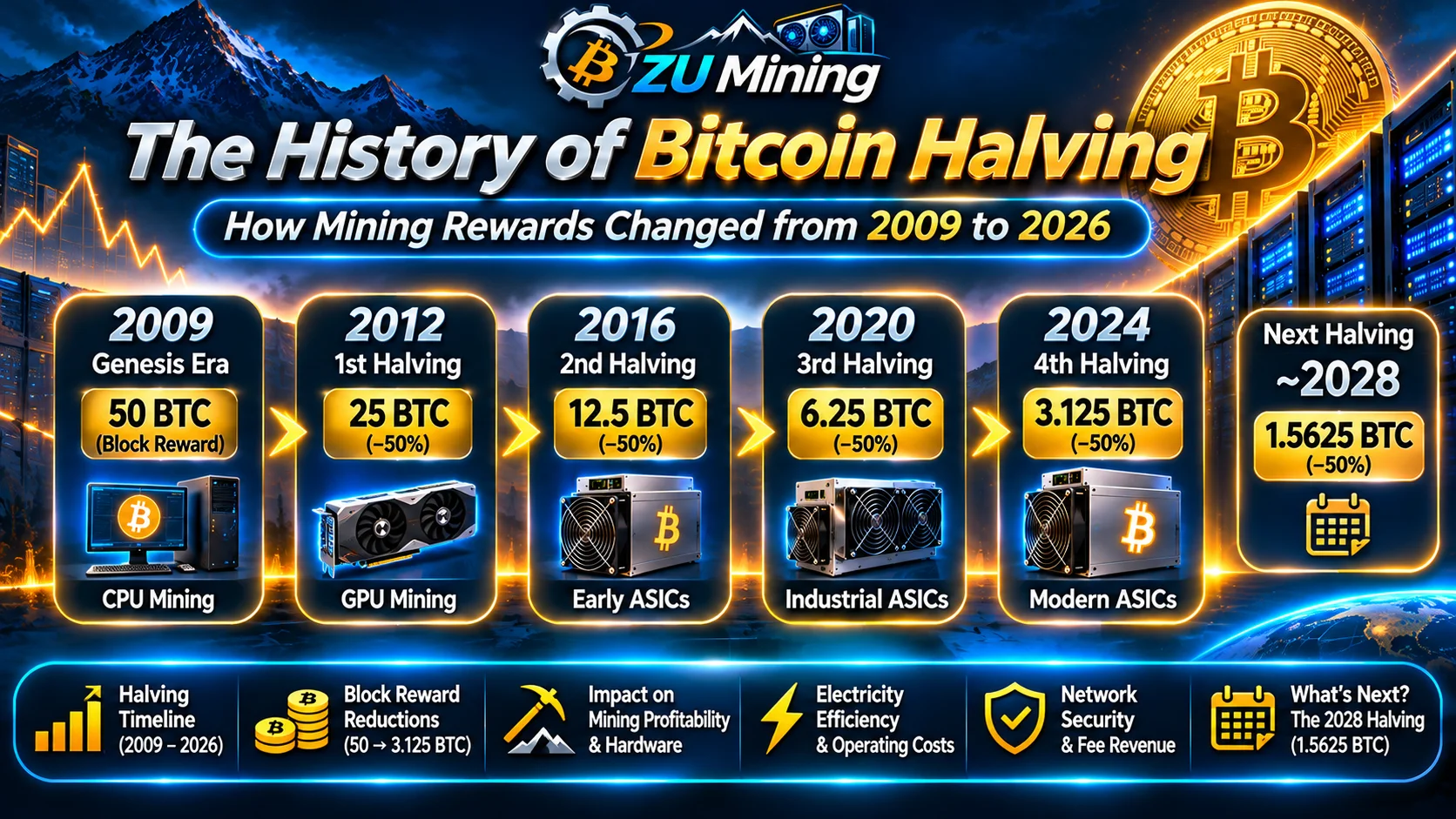
Bitcoin's fourth halving occurred in April 2024.
The block subsidy decreased from 6.25 BTC to 3.125 BTC.
Halving and difficulty adjustment are separate mechanisms.
What halving changes
Halving reduces the subsidy available from each block.
What difficulty changes
Difficulty adjusts the computational challenge required to discover a block.
How the mechanisms interact
If a lower subsidy causes some miners to shut down equipment, network hashrate may decrease.
That can slow block production until difficulty adjusts.
However, halving does not automatically cause an immediate 50% difficulty reduction.
The actual response depends on mining economics and the behavior of participants.
15. Bitcoin Mining Difficulty in 2026
By 2026, Bitcoin mining was dominated by specialized ASIC equipment and professional infrastructure.
Mining difficulty had increased enormously compared with the original difficulty 1 environment.
However, a precise difficulty figure must be taken from a current block explorer or Bitcoin node because it changes at retarget intervals.
What matters for miners in 2026?
A miner must evaluate its hashrate relative to the network.
Even a powerful ASIC may represent only a tiny fraction of global mining capacity.
Why network competition matters
A miner's expected share of block discoveries depends on its share of total network hashrate.
When competitors deploy more efficient equipment, an unchanged machine can become less profitable.
Why monitoring matters
Historical averages alone are insufficient for making current profitability estimates.
Miners need current network conditions, electricity costs, pool fees and hardware performance data.
16. How Difficulty Affects Mining Profitability
Higher difficulty generally reduces the expected number of blocks a miner can discover with a fixed hashrate over a given period.
However, profitability also depends on Bitcoin's market price, block subsidy, transaction fees and operating costs.
A simplified revenue model
A miner's expected share of network rewards is approximately:
Miner Hashrate ÷ Network Hashrate
That share can be multiplied by expected network block revenue over a chosen period.
Why difficulty matters indirectly
Difficulty helps maintain the block schedule as hashrate changes.
A miner facing increased competition generally receives a smaller share of expected rewards unless its own hashrate also increases.
Electricity expenses
Power consumption does not automatically decrease when difficulty rises.
This can squeeze profit margins.
The ZU Mining Profitability Calculator helps readers explore how hashrate, power consumption and electricity prices influence mining economics.
17. Example: A 200 TH/s ASIC Miner
Consider a hypothetical miner producing 200 TH/s.
Assume total network hashrate is 800 EH/s.
Because 800 EH/s equals 800,000,000 TH/s, the miner's network share is:
200 ÷ 800,000,000 = 0.00000025
That represents 0.000025% of the network.
Expected block subsidy revenue
Using the 3.125 BTC subsidy introduced in 2024 and approximately 144 blocks per day:
144 × 3.125 × 0.00000025 = 0.0001125 BTC per day.
This calculation excludes transaction fees, pool fees, downtime and other adjustments.
What if network hashrate doubles?
Suppose network hashrate increases to 1,600 EH/s while the miner remains at 200 TH/s.
Its network share falls by half.
Under otherwise unchanged assumptions, its expected BTC-denominated subsidy revenue also falls by approximately half.
This demonstrates how growing network competition affects an individual miner.
18. Why Mining Pools Matter When Difficulty Is High
As difficulty increases, smaller miners face greater uncertainty when attempting to discover blocks independently.
A mining pool combines the computing power of many participants.
The pool distributes eligible rewards according to its payment rules.
What pooling changes
Pooling can reduce payment variance.
Instead of waiting for an unpredictable solo block discovery, participants may receive more frequent payments.
What pooling does not change
A pool cannot bypass Bitcoin's difficulty rules.
It does not create additional block subsidies.
Expected revenue remains related to contributed hashrate, network conditions and the pool's payment terms.
Readers can explore services through the ZU Mining Pools Directory.
19. Difficulty and Bitcoin Network Security
Proof of Work helps make changes to Bitcoin's transaction history computationally expensive.
Mining difficulty reflects the target that valid block hashes must satisfy.
However, difficulty alone does not provide a complete measure of network security.
Other important factors
Security also depends on:
Active network hashrate
Distribution of mining equipment
Mining pool concentration
Hardware availability
Electricity and operating costs
Economic incentives
Network participation
Why concentration matters
A large amount of hashrate coordinated by a small number of pools can raise concerns about transaction selection and block production.
The distinction between who owns mining equipment and who coordinates it is important.
20. Common Misunderstandings About Mining Difficulty
Higher difficulty means Bitcoin produces more coins
Incorrect.
Difficulty adjustment helps maintain the block interval rather than increasing the long-term issuance schedule.
Difficulty always increases
Incorrect.
Difficulty can decline when network hashrate falls.
Difficulty changes every ten minutes
Incorrect.
The mining target generally changes every 2,016 blocks on Bitcoin mainnet.
Higher difficulty automatically means higher Bitcoin prices
Incorrect.
Difficulty and market price can influence mining economics, but neither determines the other through a guaranteed relationship.
Mining pools avoid difficulty
Incorrect.
Pools operate under the same Bitcoin consensus requirements as solo miners.
Difficulty measures electricity consumption
Incorrect.
Difficulty measures the relative challenge of finding a valid block.
Electricity consumption depends on the equipment and infrastructure performing the work.
21. How to Read Bitcoin Difficulty Charts
Historical difficulty charts can help illustrate the development of Bitcoin mining.
However, they require careful interpretation.
Long-term growth
A long-term increase generally indicates that more computational work has become necessary to find blocks.
Sudden declines
Large declines may reflect significant hashrate disruptions or miners disconnecting from the network.
Flat periods
Difficulty remains unchanged between scheduled adjustments even when network hashrate fluctuates.
Why logarithmic charts can help
Bitcoin difficulty has increased by many orders of magnitude since 2009.
A logarithmic scale can make early historical changes easier to compare with later periods.
Avoiding misleading conclusions
A chart showing rising difficulty does not automatically prove that every miner is profitable or that mining equipment is becoming more efficient.
Those questions require additional data.
22. The Future of Bitcoin Mining Difficulty
Bitcoin's difficulty adjustment mechanism is expected to remain a fundamental part of its consensus rules.
As mining hardware improves and network participation changes, difficulty will continue responding to the rate of block production.
More efficient ASIC hardware
Future devices may perform more hashes per unit of electricity.
This could change mining competition and operating economics.
Changes in energy markets
Electricity pricing and infrastructure availability may influence where mining operations are established.
Future halvings
The next Bitcoin halving is expected around 2028.
It will reduce the block subsidy from 3.125 BTC to 1.5625 BTC.
The effect on difficulty will depend on how miners respond to changing economic conditions.
Continued uncertainty
It is not possible to predict future difficulty levels reliably from historical growth alone.
Hardware deployment, market conditions and mining participation can change unexpectedly.
23. What Bitcoin's Difficulty History Teaches Us
The history of Bitcoin mining difficulty reveals several important lessons.
First, Bitcoin's block production schedule is designed to adapt to changes in computing power.
Second, mining competition has increased dramatically since the network's early years.
Third, technological improvements can make older mining hardware economically uncompetitive even when it still functions.
Fourth, difficulty can decrease as well as increase.
Fifth, a miner's profitability depends on more than the difficulty number displayed on a chart.
Finally, Bitcoin's difficulty mechanism is an example of decentralized software rules responding to real-world economic activity without requiring a central operator.
Conclusion
Bitcoin mining began in 2009 with difficulty 1 and a network small enough for ordinary CPUs to participate competitively.
GPU mining increased computational competition.
FPGA systems improved efficiency.
ASIC miners transformed the industry into a specialized global operation.
Throughout these changes, Bitcoin's difficulty adjustment mechanism helped keep block production near its intended ten-minute average.
The major mining disruption of 2021 demonstrated that difficulty could also decrease when substantial hashrate left the network.
By 2026, Bitcoin mining difficulty had become vastly greater than during the network's earliest years, reflecting the scale of modern mining competition.
Yet the basic principle remained the same.
Bitcoin adjusts the challenge of mining so that changes in computing power do not permanently change its intended block production schedule.
For miners, understanding difficulty is essential because it connects hardware performance, network competition, expected rewards and long-term profitability.
Frequently Asked Questions
What was Bitcoin's original mining difficulty?
Bitcoin mainnet began with a reference difficulty of 1 in January 2009.
How often does Bitcoin mining difficulty change?
Bitcoin generally adjusts its mining target every 2,016 blocks, approximately every two weeks.
Why does Bitcoin mining difficulty increase?
Difficulty generally increases when blocks are produced faster than the target rate, often because network hashrate has increased.
Can Bitcoin mining difficulty decrease?
Yes. Difficulty can decrease when blocks arrive more slowly than intended, often following a decline in network hashrate.
Does Bitcoin difficulty affect mining profitability?
Yes. Higher network competition generally reduces expected rewards for miners whose hashrate remains unchanged, although profitability also depends on other variables.
Is Bitcoin difficulty the same as hashrate?
No. Hashrate measures computational attempts per second, while difficulty measures the relative challenge of finding a valid block.
Does halving directly change mining difficulty?
No. Halving changes the block subsidy. Difficulty adjustment is a separate process.
What happened to Bitcoin difficulty in July 2021?
Bitcoin experienced a difficulty decrease of approximately 27.9% following a major disruption in mining hashrate.
Can a mining pool bypass Bitcoin difficulty?
No. All valid Bitcoin blocks must satisfy the network's consensus difficulty requirements.
Will Bitcoin difficulty continue increasing forever?
Not necessarily. Future difficulty depends on changes in network hashrate and block production timing.
Historical References and Further Reading
Satoshi Nakamoto. Bitcoin: A Peer-to-Peer Electronic Cash System (2008). https://bitcoin.org/bitcoin.pdf
Bitcoin Developer Documentation. Block Chain. https://developer.bitcoin.org/devguide/block_chain.html
Bitcoin Developer Documentation. Mining. https://developer.bitcoin.org/devguide/mining.html
Bitcoin Developer Reference. Block Headers and Target Encoding. https://developer.bitcoin.org/reference/block_chain.html
Bitcoin Core. Proof-of-Work Consensus Implementation. https://github.com/bitcoin/bitcoin/blob/master/src/pow.cpp
Bitcoin Wiki. Difficulty. https://en.bitcoin.it/wiki/Difficulty
Cambridge Centre for Alternative Finance. Digital Mining Research. https://www.jbs.cam.ac.uk/faculty-research/centres/alternative-finance/
Editorial note: Numerical hashrate and profitability examples are hypothetical. Difficulty values, network hashrate and mining economics should be verified against current network data before making operational decisions.