Why Payout Architecture Matters for Proof-of-Work Miners
Generating coins on a mining pool is only the first half of a profitable mining operation. How you configure pool withdrawal thresholds, custody your mined rewards, consolidate transaction inputs, and execute spot trades determines how much of your gross revenue in the ZU Mining Profitability Calculator reaches your treasury after network fees and market slippage.
1. The UTXO Micro-Payout Trap on Bitcoin, Litecoin, Dogecoin, Kaspa & Ravencoin
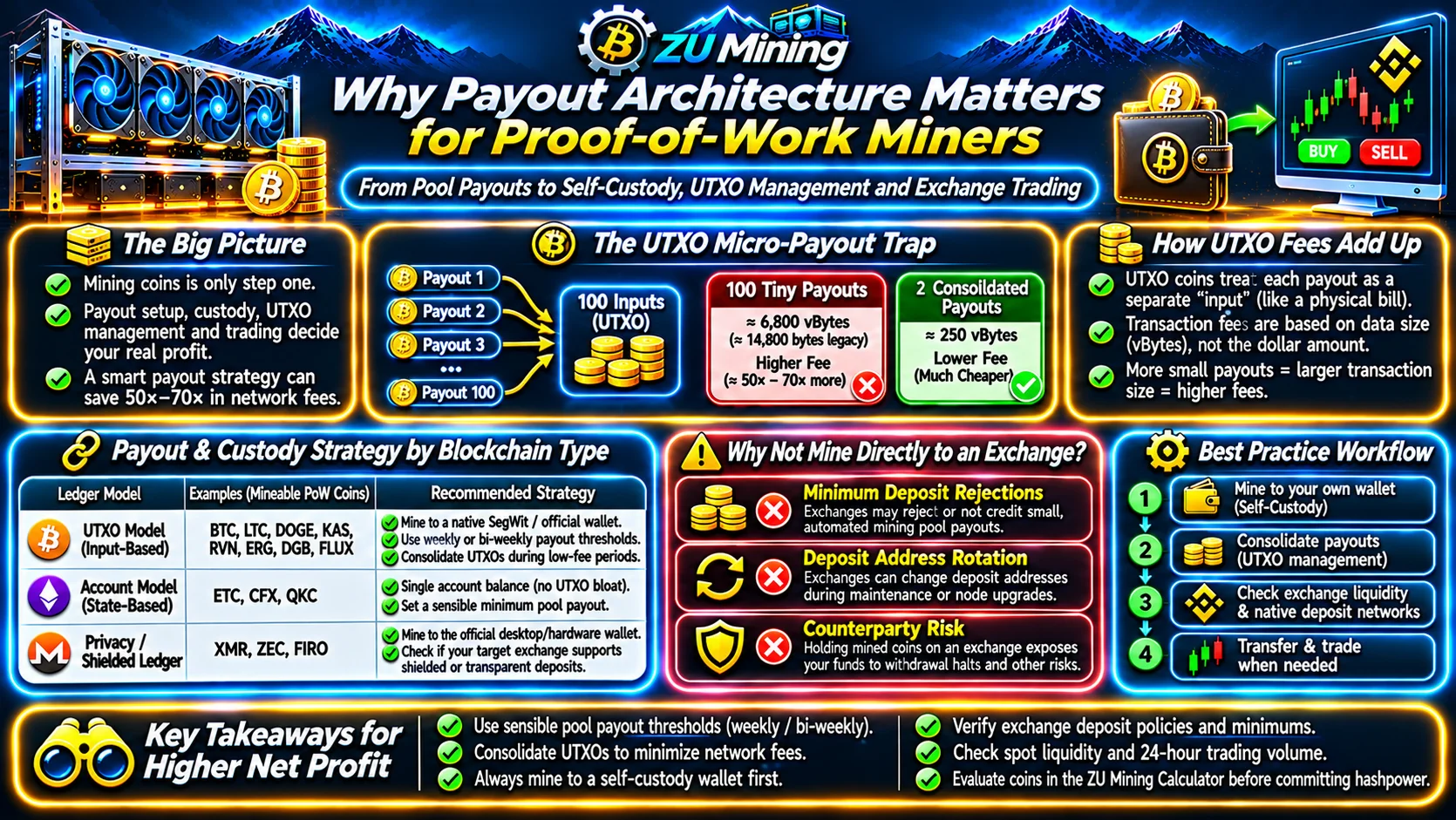
Most Proof-of-Work blockchains—including Bitcoin (BTC), Litecoin (LTC), Dogecoin (DOGE), Kaspa (KAS), Ravencoin (RVN), Ergo (ERG), and Flux (FLUX)—use the Unspent Transaction Output (UTXO) accounting model rather than an account-balance model. Think of each pool payout as a physical bill placed into your wallet:
- Every time a pool from our Verified Mining Pools Directory sends you a payout, it creates a new discrete UTXO input associated with your address.
- On-chain transaction fees are priced by transaction data size in bytes (or virtual bytes,
vBytes)—not by the dollar value being sent. Each standard P2PKH input adds ~148 bytes(or ~68 vBytesfor a Native SegWit P2WPKH `bc1q` / `ltc1q` input) to a transaction. - Worked Fee Comparison: If you set your pool threshold too low and collect 100 tiny daily payouts over three months, spending your balance in a single transaction requires signing and broadcasting all 100 inputs (`~6,800 vBytes` on SegWit or `~14,800 bytes` on legacy addresses)—costing roughly 50× to 70× more in network fees than spending 2 consolidated payouts (`~250 vBytes`), and potentially crashing hardware wallets due to signing memory limits.
| Blockchain Ledger Model | Representative Mineable PoW Coins | Recommended Miner Payout & Custody Strategy |
|---|---|---|
| UTXO Model (Input-Based) | Bitcoin (BTC), Litecoin (LTC), Dogecoin (DOGE), Kaspa (KAS), Ravencoin (RVN), Ergo (ERG), DigiByte (DGB) | Mine to Native SegWit / official self-custody wallet; configure weekly/bi-weekly pool payout thresholds; consolidate UTXOs during low-fee periods |
| Account Model (State-Based) | Ethereum Classic (ETC), Conflux (CFX), QuarkChain (QKC) | Single state balance (immune to UTXO input bloating); verify minimum pool payout to avoid per-withdrawal fee deductions |
| Privacy / Shielded Ledger | Monero (XMR — RingCT), Zcash (ZEC — Orchard/Sapling), Firo (FIRO — Spark) | Mine to official desktop/hardware wallet; verify whether target exchange supports shielded or transparent deposits |
Why You Should Never Mine Directly to an Exchange Deposit Address
2. Self-Custody First vs. Exchange Deposit Policies
While pointing your mining software directly at a centralized exchange deposit address may look convenient, it introduces three operational risks:
- Minimum Deposit Rejections: Many exchanges enforce strict minimum deposit amounts and explicitly prohibit automated mining pool payouts in their terms of service; sub-threshold micro-payouts may be permanently uncredited.
- Deposit Address Rotation & Wallet Maintenance: Exchanges periodically rotate deposit addresses during node upgrades. Changing your payout address on an anonymous PPLNS pool often requires signing a message with your wallet's private key—which is impossible if the exchange holds the private keys.
- Counterparty Risk: Holding months of mined coins on an exchange exposes your working capital to withdrawal halts. Always mine into your own self-custody wallet first, then send consolidated transfers when liquidating.
A high theoretical daily yield on a micro-cap coin in our Mineable Coins Directory can evaporate if the coin's spot order book is illiquid or if exchange wallet deposits are paused for maintenance. Before dedicating hashpower from your mining hardware, inspect 24-hour trading volume in the Mining Profitability Calculator, review How to Choose a Mining Pool, and verify active native Layer-1 deposit networks across our 28 profiles in the Crypto Exchanges Directory.