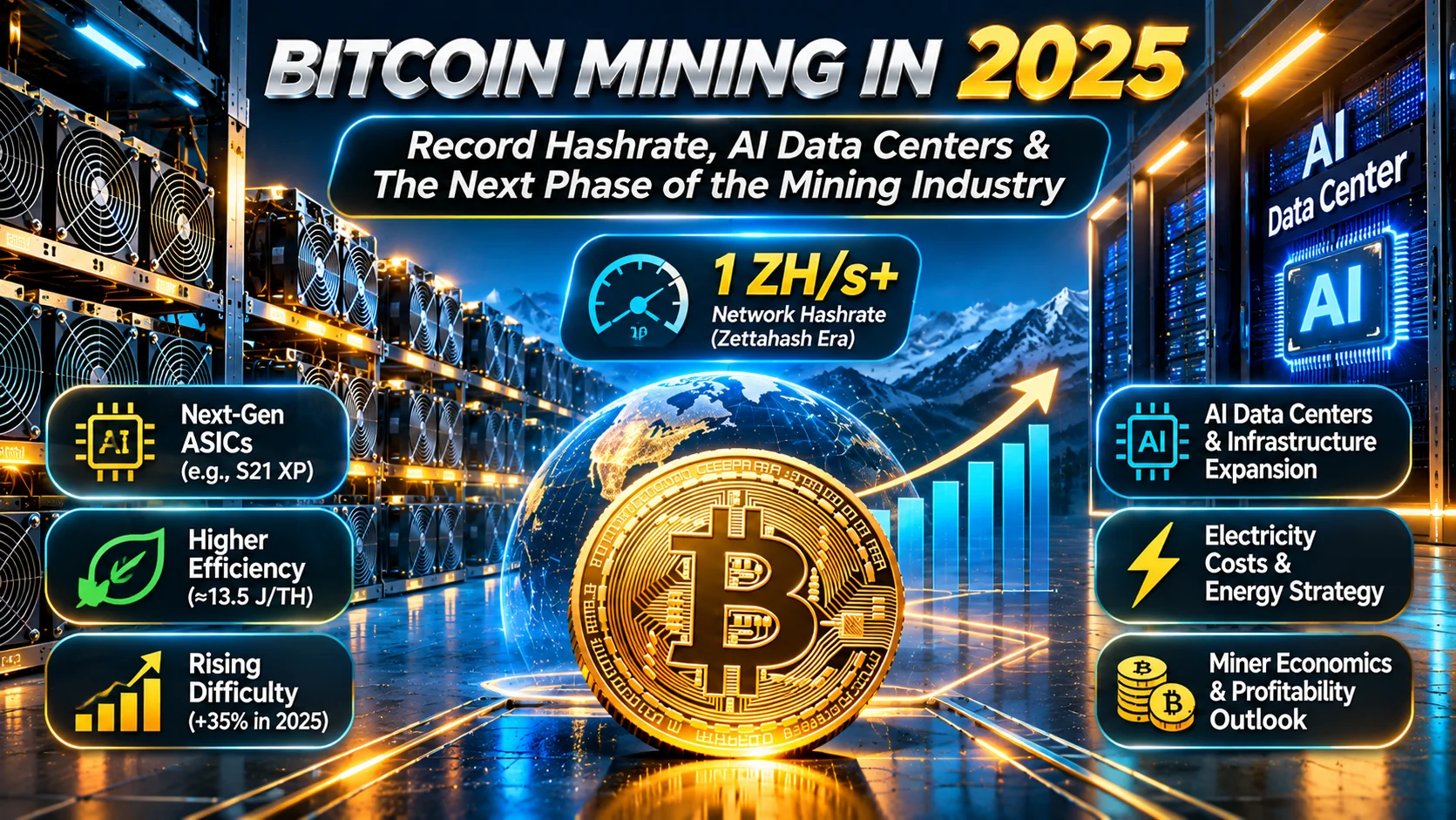
Bitcoin Mining in 2025: The Zettahash Era, AI Data Centers and Next-Generation ASIC Miners
For much of Bitcoin's early history, mining was a competition between people running computers. By 2025, it had become a competition between industrial-scale computing operations, electricity providers, equipment manufacturers and increasingly, companies building infrastructure for artificial intelligence.
The transformation was visible in one remarkable milestone: Bitcoin's global network hashrate entered the zettahash era.
One zettahash per second represents one sextillion hashing calculations every second. It is a scale of computing activity that would have been difficult to imagine when Satoshi Nakamoto launched Bitcoin in January 2009.
Yet growing computational power did not make mining easier or automatically more profitable.
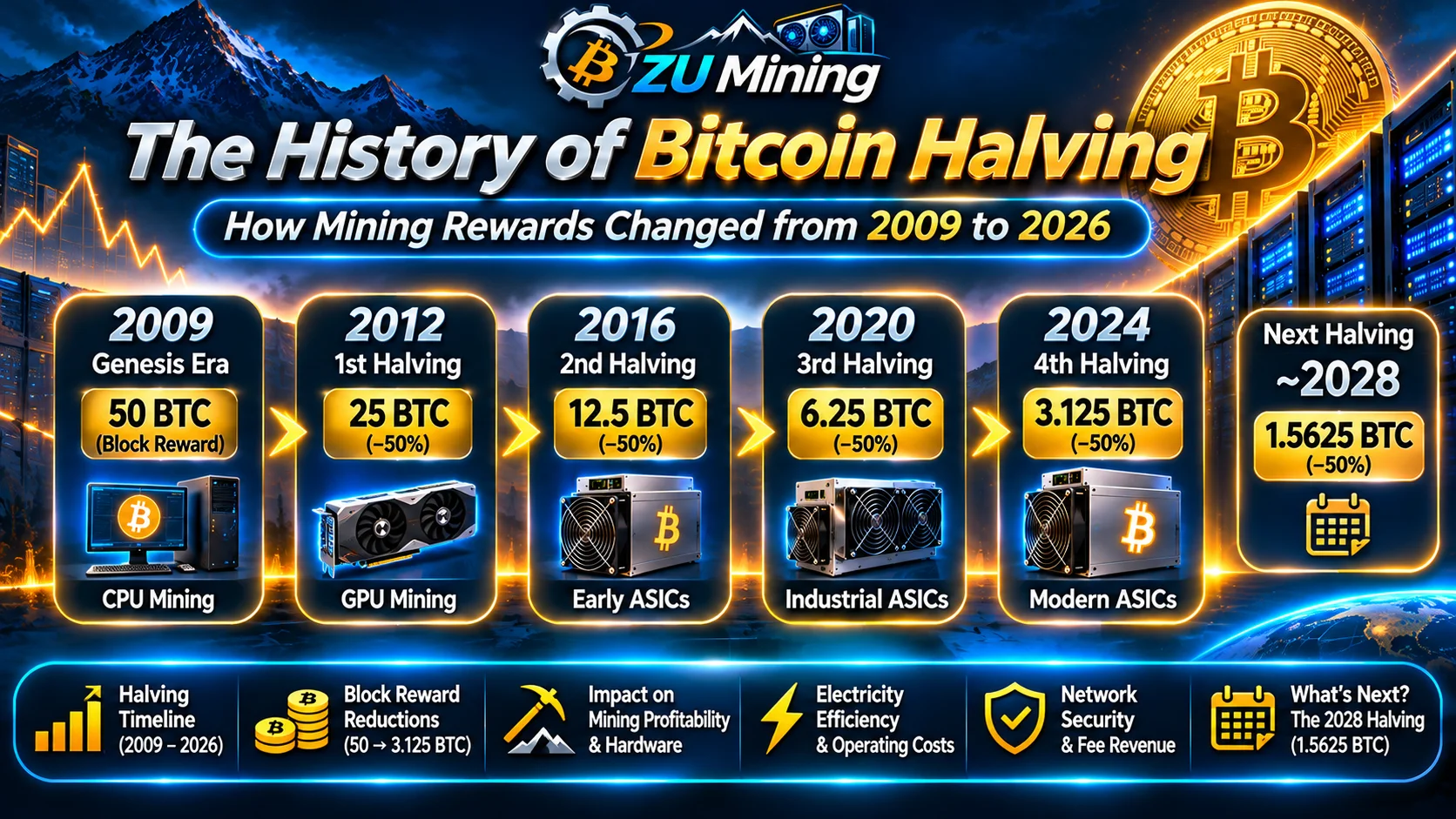
The fourth Bitcoin halving in April 2024 had reduced the block subsidy to 3.125 BTC. Throughout 2025, miners competed for that smaller subsidy while deploying increasingly efficient equipment and dealing with rising network difficulty.
Meanwhile, a different opportunity was emerging. Companies that had spent years acquiring electrical infrastructure for Bitcoin mining began considering whether some of their facilities could serve the rapidly expanding AI computing industry.
The result was a year in which Bitcoin mining became increasingly connected to the wider economics of energy, data centers and digital infrastructure.
1. Bitcoin Mining Enters the Zettahash Era
The most important technical milestone of 2025 was the Bitcoin network reaching approximately one zettahash per second.
A zettahash per second, abbreviated ZH/s, equals 1,000 exahashes per second.
For perspective:
1 terahash per second equals one trillion hashes per second.
1 petahash per second equals 1,000 TH/s.
1 exahash per second equals one million TH/s.
1 zettahash per second equals one billion TH/s.
The scale reflects the combined work of mining equipment operating around the world.
Industry reports recorded the network entering this territory during 2025. The exact date varies between measurements because estimated network hashrate fluctuates and different data providers use different averaging periods.
CoinGecko's 2025 Bitcoin Report recorded a network hashrate of approximately 851 EH/s on August 31 and noted that the network had briefly exceeded 1 ZH/s earlier in the year.
Other mining industry reports identified sustained zettahash-level activity later in 2025.
The important historical point is not one particular daily reading. It is that Bitcoin had reached an entirely new scale of computational competition.
Why a larger network hashrate matters
Bitcoin's hashrate is an estimate of the computational work being performed by miners.
A higher hashrate generally means more computing resources are competing to produce valid blocks.
It can also increase the amount of computational work an attacker would need to compete with the honest network.
However, hashrate alone does not measure every aspect of network security. Mining pool concentration, economic incentives and the distribution of infrastructure also matter.
For individual miners, growing network hashrate presents a practical challenge.
If their equipment stays the same while the network grows, their share of the total computational power becomes smaller.
That can reduce their expected Bitcoin earnings.
2. The Economic Reality After the 2024 Halving
The mining industry entered 2025 under the subsidy rules established by the fourth halving.
Every successfully mined Bitcoin block carried a subsidy of 3.125 BTC, plus the transaction fees associated with that block.
The subsidy was half its previous value.
This meant that mining businesses needed to generate sufficient revenue from fewer newly issued bitcoins.
How much Bitcoin was being created?
Bitcoin targets an average block interval of approximately ten minutes.
That corresponds to around 144 blocks per day.
At 3.125 BTC per block, expected daily issuance was:
144 × 3.125 = 450 BTC
Over 365 days, the corresponding theoretical issuance would be:
450 × 365 = 164,250 BTC
Actual issuance depends on the number of blocks produced during the period, so this is an approximate annualized calculation rather than an exact historical total.
The network's block subsidy remained unchanged throughout 2025.
What changed was the competition to earn it.
Why more hashrate does not create more Bitcoin
This is one of the most important principles for new miners to understand.
If the global hashrate doubles, Bitcoin does not permanently double the number of blocks produced each day.
The network periodically adjusts mining difficulty to maintain its target block interval.
As a result, additional mining power mainly increases competition for the available rewards.
The issuance schedule remains governed by Bitcoin's consensus rules.
3. Mining Difficulty Became a Major Challenge
Bitcoin adjusts mining difficulty every 2,016 blocks.
The adjustment helps keep average block production close to ten minutes despite changes in the amount of computational power operating on the network.
As more efficient machines entered service in 2025, network difficulty generally faced upward pressure.
Hashrate Index's annual review reported that Bitcoin difficulty exceeded 139.7 trillion during the year.
That was an important indication of how competitive the industry had become.
What difficulty means for a mining business
Consider a facility operating 100 identical ASIC miners.
Suppose its combined hashrate is 20 PH/s.
If the global network hashrate is 800 EH/s, the facility represents approximately:
20 PH/s ÷ 800,000 PH/s = 0.0025%
If the global network grows to 1,000 EH/s while the facility remains unchanged, its share becomes:
20 PH/s ÷ 1,000,000 PH/s = 0.002%
The facility's relative share has declined by 20%.
All else being equal, its expected share of block rewards would also decline.
This illustrates why mining businesses continuously monitor network conditions rather than relying only on the advertised hashrate of their machines.
4. The Next Generation of ASIC Mining Hardware
Specialized ASIC hardware remained central to Bitcoin mining throughout 2025.
ASIC stands for Application-Specific Integrated Circuit.
Unlike a general-purpose computer processor, a Bitcoin mining ASIC is designed specifically for SHA-256 hashing.
The main objectives of ASIC development are higher hashrate, lower energy consumption per terahash, improved reliability and better operational economics.
Why efficiency became more important
ASIC efficiency is commonly measured in joules per terahash, or J/TH.
A lower number means less energy is consumed per unit of hashing work.
This matters because miners must pay for the electricity their equipment consumes, regardless of whether Bitcoin's market price rises or falls.
Example: Antminer S21 XP
BITMAIN's published specifications for the Antminer S21 XP list:
Typical hashrate: 270 TH/s.
Power consumption: 3,645 watts.
Energy efficiency: 13.5 J/TH.
Mining algorithm: SHA-256.
These specifications describe typical performance under the manufacturer's stated testing conditions.
Actual results can vary depending on operating temperature, power conditions and hardware behavior.
The S21 XP illustrates the efficiency improvements that shaped the competitive environment in 2025, although the model was introduced before that year.
Comparing ASIC generations
Consider two hypothetical miners.
Miner A produces 100 TH/s while consuming 3,000 watts.
Its efficiency is:
3,000 ÷ 100 = 30 J/TH
Miner B produces 270 TH/s while consuming 3,645 watts.
Its efficiency is:
3,645 ÷ 270 = 13.5 J/TH
Miner B performs substantially more hashing work while using less than twice the electricity.
That difference can become significant across hundreds or thousands of machines.
However, greater efficiency does not automatically mean a better investment. Hardware acquisition costs and deployment expenses must also be considered.
Readers researching equipment specifications can explore the ZU Mining Hardware Directory.
5. Understanding Hashprice in 2025
One of the most useful measures of mining economics is hashprice.
Hashprice describes the expected revenue generated by a given amount of mining hashrate over a specified period.
It is commonly expressed in dollars per petahash per second per day.
For example, a hashprice of $50 per PH/s per day means that 1 PH/s of continuously operating hashrate would generate approximately $50 in daily gross mining revenue under the assumed network conditions.
This is not the same as profit.
Electricity, pool fees and other operating expenses must still be deducted.
A simple hashprice calculation
Imagine a facility operating 10 PH/s.
At a hypothetical hashprice of $50 per PH/s per day:
10 × $50 = $500 daily gross revenue
If hashprice falls to $35:
10 × $35 = $350 daily gross revenue
The facility has lost $150 in expected daily revenue without changing its equipment.
This explains why miners monitor hashprice closely.
What determines hashprice?
Several factors influence it:
Bitcoin's market price.
Network difficulty and total hashrate.
Block subsidy.
Transaction fee revenue.
The measurement period used.
During 2025, increasing competition placed pressure on mining revenue per unit of hashrate, even during periods when Bitcoin's price was relatively strong.
6. Electricity Costs Could Determine Survival
Mining businesses cannot control Bitcoin's global network difficulty.
They also cannot control Bitcoin's market price.
Electricity costs, however, are an area where operational decisions can make a substantial difference.
The Cambridge Digital Mining Industry Report published in April 2025 found that electricity represented more than 80% of surveyed miners' cash-based operational expenses.
The report also identified a median electricity cost of $45 per MWh among its respondents.
That equals approximately $0.045 per kWh.
These findings describe the surveyed industry participants and should not be interpreted as universal electricity rates for all miners.
Example: A 3,645-watt ASIC miner
An ASIC consuming 3,645 watts uses 3.645 kilowatts.
Daily energy consumption:
3.645 × 24 = 87.48 kWh
At $0.04 per kWh:
87.48 × $0.04 = $3.50 per day
At $0.08 per kWh:
87.48 × $0.08 = $7.00 per day
At $0.12 per kWh:
87.48 × $0.12 = $10.50 per day
These values are rounded.
Over a 30-day period, the electricity cost would be approximately $105, $210 or $315.
The difference is substantial for a single machine.
Across a large mining facility, electricity pricing can have a major effect on operating margins.
Why electricity prices vary
Mining facilities may obtain power through:
Commercial utility agreements.
Long-term electricity contracts.
Renewable energy arrangements.
Dedicated generation facilities.
Demand-response programs.
Each approach has different costs, risks and limitations.
The lowest advertised electricity rate is not always the lowest total operating cost.
Transmission charges, infrastructure expenses, cooling and downtime also matter.
7. The Growing Connection Between Bitcoin Mining and AI
One of the most important business developments of 2025 was the growing relationship between Bitcoin mining infrastructure and artificial intelligence data centers.
At first glance, the two industries appear quite different.
Bitcoin miners operate specialized SHA-256 computers.
AI data centers operate general-purpose servers and accelerators, including GPUs designed for demanding computational workloads.
Yet both industries require substantial electrical infrastructure.
That shared requirement created new business opportunities.
Why AI companies became interested in mining facilities
Large-scale AI computing requires access to reliable electricity, suitable land, cooling systems and high-capacity data center infrastructure.
Building these facilities can take years.
Some Bitcoin mining companies had already secured valuable power connections and developed industrial computing sites.
Those assets attracted attention from AI infrastructure companies.
However, not every Bitcoin mining facility is suitable for AI workloads.
AI data centers often require more demanding networking, redundancy, cooling and uptime standards.
Converting a mining site can involve significant capital expenditure.
8. Core Scientific and CoreWeave: A Major 2025 Case Study
A particularly important example involved Core Scientific and CoreWeave.
Core Scientific had developed substantial digital infrastructure through its Bitcoin mining and hosting operations.
CoreWeave was expanding its AI computing services.
The companies had already entered hosting agreements before 2025.
In June 2024, Core Scientific announced agreements to provide approximately 200 MW of infrastructure for CoreWeave's high-performance computing operations.
The relationship expanded the connection between mining infrastructure and AI computing.
The July 2025 acquisition announcement
On July 7, 2025, CoreWeave announced an agreement to acquire Core Scientific through an all-stock transaction.
The announcement highlighted the strategic importance of power capacity and data center infrastructure.
It represented one of the most visible examples of how infrastructure developed around cryptocurrency mining could become relevant to the AI industry.
The agreement was an announced transaction, not proof that the acquisition had been completed.
Its broader significance was the growing commercial value of power access and computing infrastructure.
Why the case matters
For mining companies, the example demonstrated that electrical infrastructure could potentially support more than one business model.
For AI companies, it highlighted the value of sites with existing power arrangements.
For investors and infrastructure planners, it raised new questions about how facilities should allocate capital between Bitcoin mining and other computing workloads.
9. Can Bitcoin ASIC Miners Be Used for AI?
A common misunderstanding is that Bitcoin mining machines can simply be converted into AI computers.
They generally cannot.
Bitcoin ASIC miners are specialized for SHA-256 hashing.
Modern AI workloads require different hardware capabilities, including large amounts of memory and support for matrix computations.
GPUs and specialized AI accelerators are designed for those tasks.
A Bitcoin ASIC cannot become an AI accelerator through a simple software update.
What can actually be reused?
Depending on the site, reusable infrastructure may include:
Land and industrial buildings.
Electricity connections.
Substations and transformers.
Certain cooling infrastructure.
Security systems.
Fiber connectivity.
Site management facilities.
Even these components may require upgrades.
For example, an AI data center may need more sophisticated cooling and networking than an ordinary air-cooled Bitcoin mining facility.
The distinction between reusing a site and reusing mining hardware is essential.
10. AI Hosting Versus Bitcoin Mining
Bitcoin mining and AI hosting have different revenue models.
A Bitcoin mining operation earns revenue based on its expected share of network rewards.
That revenue is influenced by Bitcoin's price, difficulty and transaction fees.
An AI infrastructure provider may instead receive payments through hosting contracts or computing services.
Those contracts can create a different type of revenue visibility.
However, AI infrastructure also introduces new risks.
Bitcoin mining risks
Mining operators face exposure to:
Bitcoin price volatility.
Network difficulty changes.
Hardware obsolescence.
Electricity expenses.
Equipment downtime.
AI infrastructure risks
AI data center operators may face:
Large upfront construction costs.
Financing requirements.
Customer concentration.
Technology changes.
Cooling and networking complexity.
Contract performance obligations.
Neither business model is automatically safer or more profitable.
The economics depend on individual facilities, financing structures and commercial agreements.
11. The Rise of Industrial Mining Operations
By 2025, Bitcoin mining had become increasingly dependent on large-scale infrastructure.
A modern mining facility could contain thousands of machines operating continuously.
Such facilities require more than hardware purchases.
They need electrical engineering, environmental controls, network connectivity, maintenance procedures and financial planning.
Example: A 10 MW mining facility
Consider a facility with 10 megawatts of continuous power demand.
That equals 10,000 kilowatts.
Daily electricity consumption:
10,000 × 24 = 240,000 kWh
At $0.05 per kWh:
240,000 × $0.05 = $12,000 daily
At $0.08 per kWh:
240,000 × $0.08 = $19,200 daily
At $0.12 per kWh:
240,000 × $0.12 = $28,800 daily
Over 30 days, these electricity expenses would be approximately $360,000, $576,000 and $864,000.
The calculation assumes constant power demand and excludes additional charges.
It demonstrates why energy management is fundamental to industrial mining.
12. Cooling and Infrastructure Development
Mining facilities generate substantial heat.
The higher the electrical power consumed by computing equipment, the greater the importance of effective heat removal.
During 2025, cooling infrastructure remained an important area of technical development.
Air cooling
Air cooling uses fans and ventilation to move heat away from mining equipment.
It is widely used but can be affected by dust, ambient temperatures and airflow restrictions.
Hydro cooling
Hydro-cooled mining systems use liquid-based heat transfer.
They can support high-density installations but require suitable pumps, pipes and heat exchange equipment.
Immersion cooling
Immersion systems place compatible hardware in dielectric cooling fluid.
The approach can improve thermal management in suitable deployments, although it adds engineering and maintenance complexity.
Why cooling affects profitability
Poor cooling can increase downtime and reduce equipment reliability.
Cooling equipment also consumes electricity.
Operators therefore need to consider the complete energy requirements of their facilities rather than examining ASIC specifications in isolation.
13. Mining Pools and Revenue Stability
Mining pools remained important in 2025.
A mining pool combines the hashing work of participating miners and distributes rewards according to its payout model.
Without a pool, a relatively small miner might wait a very long time before independently discovering a valid block.
Pool participation can provide more regular payouts.
Common payout models
FPPS, PPS+ and PPLNS are among the models used by mining pools.
They differ in how expected rewards, transaction fees and payout variability are handled.
A miner evaluating pools should understand these differences.
The ZU Mining Pools Directory offers a starting point for researching mining services.
Why pool selection matters
A pool's advertised fee is only one consideration.
Other factors include reliability, payout thresholds, security and how transaction fees are distributed.
Mining revenue calculations should reflect the actual terms of the selected pool.
14. Bitcoin Mining and Renewable Energy
The environmental impact of Bitcoin mining remained a significant subject of research and public debate during 2025.
Mining consumes electricity, and the environmental consequences depend partly on how that electricity is generated.
Some operators pursued renewable electricity contracts or developed facilities near energy resources.
Others explored ways to use electricity that might otherwise be curtailed or wasted.
However, the environmental benefit of any arrangement depends on the specific circumstances.
Why energy claims require careful evaluation
A mining facility using renewable electricity does not automatically have zero environmental impact.
Construction, hardware manufacturing and infrastructure also have environmental footprints.
Likewise, the use of curtailed electricity does not automatically prove that mining has no opportunity cost.
Credible environmental analysis should consider the energy source, timing, local grid conditions and alternative uses of electricity.
What Cambridge research contributed
The Cambridge Digital Mining Industry Report published in 2025 provided industry data on electricity consumption, hardware efficiency and mining operations.
Its findings helped inform discussion about the industry's energy requirements.
The report's estimates should be interpreted alongside its methodology and the dates of the underlying observations.
15. Hardware Replacement and Electronic Waste
ASIC hardware becomes less competitive as more efficient generations enter the market.
That creates an ongoing challenge for mining businesses.
A machine may still function technically while becoming economically unattractive.
For example, a miner consuming 30 J/TH may face difficulty competing with equipment operating at substantially lower energy consumption per terahash.
What happens to older machines?
Possible outcomes include:
Continued operation where electricity is inexpensive.
Resale to other operators.
Redeployment to different facilities.
Use for spare parts.
Recycling through appropriate channels.
The Cambridge report examined hardware lifecycle and electronic waste associated with Bitcoin mining.
Its findings emphasized the importance of distinguishing equipment retirement from immediate disposal.
Why lifecycle planning matters
Mining businesses should consider resale value, repair costs and expected useful life when evaluating equipment purchases.
A machine's purchase price is only one component of its total economic cost.
16. Understanding Mining Return on Investment
Mining equipment is often marketed using estimated daily profitability.
However, a positive daily operating margin does not guarantee that the original hardware investment will be recovered.
Return on investment depends on multiple variables.
Hypothetical example
Imagine a miner costing $4,000.
Suppose it generates $8 per day in gross revenue.
Its electricity cost is $5 per day.
Daily operating margin before other expenses:
$8 − $5 = $3
A simplified payback calculation would be:
$4,000 ÷ $3 = approximately 1,333 days
That is more than three and a half years.
However, this calculation assumes that daily revenue and expenses remain unchanged.
In practice, mining difficulty, Bitcoin's price, equipment performance and maintenance costs may change substantially.
The real payback period could be shorter, longer or never achieved.
Why realistic assumptions matter
A responsible mining analysis should account for uncertainty.
Historical profitability figures should not be presented as guaranteed future earnings.
The ZU Mining profitability calculator can help readers explore mining economics using their own assumptions.
17. Bitcoin Mining in Different Regions
Mining operations are influenced by local conditions.
Electricity pricing, infrastructure availability, climate and regulatory requirements can vary significantly between regions.
Some areas may offer access to inexpensive industrial electricity.
Others may provide favorable cooling conditions or existing data center infrastructure.
However, geographic advantages can change over time.
What determines location suitability?
Important considerations include:
Electricity availability and pricing.
Grid reliability.
Local regulations.
Cooling requirements.
Equipment transportation.
Internet connectivity.
Maintenance resources.
Environmental obligations.
A low electricity rate alone does not make a location suitable for mining.
Reliable infrastructure and predictable operating conditions are also important.
18. Why Small Miners Faced Greater Competition
The growth of industrial mining increased the challenges faced by smaller operators.
Large facilities may benefit from negotiated electricity agreements, bulk hardware purchases and dedicated maintenance teams.
Smaller miners often have less flexibility.
They may pay higher electricity rates and have limited access to specialized infrastructure.
Does that mean small-scale mining disappeared?
No.
Individuals and smaller businesses continued participating in Bitcoin mining.
However, the economics became increasingly sensitive to electricity costs, hardware efficiency and operational conditions.
Some operators mined for educational purposes or personal interest rather than expecting substantial profits.
Others used hosted mining services.
In all cases, realistic cost calculations remained essential.
19. The Security Implications of Growing Hashrate
Bitcoin's Proof-of-Work security model depends on miners performing computational work.
A larger network hashrate can increase the computational resources required to compete with the honest network.
However, network security is more complex than a single hashrate figure.
Mining pool concentration
Mining pools coordinate the work of many participants.
A large pool may represent significant network hashrate without owning every machine contributing to it.
This distinction matters when evaluating concentration.
Infrastructure concentration
Mining facilities can also become concentrated in particular regions or electricity markets.
That may create exposure to local disruptions or regulatory changes.
Economic incentives
Miners must receive sufficient economic incentives to continue operating.
The relationship between transaction fees, block subsidies and security expenditure becomes increasingly important as Bitcoin moves through successive halving eras.
The developments of 2025 reinforced the need to evaluate these factors together.
20. What 2025 Revealed About Bitcoin Mining's Future
The year demonstrated that Bitcoin mining was no longer simply a matter of purchasing a machine and connecting it to a mining pool.
The industry had become a sophisticated infrastructure business.
Three developments stood out.
First, the network reached zettahash-scale computational activity.
Second, the economic pressure created by the 2024 halving continued to reward operational efficiency.
Third, the growth of AI computing introduced new opportunities and challenges for companies controlling substantial electricity and data center infrastructure.
These developments did not mean that Bitcoin mining was disappearing.
Instead, they showed that the industry was changing.
Mining companies increasingly needed to think about electricity markets, infrastructure utilization, equipment lifecycle and long-term business strategy.
Looking beyond 2025
Future mining economics would continue to depend on Bitcoin's market price, network difficulty, transaction fees and technological development.
The next halving, expected around 2028, would reduce the block subsidy again.
That approaching event would place further emphasis on energy efficiency and the sustainability of mining revenue.
At the same time, the relationship between mining infrastructure and other computing industries could continue evolving.
The direction of that evolution would depend on commercial demand, technology and energy availability.
Conclusion
Bitcoin mining reached an important stage of maturity in 2025.
The network entered the zettahash era, reflecting an extraordinary expansion in computational competition since Bitcoin's launch in 2009.
Mining businesses continued adapting to the reduced block subsidy introduced in April 2024.
Newer ASIC equipment offered improvements in energy efficiency, but increasing network difficulty placed pressure on revenue per unit of hashrate.
Electricity costs remained central to operating profitability.
Meanwhile, the growing AI industry created a new opportunity for companies with access to power and data center infrastructure.
The relationship between Core Scientific and CoreWeave demonstrated how assets developed around cryptocurrency mining could become relevant to high-performance computing.
Yet the transition was not straightforward.
Bitcoin ASIC miners and AI accelerators serve different purposes, and adapting facilities for AI workloads can require substantial investment.
The defining lesson of 2025 was that mining success increasingly depended on infrastructure quality, efficient operations and realistic economic planning.
Bitcoin's network had become more computationally powerful than ever, but that did not make mining profits automatic.
For miners, understanding the difference between technological progress and financial performance remained essential.
Frequently Asked Questions
Did Bitcoin mining reach one zettahash per second in 2025?
Yes. Industry measurements recorded Bitcoin's network reaching approximately 1 ZH/s during 2025, although the reported timing varies according to measurement methodology.
What does one zettahash per second mean?
It represents one sextillion hashing calculations per second.
What was Bitcoin's block subsidy in 2025?
The subsidy was 3.125 BTC per block, following the fourth halving in April 2024.
Did mining become more profitable in 2025?
Not universally. Profitability depended on Bitcoin's price, network difficulty, transaction fees, equipment efficiency and operating costs.
Why were Bitcoin mining companies interested in AI data centers?
Some mining companies already controlled electricity connections and industrial computing infrastructure that could potentially support AI workloads after suitable upgrades.
Can a Bitcoin ASIC miner run AI models?
Generally, no. Bitcoin ASIC miners are specialized for SHA-256 hashing and cannot simply be converted into general-purpose AI accelerators.
What is hashprice?
Hashprice measures expected mining revenue per unit of hashrate over a given period.
Why is ASIC efficiency important?
More efficient machines consume less electricity per unit of hashing work, which can improve operating economics.
Did the growth of AI mean Bitcoin mining was ending?
No. AI infrastructure became an additional business opportunity for some companies, while Bitcoin mining continued operating globally.
What was the next major event miners were preparing for?
The next Bitcoin halving, expected around 2028, when the block subsidy is scheduled to decline to 1.5625 BTC.
Historical References and Further Reading
Cambridge Centre for Alternative Finance. Cambridge Digital Mining Industry Report 2025. https://www.jbs.cam.ac.uk/wp-content/uploads/2025/04/2025-04-cambridge-digital-mining-industry-report.pdf
CoinGecko Research. 2025 Bitcoin Report. https://assets.coingecko.com/reports/2025/CoinGecko-2025-Bitcoin-Report.pdf
Hashrate Index. 2025 Bitcoin Mining Year in Review. Published January 30, 2026. https://hashrateindex.com/blog/hashrate-index-2025-bitcoin-mining-year-in-review-standing-on-soft-ground/
BITMAIN Support. Antminer S21 XP Specifications. https://support.bitmain.com/hc/en-us/articles/35383015643673-S21-XP-Specifications
CoreWeave. CoreWeave to Acquire Core Scientific. Announcement dated July 7, 2025. https://coreweave.com/news/coreweave-to-acquire-core-scientific
Core Scientific Investor Relations. Core Scientific to Provide Approximately 200 MW of Infrastructure to Host CoreWeave's High-Performance Computing Services. https://investors.corescientific.com/news-events/press-releases/detail/74/core-scientific-to-provide-approximately-200-mw-of-infrastructure-to-host-coreweaves-high-performance-computing-services-capturing-significant-ai-compute-opportunity
Bitcoin Developer Documentation. Mining. https://developer.bitcoin.org/devguide/mining.html
Cambridge Centre for Alternative Finance. Cambridge Bitcoin Electricity Consumption Index. https://ccaf.io/cbnsi/cbeci
Editorial note: This article documents developments during 2025 using historical records and industry research. Financial examples are illustrative, not guarantees of mining returns. Some retrospective industry reports were published in 2026 and are identified accordingly.