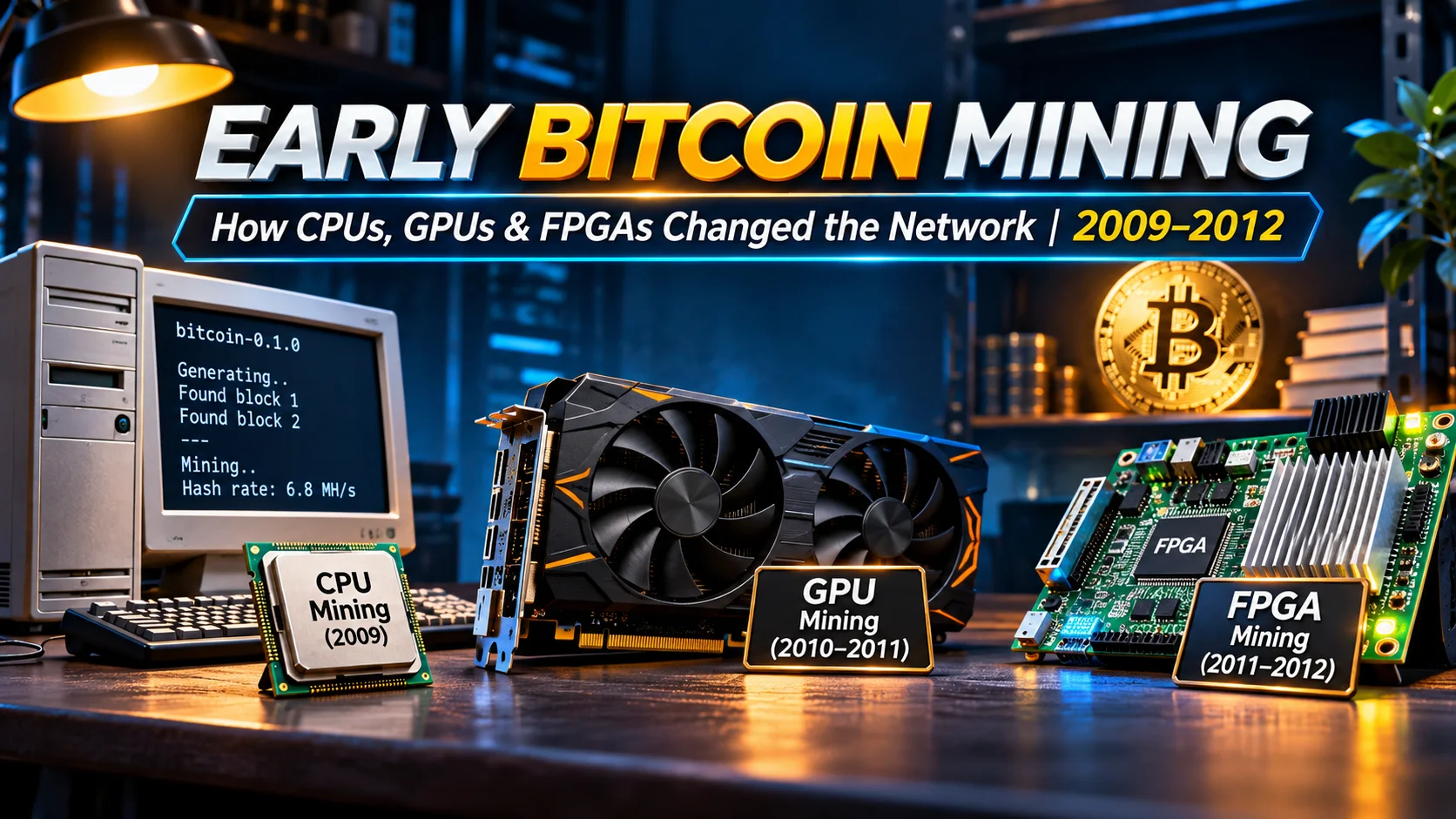
Early Bitcoin Mining: How CPUs, GPUs and FPGAs Changed the Network (2009–2012)
Before industrial mining facilities and specialized ASIC machines existed, Bitcoin's network was maintained by a small community of people using ordinary computers. Their experiments between 2009 and 2012 shaped the mining industry we know today.
When a Personal Computer Could Participate in Bitcoin Mining
Picture a computer enthusiast sitting at a desk in early 2009. The machine might have been used for programming, browsing the internet, or playing games. It had no specialized cryptocurrency hardware, and its owner probably knew very little about the economic value Bitcoin might eventually acquire.
Yet that ordinary computer could participate in securing a new digital currency network.
Bitcoin mining began at a time when the entire network was small enough for general-purpose processors to contribute meaningful computing power. There were no commercial ASIC mining machines, no established industrial mining facilities, and no mature marketplace for specialized mining equipment.
The software itself was experimental. Its users were testing whether a decentralized monetary network could function without a central transaction processor.
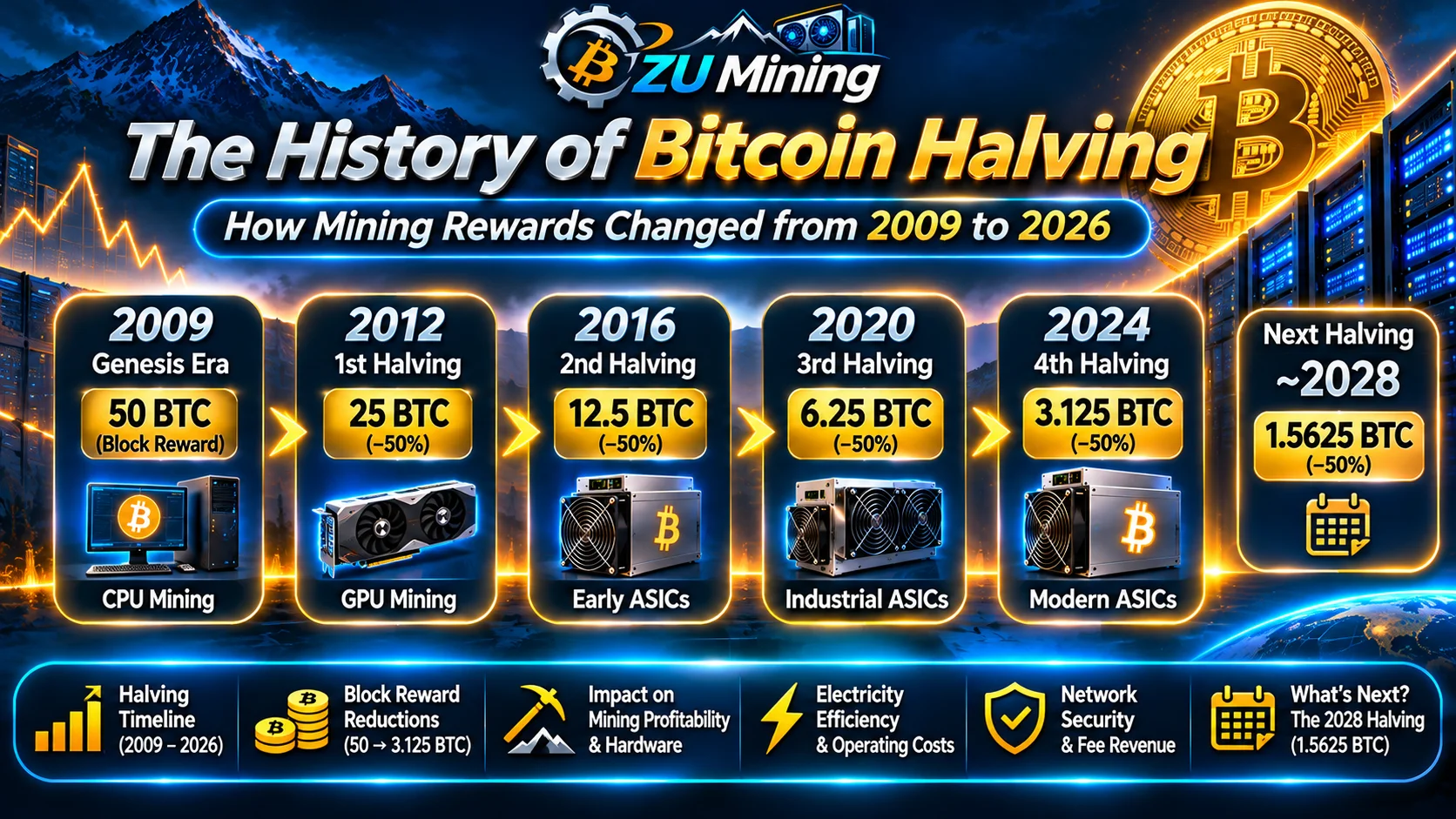
Over the next four years, Bitcoin mining changed dramatically. Graphics cards displaced ordinary processors, collaborative mining pools altered how participants received rewards, and programmable hardware introduced new possibilities for energy efficiency.
Understanding this period reveals something important about Bitcoin: the technology used to secure a blockchain can change substantially even when its underlying Proof-of-Work rules remain the same.
1. The Original Bitcoin Software Included CPU Mining
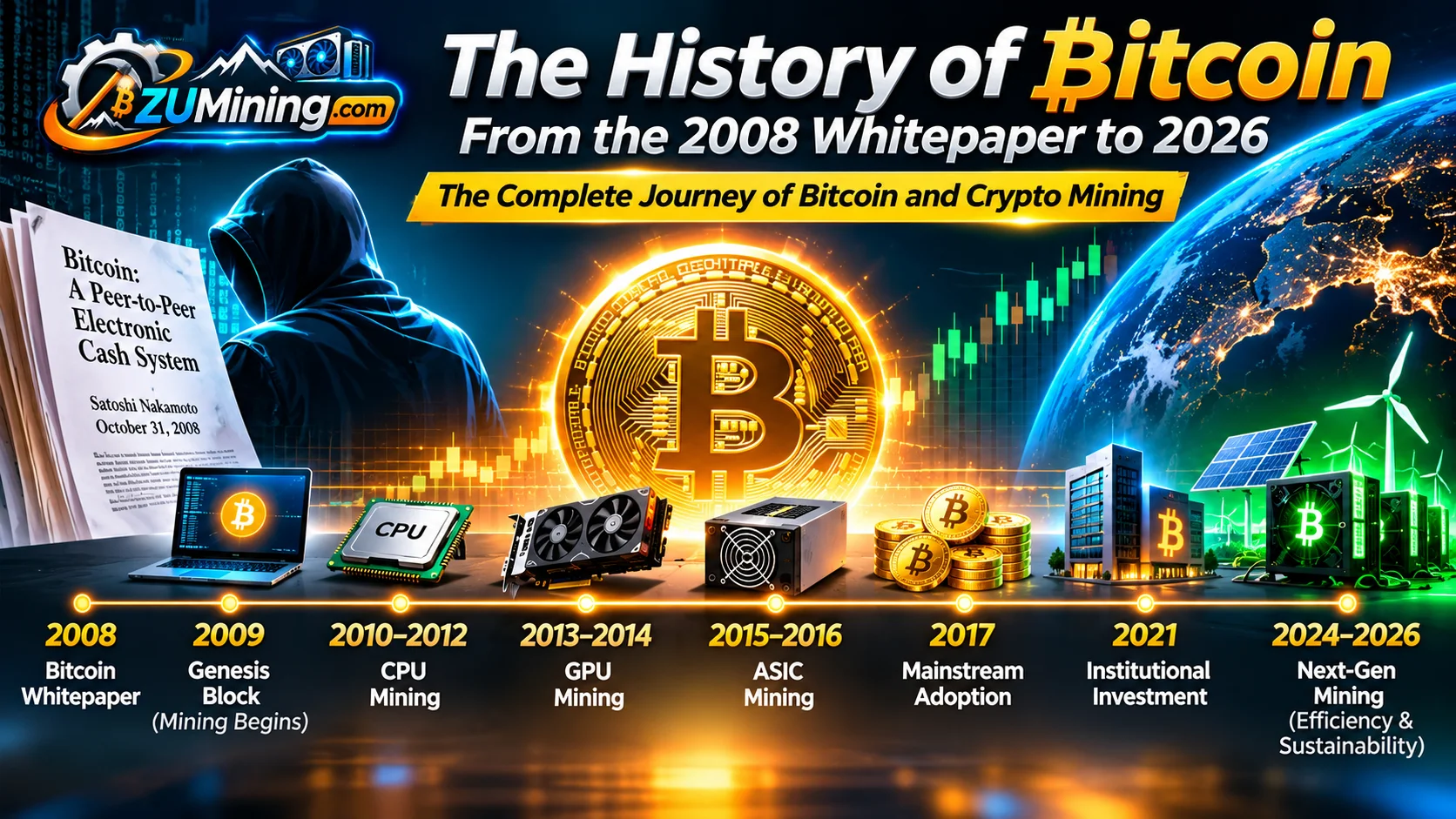
When Satoshi Nakamoto released the first Bitcoin software in January 2009, mining was built into the application. As explored in our historical overview of The History of Bitcoin from 2008 to 2026, Proof-of-Work calculation was an integral component of the initial client.
The original client was not simply a wallet. It also supported network participation, transaction verification, and the generation of new blocks.
Early users could enable coin generation through the software interface.
The application used a computer's central processing unit, or CPU, to perform the hashing calculations required by Bitcoin's Proof-of-Work mechanism.
This was a natural starting point.
CPUs were already available in practically every personal computer, and Bitcoin had not yet attracted enough participants to justify dedicated mining equipment.
What did the CPU actually calculate?
Bitcoin mining involves repeatedly hashing a candidate block header using the SHA-256 algorithm twice.
The resulting hash must be numerically lower than a target defined by the network's difficulty rules.
A miner changes parts of the candidate block data and tries again until a valid result is found.
There is no shortcut that guarantees the correct answer.
Each attempt has a probability of success determined by the current target.
A faster processor can generally perform more attempts over a given period, improving its chances of finding a valid block.
However, mining success remains probabilistic.
Two computers with different hash rates can experience very different short-term results simply because of chance.
Why was CPU mining practical in 2009?
The answer was not that early processors were unusually powerful.
It was that Bitcoin had very little mining competition.
The network's difficulty began at its minimum value. With relatively few participants contributing computing power, ordinary processors could sometimes discover blocks.
As more miners joined, the network's total hash rate increased.
Bitcoin's difficulty adjustment mechanism was designed to respond to these changes and maintain an average block interval of approximately ten minutes over time.
This meant that early CPU mining was never guaranteed to remain competitive indefinitely.
2. The First Miners Were Experimenters, Not Industrial Operators
The early Bitcoin community included programmers, cryptographers, open-source enthusiasts, and people interested in decentralized systems.
Among the best-known early participants was Hal Finney.
Finney had extensive experience with cryptography and digital cash research. He tested Bitcoin software during the network's earliest days and communicated directly with Satoshi Nakamoto.
His involvement was important because it demonstrated that Bitcoin could be operated and tested by someone other than its creator.
Other early contributors helped investigate software behavior, report bugs, and improve the reliability of the network.
Their work was not organized around the commercial mining industry that would emerge later.
Many participants were interested in whether Bitcoin's underlying ideas could work in practice.
Mining before an established Bitcoin market
In early 2009, Bitcoin did not have a widely established exchange price.
This created an unusual situation.
A participant could spend electricity and computing resources generating bitcoins without having a reliable way to calculate their monetary return.
The familiar modern question of daily mining profitability had little practical meaning when a market price was not readily available.
Instead, the reward was partly technical.
Participants were helping test a new system, discovering blocks, and experimenting with peer-to-peer digital money.
That distinction is essential when comparing early Bitcoin mining with today's commercial operations.
3. How Bitcoin Mining Difficulty Changed the Competition
Bitcoin's Proof-of-Work difficulty is one of the main reasons mining hardware evolved so quickly.
The protocol adjusts its mining target every 2,016 blocks.
If blocks were found faster than the expected schedule during the previous adjustment period, the difficulty generally increases.
If blocks were found more slowly, the difficulty can decrease.
The objective is to maintain an average block interval close to ten minutes, although individual blocks can arrive much faster or slower.
More computing power does not create unlimited new Bitcoin
Imagine that a network contains only a handful of miners.
If additional participants join and contribute substantially more hash power, blocks may initially be found faster.
But the next difficulty adjustment responds to that change.
Over time, the network returns toward its intended average production schedule.
This means that buying more mining hardware does not automatically increase the total number of bitcoins issued by the network over the long term.
Instead, it changes the competition for a relatively predictable stream of block rewards.
The economic consequence
Suppose a miner contributes 10% of the network's total hash rate.
If the network's total computing power doubles while that miner's equipment remains unchanged, the miner's relative share falls to approximately 5%.
The expected proportion of block rewards falls accordingly.
This simple relationship helped drive the first major mining hardware competition.
Miners increasingly needed faster equipment just to maintain their previous share of the network.
4. The GPU Mining Breakthrough of 2010
The next major development came from graphics processing units.
GPUs were originally designed to handle graphics workloads, including operations that benefit from parallel processing.
Unlike a typical CPU, which is optimized for a broad range of computing tasks, a GPU contains many execution resources capable of performing large numbers of similar operations. For an in-depth breakdown of computational architectures, read our guide on ASIC vs. GPU vs. CPU Mining Hardware Architecture.
Bitcoin's repetitive hashing workload offered an opportunity to use this parallel architecture.
Laszlo Hanyecz and early GPU experiments
Laszlo Hanyecz is widely associated with some of the earliest publicly documented GPU mining experiments.
In May 2010, he discussed a working OpenCL-based approach to Bitcoin generation.
OpenCL provided a framework for running suitable computations on different processing devices, including graphics hardware.
Other developers and miners continued exploring GPU-based implementations during 2010.
The transition was not a single event in which every miner suddenly changed equipment.
Different participants experimented with hardware, software, and optimization techniques at different times.
By the latter part of 2010, GPU mining was becoming increasingly influential.
Why GPUs changed the economics
A capable graphics card could perform far more Bitcoin hashing operations per second than many contemporary CPUs.
This gave GPU miners a substantial competitive advantage.
A miner who previously relied on a desktop processor might suddenly find that other participants were contributing many times more computational power.
The original CPU could still perform valid hashing work, but its share of the network was shrinking.
This was the beginning of Bitcoin's hardware specialization.
5. Hash Rate Became the Language of Mining Performance
As mining hardware improved, participants needed a practical way to compare computing performance.
Hash rate became the central measurement. Miners can model hashrate and difficulty variables using the Live Crypto Mining Profitability Calculator.
It describes the number of hashing attempts a mining device can perform per second.
Common units include:
| Unit | Meaning |
|---|---|
| H/s | Hashes per second |
| kH/s | Thousands of hashes per second |
| MH/s | Millions of hashes per second |
| GH/s | Billions of hashes per second |
| TH/s | Trillions of hashes per second |
During the early CPU era, mining performance was often discussed in relatively small units compared with today's Bitcoin mining equipment.
As GPU systems became more powerful, hundreds of megahashes per second became achievable on certain hardware.
However, comparing hash rates without identifying the algorithm and measurement conditions can be misleading.
A GPU's performance on Bitcoin's SHA-256 workload does not necessarily predict its performance on another cryptocurrency's mining algorithm.
This is one reason mining hardware comparisons must always account for the algorithm being used.
Hash rate was only part of the story
Higher performance could increase a miner's expected reward share, but it also came with costs.
Graphics cards required electricity, produced heat, and depended on stable software and hardware.
A faster system was not necessarily a better economic choice under every electricity price or equipment budget.
This trade-off would become even more important during the following FPGA era.
6. The Emergence of Dedicated GPU Mining Computers
The transition to GPU mining also changed the physical appearance of mining equipment.
A typical personal computer might contain one graphics card.
Some mining enthusiasts began assembling systems designed to accommodate multiple GPUs.
These machines often required greater attention to power delivery, cooling, motherboard compatibility, and physical space.
The familiar image of a mining rig with several graphics cards developed from this period of experimentation.
A new hardware culture
Early GPU miners exchanged information about compatible graphics cards, software improvements, and operating conditions.
Mining increasingly attracted people who were interested in computer hardware performance rather than cryptocurrency theory alone.
Graphics cards that were valuable to gamers and graphics professionals also became attractive to miners.
This created an additional source of demand for certain hardware models.
The transition also introduced an important problem that remains relevant in computing today.
Hardware optimized for one workload may become economically unattractive when a more efficient technology appears.
For Bitcoin miners, GPUs were a major improvement over CPUs, but they were not the final stage of development.
7. Mining Pools Changed How Participants Received Rewards
Mining hardware was not the only part of Bitcoin's ecosystem evolving in 2010.
Mining pools became increasingly important.
In solo mining, an individual miner receives a block reward only when that miner discovers a valid block accepted by the network.
As the network grows, smaller miners may wait a very long time between successful block discoveries.
The expected reward can be mathematically reasonable while the actual timing remains highly unpredictable.
Mining pools were developed to address this variability.
How pooling changed the experience
A mining pool coordinates the work of multiple participants.
When the pool successfully mines a block, rewards can be distributed among participants according to the pool's payout system and their contributed work.
The pool does not create additional Bitcoin.
Instead, it changes how mining rewards and risk are shared.
This can produce smaller and more frequent payouts compared with solo mining.
The significance of Slush Pool
Slush Pool, launched in late 2010, became one of the earliest widely recognized public Bitcoin mining pools.
It demonstrated that miners could cooperate without combining their computers into one physical machine.
The idea was influential because it made participation more practical for miners who could no longer expect frequent solo block discoveries.
Mining pools eventually became a major component of the Bitcoin mining ecosystem.
They also introduced new questions about pool governance, fees, reward distribution, and the concentration of block production.
For a separate explanation of pool reward systems, see our guide to Choosing a Cryptocurrency Mining Pool.
8. The Hidden Challenge of GPU Mining: Electricity and Heat
GPU mining improved computational performance, but it also increased the importance of energy consumption.
A computer operating under a sustained computational workload can consume substantial electricity.
The exact amount depends on the hardware, workload, configuration, and supporting components.
As miners began operating multiple graphics cards, electricity costs and cooling became more visible concerns.
Why efficiency matters
Consider two hypothetical mining devices.
Device A performs 100 million hashes per second while consuming 200 watts.
Device B performs the same amount of work while consuming 100 watts.
Both provide the same hash rate, but Device B requires half as much electrical power for the measured workload.
That difference becomes significant when equipment operates continuously.
Electricity costs can gradually exceed the value of hardware savings.
This is why mining performance should be evaluated using both computational output and power consumption.
Heat is part of the energy equation
Most electrical energy consumed by mining equipment eventually becomes heat.
That heat must be managed to maintain reliable operation.
In the early GPU mining era, this created practical challenges for hobbyists using equipment originally designed for gaming or general computing.
Cooling fans, ventilation, component temperatures, and hardware reliability became important operational considerations.
These problems encouraged interest in devices capable of performing the same work with less electricity.
9. FPGA Mining Arrives in 2011
By 2011, another class of computing hardware was entering Bitcoin mining.
FPGA stands for Field-Programmable Gate Array.
An FPGA is a programmable semiconductor device whose internal logic can be configured for particular computational tasks.
Unlike a CPU or GPU, which executes instructions through a more general-purpose architecture, an FPGA can implement specialized digital logic for a chosen workload.
This made FPGAs attractive for repetitive operations such as Bitcoin hashing.
Why FPGAs were important
The main appeal of FPGA mining was not simply raw speed.
Energy efficiency was a major advantage.
An FPGA-based design could perform hashing calculations using a hardware architecture tailored more closely to the algorithm.
For some systems, this offered meaningful improvements in the amount of electricity required per hash.
This mattered because mining competition was no longer determined solely by who could achieve the highest hash rate.
The cost of producing that hash rate was becoming increasingly important.
The limitations of FPGA mining
FPGAs also had disadvantages.
They could be expensive, difficult to obtain, and more challenging to develop for than ordinary graphics cards.
Creating efficient FPGA designs required specialized knowledge of digital hardware and logic implementation.
The market for Bitcoin mining FPGAs was therefore more limited than the broader consumer graphics card market.
Nevertheless, FPGA mining represented a major step toward dedicated mining hardware.
It showed that increasingly specialized electronics could outperform general-purpose computing equipment in important economic measurements.
10. The Mining Landscape in 2012
By 2012, Bitcoin mining looked very different from the experimental environment of 2009.
The network had more participants, mining software had evolved, and hardware competition had intensified.
CPU mining was no longer competitive against more capable equipment under ordinary commercial conditions.
GPU mining remained important, while FPGA devices demonstrated the advantages of specialized hardware and improved energy efficiency.
Mining pools also made it possible for participants to share rewards without operating at the scale required to discover blocks frequently on their own.
The combination of these changes helped transform Bitcoin mining from an individual computing experiment into a specialized technical activity.
Three generations of hardware
| Hardware | Main advantage | Main limitation |
|---|---|---|
| CPU | Widely available and easy to access | Limited SHA-256 mining performance |
| GPU | High parallel processing performance | Significant electricity and cooling requirements |
| FPGA | Specialized logic and improved efficiency | Higher development complexity and limited accessibility |
These hardware generations overlapped.
Not every miner upgraded at the same time, and the exact transition depended on equipment availability, electricity costs, and individual circumstances.
What mattered was the overall direction.
Bitcoin mining was moving toward increasingly specialized hardware.
11. What the Early Mining Era Teaches Us
The years from 2009 through 2012 provide several useful lessons about Proof-of-Work systems.
Technology can change without changing the consensus algorithm
Bitcoin continued using its SHA-256-based Proof-of-Work mechanism while mining hardware evolved dramatically.
The protocol did not require miners to use a specific brand or class of computer.
Competition encouraged participants to discover more effective ways of performing the same calculations.
Network difficulty changes the economics of participation
A machine's performance does not exist in isolation.
Its expected share of mining rewards depends on the total computational power competing on the network.
This means that hardware can become less economically useful even when it continues operating exactly as designed.
Mining rewards are uncertain
Finding a block is a probabilistic process.
Pools can reduce payout variability for individual participants, but they do not eliminate market, operational, or technical risks.
Efficiency can matter as much as performance
The FPGA era highlighted the importance of electrical efficiency.
A device that performs fewer hashes than another machine may still offer better economics if it consumes substantially less energy.
Specialization creates new barriers
The transition from CPUs to GPUs and FPGAs improved mining performance, but it also increased the importance of technical knowledge, hardware access, and operating costs.
This introduced difficult questions about how accessible mining could remain as the network matured.
12. Why the Early Mining Years Still Matter
Modern Bitcoin mining is dominated by specialized ASIC equipment, but its origins remain relevant.
The earliest miners demonstrated that a decentralized network could be secured through competitive computing.
GPU developers showed how parallel hardware could dramatically increase the available computational power.
Mining pools created new ways to distribute rewards among participants.
FPGA designers demonstrated the potential of dedicated hardware architectures and improved energy efficiency.
Each development influenced the next.
The transition from general-purpose computing to specialized mining equipment was not an accidental feature of Bitcoin's history.
It emerged from the economic incentives built into Proof-of-Work competition.
Understanding this process helps explain why modern Bitcoin mining differs so much from mining on other cryptocurrencies.
Some networks use algorithms designed around different hardware requirements, while others use consensus mechanisms that do not involve mining at all.
For readers comparing mining equipment across cryptocurrencies, the Mining Hardware Directory provides a starting point for exploring different device categories.
Conclusion: The End of Bitcoin's Experimental Mining Era
Between 2009 and 2012, Bitcoin mining underwent an extraordinary technological transformation.
What began with ordinary desktop processors evolved into a competitive environment involving powerful graphics cards, collaborative mining pools, and programmable hardware.
The people involved were not simply collecting digital coins.
They were experimenting with software, testing the boundaries of computer hardware, and discovering the practical consequences of a decentralized Proof-of-Work system.
By the end of 2012, the foundations of a specialized mining industry were already in place.
The next major breakthrough would arrive with application-specific integrated circuits, better known as ASICs.
Their introduction would change Bitcoin mining again, making purpose-built hardware the dominant approach to securing the network.
The early CPU, GPU, and FPGA years remain an important chapter in understanding how that transformation became possible.
Frequently Asked Questions
Could an ordinary computer mine Bitcoin in 2009?
Yes. Early Bitcoin software supported CPU mining, and the network initially had very little computational competition. Ordinary personal computers could participate meaningfully.
Who were the first Bitcoin miners?
Satoshi Nakamoto mined Bitcoin's earliest blocks. Hal Finney and other early software testers were among the first participants in the network.
When did GPU Bitcoin mining begin?
Publicly documented GPU mining experiments appeared during 2010. GPU mining became increasingly influential as software improved and more participants adopted graphics hardware.
Why were GPUs better than CPUs for Bitcoin mining?
GPUs could perform large numbers of similar hashing calculations in parallel, providing substantially greater throughput for Bitcoin's mining workload than many contemporary CPUs.
What was the first public Bitcoin mining pool?
Slush Pool, launched in late 2010, is widely recognized as the first public Bitcoin mining pool.
What is FPGA mining?
FPGA mining uses programmable semiconductor logic configured for hashing calculations. It became important around 2011 and 2012 because it offered opportunities for improved energy efficiency.
Did FPGA mining replace GPU mining immediately?
No. Hardware generations overlapped, and adoption depended on availability, technical knowledge, costs, and individual mining conditions.
Why is CPU mining no longer competitive for Bitcoin?
Modern Bitcoin mining is dominated by specialized ASIC equipment that performs SHA-256 calculations far more efficiently than ordinary CPUs.
Historical References and Further Reading
Satoshi Nakamoto. Bitcoin v0.1 Alpha Release Notes (2009). Original correspondence describing early Bitcoin software and CPU-based coin generation. https://satoshinakamoto.me/2009/01/12/bitcoin-list-bitcoin-v0-1-alpha-release-notes/
Cocco, S., and Marchesi, M. Modeling and Simulation of the Economics of Mining in the Bitcoin Market (2016). Research examining Bitcoin mining economics and the evolution from CPUs to GPUs, FPGAs, and ASICs. https://doi.org/10.1371/journal.pone.0164603
Andreas M. Antonopoulos. Mastering Bitcoin, Chapter 10: Mining and Consensus. Technical discussion of mining, competitive hashing, and the evolution of Bitcoin mining hardware. https://cypherpunks-core.github.io/bitcoinbook/ch10.html
Bitcoin Wiki. Historical Events of 2010. A chronology of early GPU mining developments, mining pools, and other events from Bitcoin's first years. https://bitcoinwiki.org/wiki/2010
Bitcoin Developer Documentation. Technical resources for understanding Bitcoin's blockchain, mining, network rules, and consensus mechanisms. https://developer.bitcoin.org/
This article is intended for historical and educational purposes. It does not provide financial or investment advice.