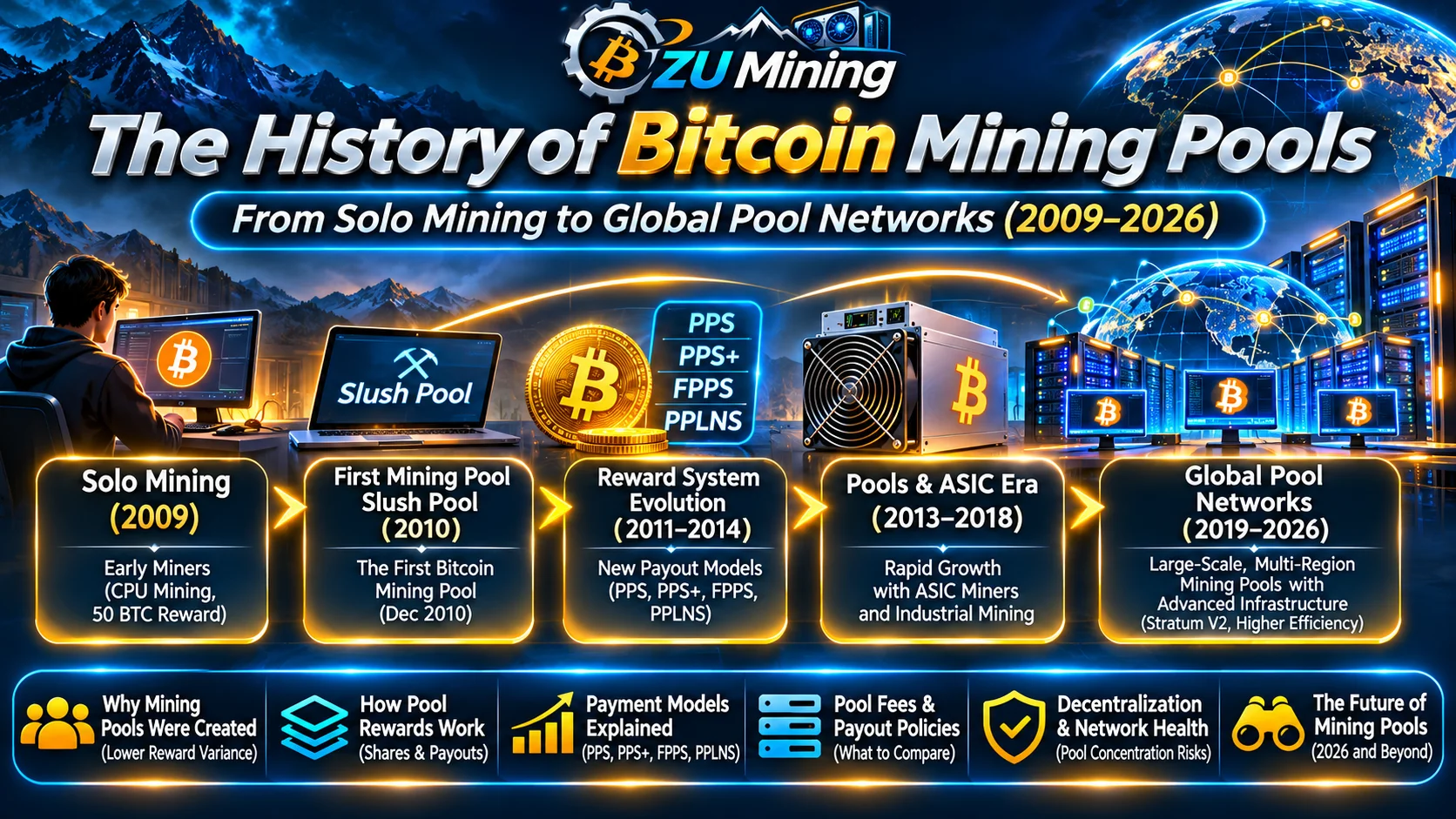
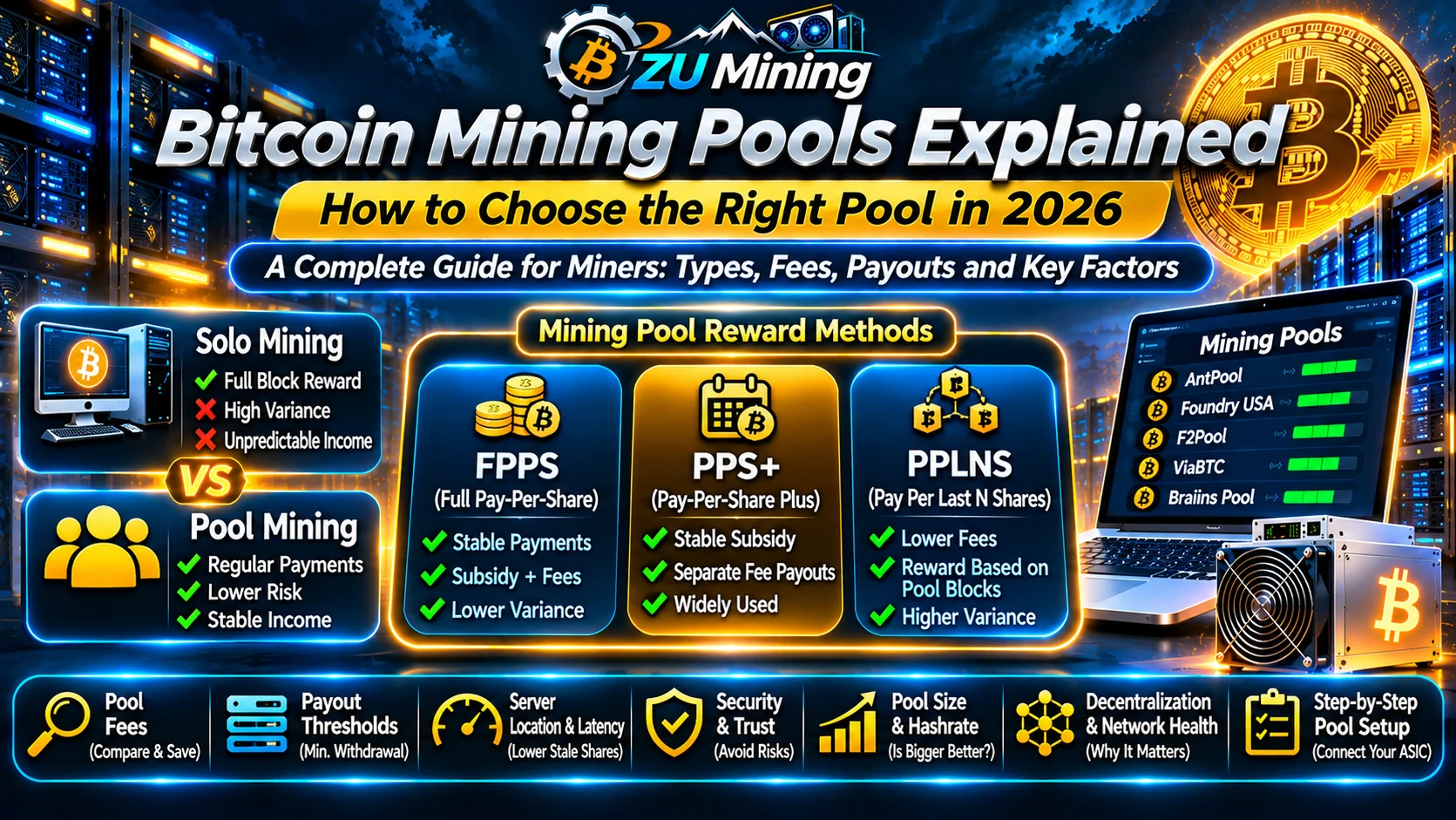
Bitcoin Mining Pools Explained: How to Choose the Right Pool in 2026
Updated November 2026
Imagine buying a modern Bitcoin ASIC miner, connecting it to the internet and watching it perform hundreds of trillions of hashes every second. The machine is working, electricity is being consumed, and its cooling fans are running continuously. Yet after several weeks of solo mining, your Bitcoin wallet may still show no mining rewards.
That does not necessarily mean anything is wrong.
Bitcoin mining is a competition involving an enormous amount of computing power. Even a powerful individual ASIC represents only a tiny fraction of the global network. Discovering a block independently is possible, but the waiting time can be extremely unpredictable.
Mining pools offer an alternative. Instead of competing independently, miners contribute their computing power to a shared operation and receive payments according to the pool's rules.
For most smaller Bitcoin mining operations, choosing a mining pool is one of the first important decisions after selecting hardware.
But not all pools work the same way. Payment methods, fees, reliability, payout thresholds and security practices can affect both earnings and operating experience.
This guide explains how Bitcoin mining pools work, what different payout systems mean, and how to evaluate a pool without relying on advertising claims.
1. What Is a Bitcoin Mining Pool?
A Bitcoin mining pool is a service that coordinates hashing work from multiple miners.
Each participating miner contributes computational power to the pool. The pool distributes work, tracks contributed shares and calculates payments according to its payout policy.
When a pool discovers a valid Bitcoin block, the reward is handled according to the pool's payment system.
A block's total reward consists of the block subsidy and transaction fees.
Following Bitcoin's April 2024 halving, the block subsidy became 3.125 BTC per block. This subsidy is scheduled to decrease again at the next halving, expected around 2028.
Mining pools do not create extra Bitcoin. They change how mining rewards and payment uncertainty are distributed among participants.
A simple example
Consider three miners:
Miner A contributes 100 TH/s.
Miner B contributes 200 TH/s.
Miner C contributes 700 TH/s.
Together, they contribute 1,000 TH/s, equivalent to 1 PH/s.
If their shares are all accepted and their contributions remain consistent, Miner A provides approximately 10% of the group's hashrate, Miner B provides 20%, and Miner C provides 70%.
Actual pool payments depend on the selected payout method, fees, valid shares and other pool rules.
The important principle is that miners can cooperate without physically combining their machines.
2. Why Most Individual Miners Use Pools
Bitcoin mining has become extremely competitive.
A single ASIC miner may deliver hundreds of terahashes per second, but the global network operates at a vastly greater scale.
The problem with solo mining
Solo mining has substantial payment variance.
A miner might discover a block unexpectedly early or operate for years without finding one.
The expected reward can be calculated statistically, but the actual timing remains uncertain.
What a pool changes
A pool combines hashing contributions from many participants.
Depending on its payout model, miners can receive smaller, more frequent payments instead of waiting for a complete block reward.
This makes cash-flow planning easier for operators paying ongoing electricity and hosting bills.
What a pool cannot change
A mining pool cannot eliminate electricity expenses, guarantee profitability or bypass Bitcoin's proof-of-work requirements.
It also cannot guarantee that every submitted share will be accepted.
Pool mining primarily changes payment distribution and variance.
3. Solo Mining Versus Pool Mining
Both approaches contribute hashing power to Bitcoin, but they create very different operating experiences.
Solo mining
A solo miner independently attempts to discover valid blocks.
If the miner finds a block, the miner may receive the entire eligible block reward, subject to its setup and any service arrangements.
If the miner does not find a block, there is no block discovery reward.
Pool mining
A pool miner contributes hashrate to a coordinated group.
Payments are calculated using the pool's reward system.
The miner usually receives smaller amounts more regularly, although the frequency depends on the pool and payout policy.
Comparison
| Factor | Solo Mining | Pool Mining |
|---|---|---|
| Payment frequency | Highly unpredictable | Usually more frequent |
| Reward variance | Very high | Generally lower |
| Pool fees | None for fully independent mining | Usually charged |
| Configuration | More involved for independent operation | Often straightforward |
| Suitable for | Operators accepting high variance | Miners seeking more predictable payments |
For a small mining business with regular electricity expenses, payment predictability may be more valuable than the possibility of receiving an entire block reward.
4. How Mining Pools Track Your Contribution
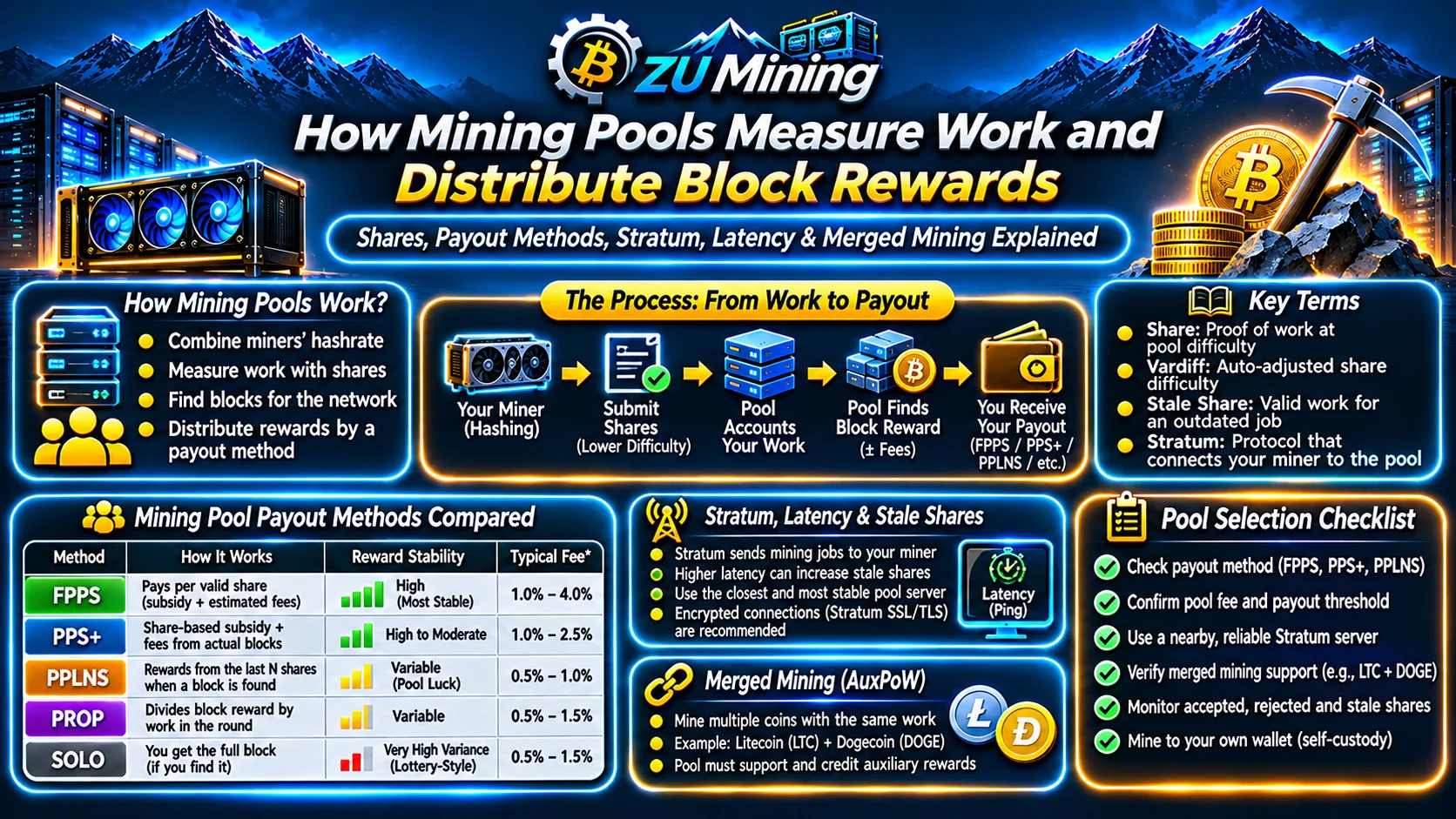
Mining pools generally use a system of submitted shares.
A share is proof that a miner has performed work meeting a difficulty target assigned by the pool.
This share target is usually easier than Bitcoin's network target.
Why shares exist
A pool needs a practical way to estimate how much useful hashing work each miner contributes.
Waiting for every participant to discover a complete Bitcoin block would not provide enough information for regular accounting.
Shares solve that problem.
Accepted shares
An accepted share meets the pool's requirements and arrives within the relevant time window.
Accepted shares are used to account for mining contributions.
Rejected shares
A rejected share is not credited as valid work.
Possible causes include stale jobs, duplicate submissions, incorrect configuration or communication problems.
Stale shares
A stale share generally refers to work submitted after it is no longer useful for the pool's current job.
High network latency, unstable connectivity and frequent interruptions can increase stale submissions.
Why share difficulty matters
Pool share difficulty is not the same as Bitcoin network difficulty.
Pools may adjust share difficulty to manage communication and accounting efficiency.
A higher assigned share difficulty generally results in fewer submitted shares for the same amount of hashing work, with each qualifying share representing more work.
This does not directly increase the miner's actual hashrate.
5. Understanding FPPS Mining Pool Payments
FPPS stands for Full Pay Per Share.
Under a typical FPPS arrangement, miners receive payments based on accepted shares and the pool's calculation of expected block rewards.
FPPS generally incorporates both expected block subsidy revenue and an estimated transaction-fee component.
Why miners choose FPPS
FPPS can provide comparatively predictable payments.
The pool operator assumes much of the short-term variance associated with discovering blocks.
What to check
FPPS does not mean every pool calculates payments identically.
Operators should examine:
The pool's published fee percentage
How transaction-fee estimates are calculated
Payment timing
Minimum payout requirements
Treatment of rejected shares
Any additional charges
An important limitation
FPPS reduces reward variance but does not eliminate changes in income caused by network difficulty, hashrate or transaction-fee conditions.
6. How PPS and PPS+ Differ
PPS stands for Pay Per Share.
Under a conventional PPS arrangement, a miner receives a predetermined expected-value payment for qualifying shares, generally based on the block subsidy.
The pool assumes the risk of discovering fewer blocks than statistically expected.
PPS+
PPS+ combines a PPS-style payment for the block subsidy with a separate distribution mechanism for transaction fees.
The transaction-fee portion is commonly linked to the pool's actual fee revenue over an accounting period.
FPPS versus PPS+
The main difference is how the transaction-fee component is calculated and distributed.
FPPS commonly uses an expected transaction-fee component.
PPS+ commonly distributes transaction fees using a separate calculation based on actual pool results.
Specific implementations vary between providers.
Why the distinction matters
Bitcoin transaction fees fluctuate.
During periods of elevated transaction activity, the treatment of transaction fees can materially affect pool payouts.
Miners should compare documented payment formulas rather than assuming two pools with the same headline fee will produce identical results.
7. What Is PPLNS?
PPLNS stands for Pay Per Last N Shares.
Instead of paying a fixed expected amount for every accepted share, PPLNS distributes rewards using shares submitted during a defined accounting window.
The pool generally pays participants when it discovers eligible blocks.
How it works
Imagine a pool discovers a block and examines the qualifying shares within its designated window.
Each miner's eligible contribution determines its share of the distributed reward.
The accounting window may include shares from before the block was discovered.
Advantages
PPLNS may have competitive fees.
It can reward miners who maintain consistent participation over time.
Disadvantages
Payments fluctuate with the pool's actual block discoveries.
A pool experiencing an unlucky period may pay less than expected over a short interval.
Is PPLNS worse than FPPS?
Not necessarily.
Over sufficiently long periods, different payout systems may offer comparable expected economics after accounting for fees and rules.
However, their short-term cash-flow patterns can differ substantially.
8. FPPS, PPS+ and PPLNS Compared
| Feature | FPPS | PPS+ | PPLNS |
|---|---|---|---|
| Subsidy payments | Expected-value shares | Expected-value shares | Based on pool block results |
| Transaction fees | Usually estimated | Usually actual-fee based | Usually included in distributed rewards |
| Short-term variance | Relatively low | Relatively low for subsidy | Higher |
| Dependence on pool luck | Lower for miner | Lower for subsidy | Higher |
| Best suited to | Predictable cash flow | Subsidy stability with fee participation | Miners comfortable with variable payouts |
No payout method is universally best.
The appropriate choice depends on electricity costs, financial reserves, operating schedule and the pool's specific terms.
9. How Mining Pool Fees Affect Profit
Mining pool fees are usually expressed as a percentage of eligible mining revenue.
A pool advertising a lower fee is not automatically the most profitable option.
Example
Assume a miner earns an expected gross mining revenue of $12 per day before pool fees and electricity costs.
At a 1% pool fee:
$12 × 0.01 = $0.12
Expected revenue after the fee is $11.88.
At a 2.5% pool fee:
$12 × 0.025 = $0.30
Expected revenue after the fee is $11.70.
The difference is $0.18 per day.
Over 30 days, that equals $5.40 under unchanged assumptions.
Why the cheapest pool may not be best
A low-fee pool with frequent outages or high stale-share rates could perform worse than a slightly more expensive, reliable alternative.
Actual accepted work and payment terms matter more than the advertised fee alone.
10. Electricity Costs and Real Mining Profitability
Pool selection should be considered alongside electricity expenses.
Suppose a miner consumes 3,500 watts.
Its daily electricity consumption is:
3.5 kW × 24 hours = 84 kWh
At an electricity price of $0.10 per kWh:
84 × $0.10 = $8.40 per day.
If the miner's revenue after pool fees is $11.70, the remaining amount is:
$11.70 − $8.40 = $3.30 per day.
This is an illustrative operating margin before hardware depreciation, maintenance, cooling overhead, taxes and other expenses.
A miner paying $0.15 per kWh would face daily machine electricity costs of $12.60.
Under the same revenue assumption, the operation would be unprofitable before additional expenses.
The ZU Mining Profitability Calculator can help estimate mining revenue and electricity expenses using different hardware and cost assumptions.
11. Understanding Minimum Payout Thresholds
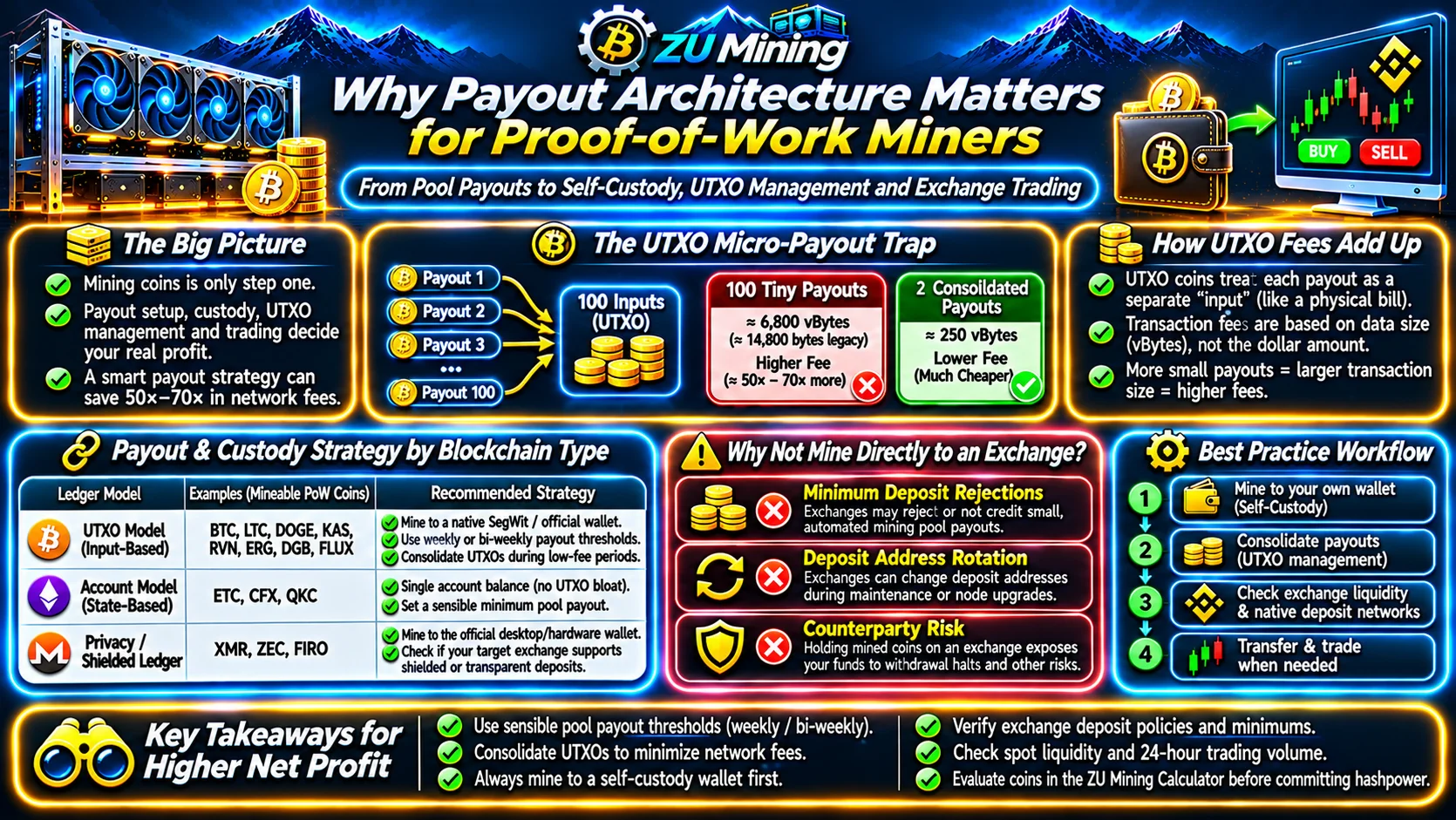
Mining pools often require a minimum account balance before issuing a payment.
For example, a pool might specify a threshold of 0.001 BTC.
A miner whose accumulated balance is below that threshold may need to wait until enough rewards have accrued.
Why thresholds matter
A miner with limited hashrate might take a considerable amount of time to reach a high payout threshold.
This can delay access to mining revenue.
What to investigate
Check whether the pool offers automatic payments, manual withdrawals or different thresholds.
Also examine whether transaction costs are deducted and whether changing the payout address triggers a security delay.
The advertised payout frequency is not necessarily the frequency at which every miner receives funds.
12. Pool Server Location and Latency
Mining pools operate servers in different geographic regions.
The connection between an ASIC miner and the selected pool server affects how quickly mining jobs and share submissions travel.
Why latency matters
A slow or unstable connection can contribute to stale shares.
However, geographical distance alone does not determine connection quality.
Routing, congestion, packet loss and server reliability also matter.
How to choose a server
Prefer a stable endpoint with low latency and minimal packet loss.
Test the pool's available regional endpoints when possible.
Compare actual rejected and stale share percentages after connecting.
Avoid chasing tiny differences
A few milliseconds of latency difference may be less important than overall connection stability.
The best server is the one that consistently delivers reliable mining communication.
13. Stratum and Mining Pool Communication
Stratum is a mining communication protocol used to coordinate work between miners and pools.
It allows a pool to distribute mining jobs and receive submitted shares.
Stratum V1
Stratum V1 became widely used throughout the mining industry.
It provides an established communication method for coordinating mining work.
Stratum V2
Stratum V2 introduces improvements involving communication efficiency, security and job negotiation capabilities.
Its features can support a more flexible relationship between miners and mining infrastructure.
Does every pool support Stratum V2?
No.
Support depends on the pool, mining firmware and compatible infrastructure.
Miners should verify current compatibility before changing their configuration.
Why protocol support matters
Protocol compatibility affects connectivity, security options and potential control over mining work.
A pool's Stratum version is therefore worth evaluating alongside fees and reliability.
14. Comparing Well-Known Bitcoin Mining Pools
Several established providers have served Bitcoin miners over the years.
Examples include AntPool, F2Pool, ViaBTC, Foundry USA Pool and Braiins Pool.
These names are provided for research, not as a ranking or endorsement.
AntPool
AntPool is a long-established mining pool associated with the broader Bitcoin mining industry.
Miners should review its current payment options, fees and regional service availability.
F2Pool
F2Pool operates mining pool services and has a long history in cryptocurrency mining.
Users should confirm its current Bitcoin payout model and account requirements.
ViaBTC
ViaBTC provides mining pool services and related mining tools.
Miners should examine its available payment methods and applicable charges.
Foundry USA Pool
Foundry USA Pool is a major participant in Bitcoin mining infrastructure.
Its current access arrangements and services should be verified directly.
Braiins Pool
Braiins Pool has a long history in Bitcoin mining and is associated with mining software and protocol development.
Its current fee structure and compatibility requirements should be checked before joining.
Why this is not a fixed ranking
Pool fees, payout systems, market share and service conditions change.
A trustworthy comparison should use current provider documentation and independently observed performance rather than an outdated list of supposed winners.
15. How Pool Size Affects Mining
A large pool generally combines more hashrate than a small pool.
That can make block discoveries more frequent.
Large pools
Larger pools may discover blocks relatively frequently.
This can be useful for payout systems tied to actual block discoveries.
Smaller pools
Smaller pools may experience longer intervals between block discoveries.
For PPLNS participants, this can create greater short-term payout variation.
Does a bigger pool automatically pay more?
No.
For a miner contributing the same accepted work, expected revenue depends on the payout formula, fees and other conditions.
Pool size alone does not guarantee higher expected profit.
Decentralization considerations
A network in which too much hashrate is coordinated by a few operators raises concerns about concentration.
Miners may consider the distribution of mining power when choosing a pool.
16. Mining Pool Security Checklist
A mining pool account can contain accumulated mining revenue and sensitive account settings.
Security should therefore be treated as an essential selection criterion.
Account protection
Enable multifactor authentication when available.
Use a unique password.
Protect the email account associated with the pool.
Withdrawal protection
Look for withdrawal-address confirmation and notification features.
Understand any waiting periods applied to payout-address changes.
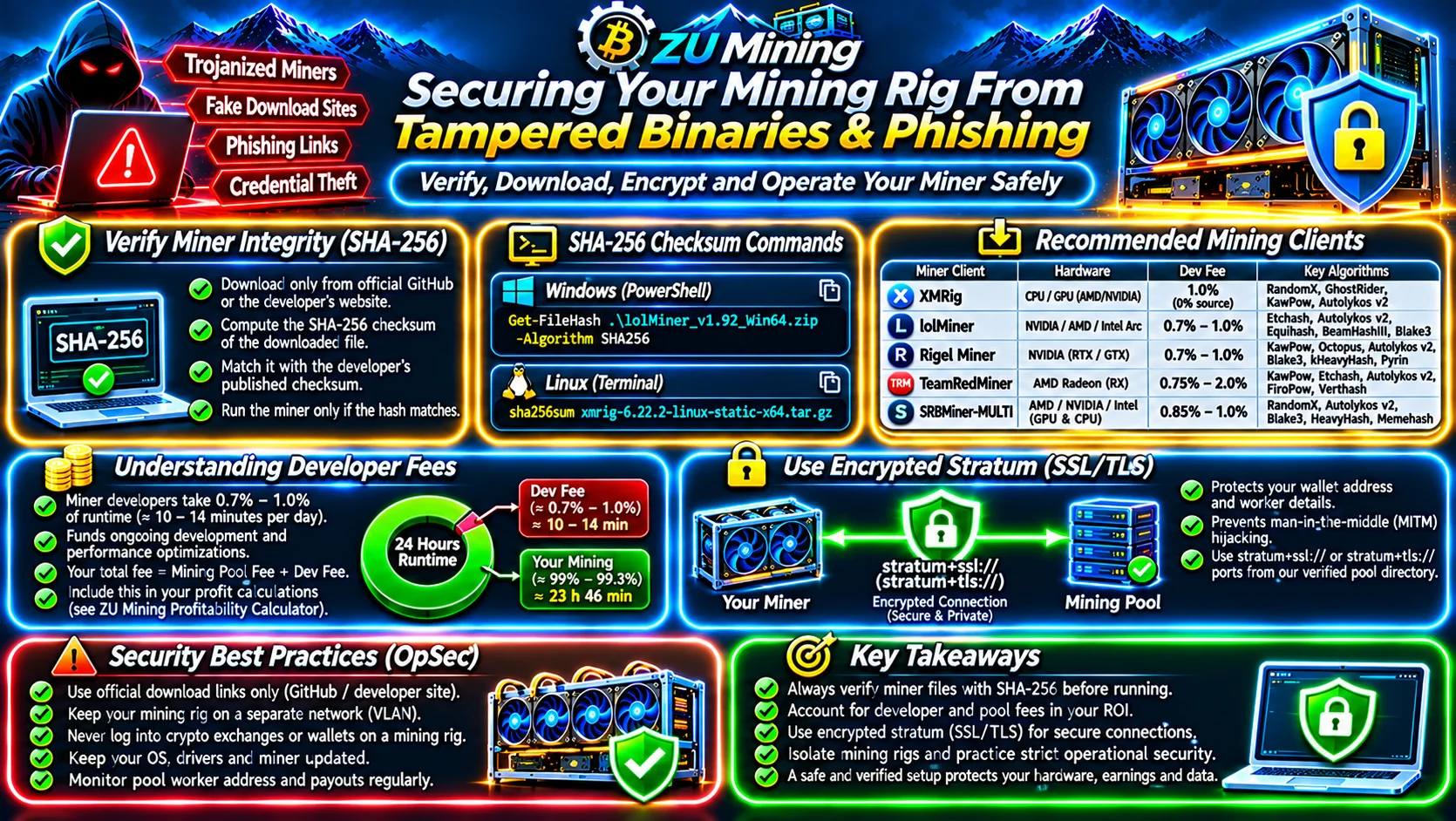
Connection security
Use the pool's officially documented connection endpoints.
Verify whether secure Stratum connections are supported by your hardware and firmware.
Provider transparency
Review the pool's published terms, support documentation and incident communications.
Be cautious of services promising guaranteed mining profits.
Independent verification
Confirm pool addresses and instructions through official provider sources.
Avoid relying solely on social media messages or unofficial configuration guides.
17. How to Connect an ASIC Miner to a Pool
The exact setup varies by manufacturer and firmware, but the general process is similar.
Step 1: Select a compatible pool
Confirm that the pool supports Bitcoin SHA-256 mining and your equipment's communication protocol.
Step 2: Create an account if required
Some pools use registered accounts.
Others may support mining configurations based on a payout address.
Follow the provider's documented requirements.
Step 3: Locate the official mining endpoint
Find the Stratum server address and port in the pool's official documentation.
Step 4: Open the ASIC configuration interface
Access the miner through its authorized local management interface.
Step 5: Enter the pool information
Configure the pool endpoint, worker identifier and other required fields.
Step 6: Configure backup pools
Where supported, secondary endpoints can help maintain mining operation if the primary connection fails.
Step 7: Verify accepted work
After connecting, confirm that the miner is submitting accepted shares and that the pool dashboard recognizes its hashrate.
Step 8: Monitor performance
Check actual hashrate, rejected shares, temperature, uptime and estimated earnings.
Do not assume the configuration is correct merely because the miner's fans are running.
18. Common Mining Pool Problems
High rejected share rate
Possible causes include unstable connectivity, incorrect configuration or firmware problems.
Review miner logs and pool status information.
High stale share rate
Test network stability and alternative regional endpoints.
Check whether the problem appears during periods of network congestion.
Pool dashboard shows zero hashrate
Confirm the worker name and pool URL.
Allow for the pool's reporting delay.
Verify that the miner is submitting accepted shares.
Payments are delayed
Check the minimum payout threshold, scheduled payment cycle and withdrawal status.
Review official service notices before assuming a technical failure.
Earnings differ from estimates
Compare accepted hashrate, network difficulty, transaction-fee conditions, pool fees and actual uptime.
Short measurement windows can produce misleading comparisons.
19. A Practical Seven-Day Pool Comparison
Rather than selecting a pool based only on its advertised fee, miners can evaluate providers using a structured test.
Day 1: Record your baseline
Document hardware hashrate, power consumption, electricity rate and current pool settings.
Days 2 and 3: Measure the first pool
Record accepted hashrate, rejected shares, stale shares and reported earnings.
Days 4 and 5: Measure an alternative pool
Use comparable hardware and operating conditions.
Days 6 and 7: Review the results
Compare the performance records.
Pay attention to network difficulty changes, transaction-fee conditions and reporting differences.
Important limitation
A seven-day comparison is useful for detecting obvious reliability problems.
It is not enough to establish which pool will produce the highest long-term returns, especially when comparing payout models with different variance.
For more reliable conclusions, monitor performance over longer periods.
20. How to Calculate Effective Pool Performance
An advertised pool fee does not tell the entire story.
Consider two hypothetical pools.
Pool A charges 1%.
Pool B charges 2%.
Assume Pool A experiences an effective 3% loss of otherwise eligible work due to rejected or stale shares, while Pool B experiences a 0.5% loss.
Using a simplified gross revenue of $15 per day:
Pool A
$15 × 0.97 × 0.99 = $14.4045
Pool B
$15 × 0.995 × 0.98 = $14.6265
In this simplified example, Pool B produces a higher effective amount despite charging a higher fee.
Actual pool calculations depend on payout methodology and whether rejected work would otherwise have qualified.
The example illustrates why reliability can outweigh a small difference in advertised fees.
21. Pool Mining and Bitcoin Decentralization
Mining pools provide practical benefits, but they also create important governance questions.
A pool operator may coordinate the construction and distribution of block templates.
This can concentrate influence over which transactions are included in blocks.
Why miner choice matters
Miners can evaluate pool policies and choose different operators.
The availability of multiple independent pools supports a more diverse mining ecosystem.
The role of Stratum V2
Job negotiation capabilities associated with Stratum V2 can support greater miner involvement in block-template selection when the required infrastructure is deployed.
These capabilities are not automatically available in every implementation.
A balanced approach
Miners should evaluate profitability and operational reliability while also considering how their pool choice affects network concentration.
22. How Mining Pools May Evolve After 2026
Bitcoin mining economics will continue changing as block subsidies decline over successive halvings.
Transaction fees may become increasingly important to miner revenue, although their future level remains uncertain.
More attention to transaction fees
Different payout models may become more consequential when transaction fees represent a larger portion of total block rewards.
Greater protocol flexibility
Improved mining protocols may support more efficient communication and additional miner control.
Continued competition
Pools will likely continue competing on reliability, fees, transparency and payment systems.
No guaranteed outcome
Future pool market shares, payout structures and profitability cannot be predicted with certainty.
Miners should periodically reassess their arrangements rather than assuming that one provider will remain the best choice indefinitely.
23. Choosing the Right Pool for Your Mining Operation
The best pool depends on the miner's circumstances.
A small operator with limited financial reserves may prioritize predictable payments and a low withdrawal threshold.
A larger operator may focus on infrastructure reliability, reporting tools and commercial arrangements.
A miner comfortable with variable income may consider a PPLNS arrangement.
An operator interested in Bitcoin's decentralization may also evaluate how much network hashrate is already coordinated by a prospective pool.
Before making a decision, compare the pool's current documentation, fees, payout rules and security practices.
The ZU Mining Pools Directory provides a starting point for exploring mining pool services.
Conclusion
Bitcoin mining pools make it possible for individual miners to participate in a highly competitive network without relying entirely on the chance of discovering a block alone.
FPPS, PPS+ and PPLNS offer different ways to distribute mining rewards and payment uncertainty.
Pool fees matter, but they should never be evaluated in isolation.
Accepted hashrate, reliable connectivity, payout thresholds, security, transaction-fee treatment and decentralization are also important.
For a miner paying ongoing electricity costs, a dependable pool with transparent rules can be more useful than a provider advertising the lowest headline fee.
The most effective approach is to understand the payment model, verify current provider terms, monitor actual performance and reassess the decision as mining conditions change.
Frequently Asked Questions
What is a Bitcoin mining pool?
A mining pool coordinates computing power from multiple miners and distributes payments according to a defined reward system.
Is pool mining better than solo mining?
Pool mining generally provides more predictable payments, while solo mining involves much greater reward variance.
What does FPPS mean?
FPPS stands for Full Pay Per Share. It generally pays miners based on accepted shares and expected block subsidy and transaction-fee revenue.
What is the difference between PPS+ and PPLNS?
PPS+ commonly pays the subsidy component using a PPS-style calculation and distributes transaction fees separately. PPLNS distributes rewards according to qualifying shares in a defined window when the pool discovers blocks.
Do larger pools always pay more?
No. Expected earnings depend on payment rules, fees and valid contributed work, not simply pool size.
Can mining pools guarantee profits?
No. Mining profitability depends on hardware, electricity expenses, Bitcoin market conditions, network competition and other operating costs.
What is a stale share?
A stale share is mining work submitted after it is no longer useful for the pool's current job.
Why do pools have minimum payout thresholds?
Thresholds help pools manage payment processing and transaction costs, but they can delay withdrawals for miners with smaller balances.
Can I change mining pools?
Generally, yes. Miners can change their pool configuration, subject to their hardware, firmware and any contractual obligations.
Does pool mining affect Bitcoin decentralization?
Pool concentration can influence how block production is coordinated. Choosing among independent operators is one factor miners can consider.
References and Further Reading
Bitcoin Developer Documentation. Mining. https://developer.bitcoin.org/devguide/mining.html
Bitcoin Developer Documentation. Block Chain. https://developer.bitcoin.org/devguide/block_chain.html
Stratum V2 Project. Mining Protocol Documentation. https://stratumprotocol.org/
Bitcoin Core. Open-Source Bitcoin Software. https://bitcoincore.org/
Cambridge Centre for Alternative Finance. Digital Mining Research. https://www.jbs.cam.ac.uk/faculty-research/centres/alternative-finance/
Bitcoin Whitepaper. Bitcoin: A Peer-to-Peer Electronic Cash System. https://bitcoin.org/bitcoin.pdf
Editorial note: Revenue figures, electricity costs, pool fees and performance comparisons in this article are illustrative examples. Confirm current pool policies and network data before making financial or operational decisions.