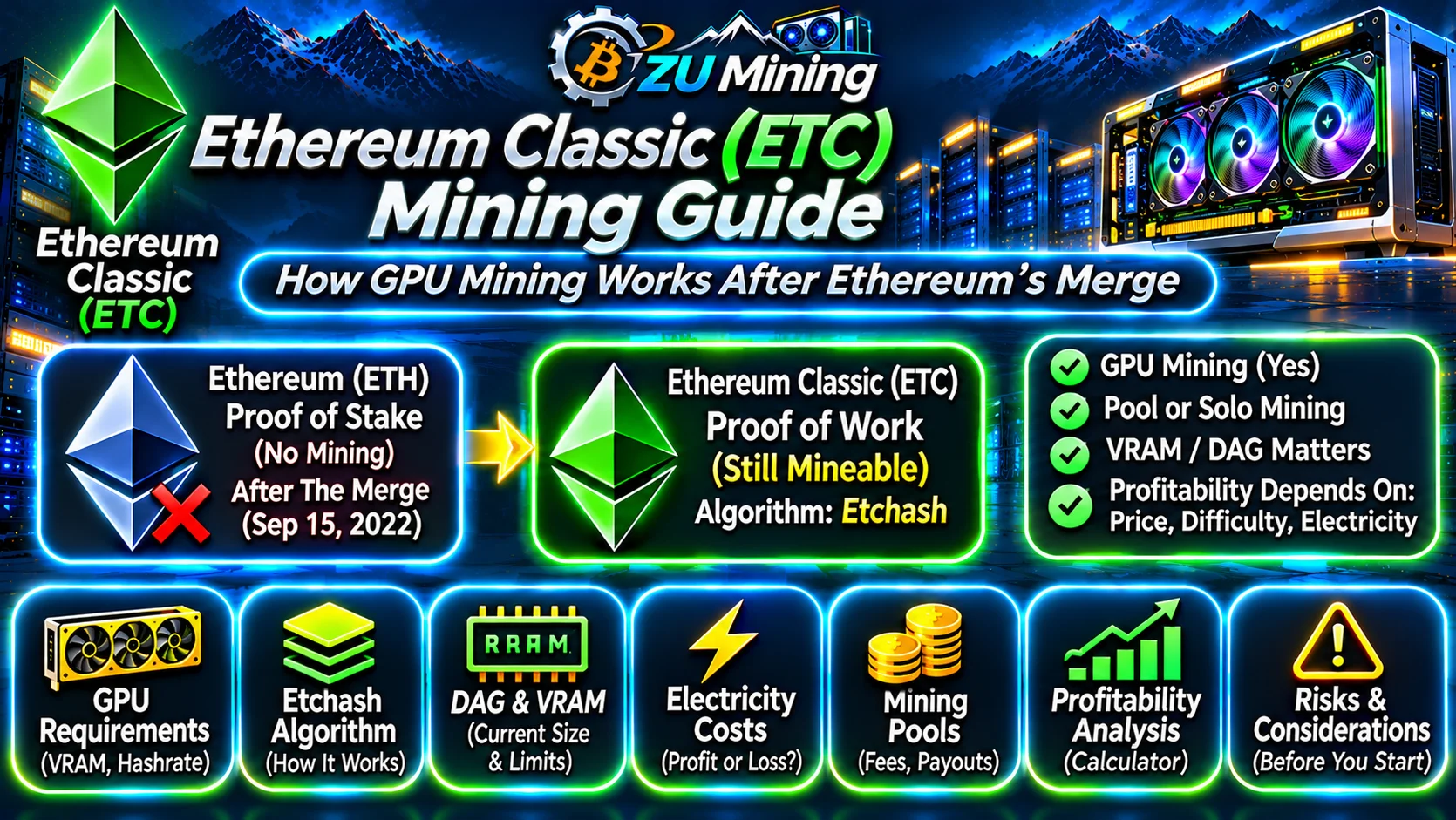
Ethereum Classic (ETC) Mining Guide: How GPU Mining Works After Ethereum’s Merge
When Ethereum ended Proof-of-Work mining in September 2022, millions of graphics cards around the world suddenly lost the cryptocurrency they had primarily been purchased to mine.
Some miners sold their GPUs. Others shut their rigs down. Many began searching for another Proof-of-Work network where their hardware could still be useful.
Ethereum Classic was one of the most obvious alternatives.
The names Ethereum and Ethereum Classic are similar, and both networks share a common history, but they are separate blockchains. Ethereum now uses Proof of Stake and ETH can no longer be mined. Ethereum Classic continues to use Proof of Work, which means ETC can still be mined with compatible hardware.
That does not automatically make ETC profitable.
Before pointing a GPU rig at Ethereum Classic, miners need to understand its algorithm, hardware requirements, electricity consumption, network competition, pool fees and expected revenue.
This guide focuses on those practical questions.
What Is Ethereum Classic?
Ethereum Classic is a Proof-of-Work blockchain with the ticker ETC.
Ethereum and Ethereum Classic share historical roots, but today they operate as independent networks with separate coins, communities, development paths and consensus mechanisms.
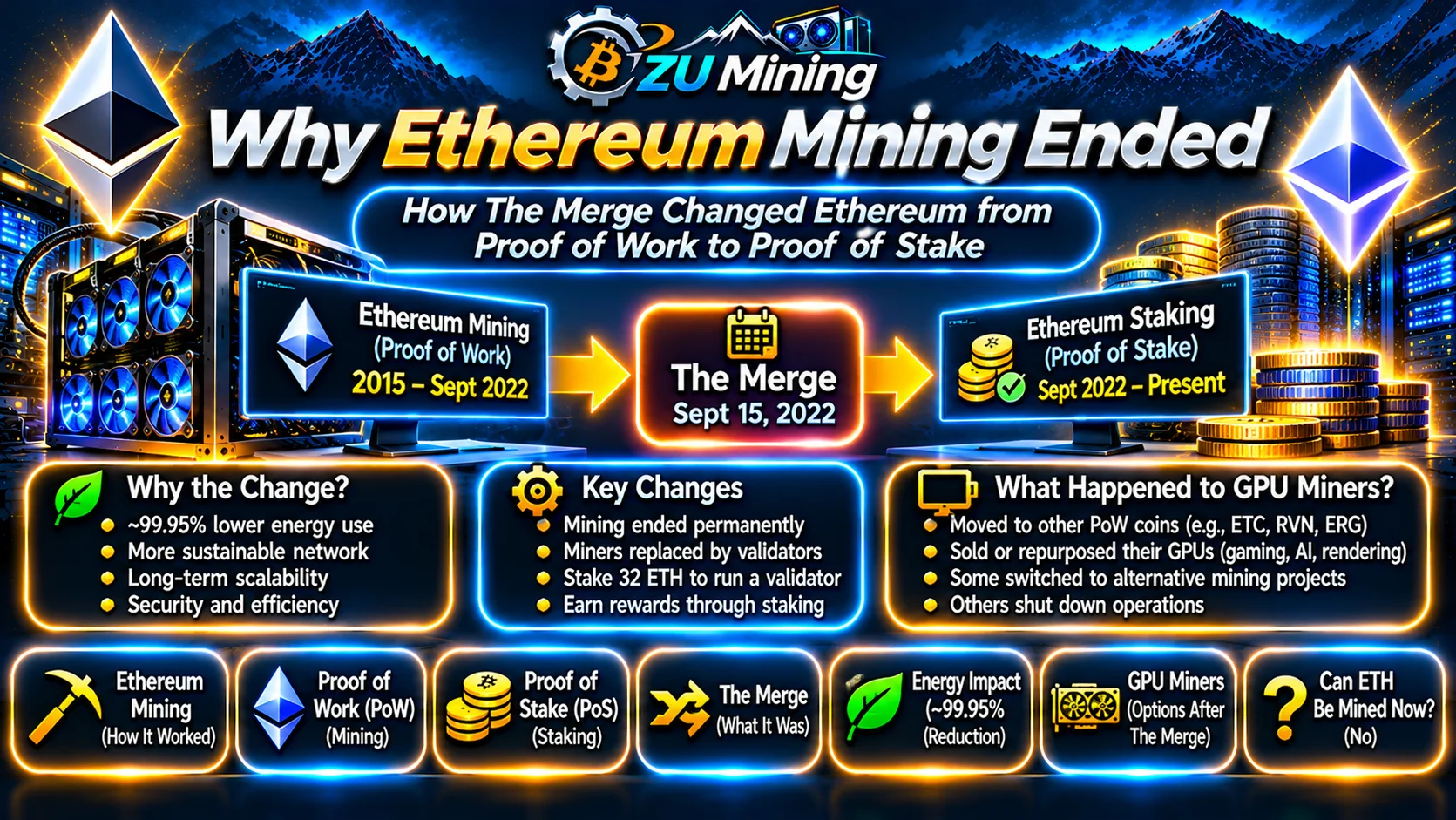
The distinction became especially important after Ethereum completed The Merge. For a comprehensive analysis of that network upgrade, read our guide on Why Ethereum Mining Ended and How The Merge Transformed Crypto Mining.
Ethereum moved from Proof of Work to Proof of Stake.
Ethereum Classic remained a Proof-of-Work network.
This means a miner cannot mine ETH, but compatible mining hardware can still participate in ETC mining.
If you have not read about that transition yet, our guide on why Ethereum mining ended after The Merge explains what changed and why GPU miners lost ETH as a mineable asset.
How Ethereum Classic Mining Works
Ethereum Classic miners contribute computational work to the network.
Mining hardware repeatedly performs calculations while competing to produce valid Proof-of-Work results.
Miners generally connect their hardware to mining software, which then communicates with either a mining pool or a solo-mining setup.
The miner performs work.
Valid shares are submitted to the pool.
The pool tracks contributed work.
When the pool successfully mines blocks, rewards are distributed according to its payout model.
The exact amount an individual miner receives depends on several variables, including hashrate, network difficulty, pool rules and fees.
What Mining Algorithm Does ETC Use?
Ethereum Classic uses Etchash.
Etchash is closely related to the Ethash family of mining algorithms historically associated with Ethereum-style GPU mining.
This matters because the workload is memory intensive.
A GPU's mining performance therefore depends on more than its core clock speed.
Memory bandwidth, VRAM capacity, memory tuning, power configuration and cooling can all affect real-world results.
Two GPUs that perform similarly in gaming do not necessarily produce identical ETC mining efficiency.
ETC Mining and the DAG
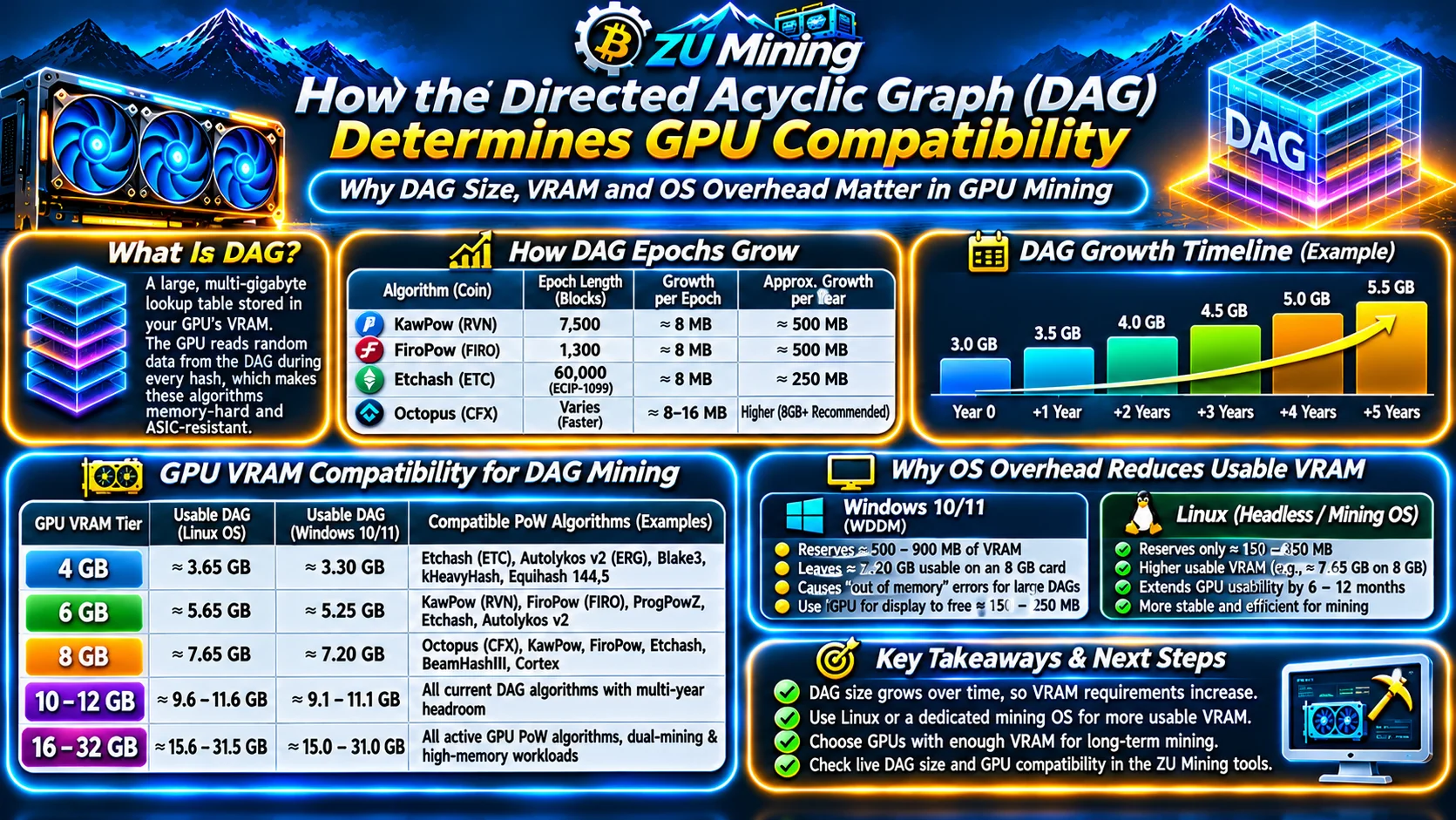
Etchash mining uses a dataset commonly referred to as the DAG.
The DAG changes over time and must fit within the GPU's available usable memory.
This makes VRAM an important consideration when evaluating mining hardware. To understand memory thresholds and epoch allocations for Etchash and other algorithms, consult our GPU VRAM & DAG Size Guide.
A card may have enough raw computing performance to perform the algorithm, but insufficient usable VRAM can eventually prevent it from mining the network normally as the DAG grows.
This is why miners should verify current DAG requirements instead of assuming that an older GPU remains suitable indefinitely.
Our GPU VRAM and DAG Size Guide explains this relationship in more detail.
Can Ethereum Classic Be Mined With GPUs?
Yes.
Ethereum Classic remains a GPU-mineable Proof-of-Work cryptocurrency.
But "mineable" and "profitable" are two very different things.
A GPU can successfully perform ETC mining while still generating less revenue than its electricity costs.
Before starting, compare the card's expected hashrate and wall power against current network conditions.
The ZU Mining GPU Mining Calculator can help estimate mining revenue and electricity costs for supported hardware and coins.
What Determines ETC GPU Performance?
Several factors influence the performance of a GPU on Etchash.
Memory Performance
Etchash is memory intensive, making GPU memory performance important.
VRAM Capacity
The GPU needs enough usable memory for the mining workload and current DAG.
Power Limit
Reducing unnecessary power consumption can improve efficiency even when maximum raw hashrate falls slightly.
Memory Clock
Memory tuning can have a significant impact on performance on memory-intensive algorithms.
Core Settings
Core clock requirements can differ from workloads that depend heavily on GPU compute cores.
Temperature
Excessive temperatures can cause instability, throttling and potentially reduce hardware longevity.
Driver and Mining Software
Different driver and miner combinations can affect stability and reported performance.
Optimization should focus on stable efficiency rather than simply chasing the highest possible hashrate.
Hashrate Is Only Half the Equation
Suppose GPU A produces 60 MH/s while consuming 160 watts.
GPU B produces 55 MH/s while consuming only 110 watts.
GPU A has the higher raw hashrate.
But GPU B may offer better efficiency.
For GPU A:
60 MH/s ÷ 160 W = 0.375 MH/s per watt
For GPU B:
55 MH/s ÷ 110 W = 0.50 MH/s per watt
The second GPU produces less total hashrate but more mining work per watt.
When electricity is expensive, that difference can matter more than a few additional megahashes.
Calculating Electricity Cost
A miner should know the approximate wall power of the entire rig, not just the GPUs. You can model electricity expenses against estimated coin yields using our GPU Mining Profitability Calculator.
Imagine an ETC mining rig drawing 900 watts.
900 watts equals:
0.9 kW
Operating continuously for 24 hours:
0.9 × 24 = 21.6 kWh per day
At an electricity price of $0.05 per kWh:
21.6 × $0.05 = $1.08 per day
At $0.10 per kWh:
21.6 × $0.10 = $2.16 per day
At $0.20 per kWh:
21.6 × $0.20 = $4.32 per day
The same mining rig can therefore move from potentially viable to deeply uncompetitive simply because of electricity pricing.
This is why copying somebody else's mining profitability screenshot is rarely useful without knowing their energy cost.
Revenue Is Not Profit
This distinction is essential.
Suppose a rig earns an estimated $3.00 worth of ETC per day.
That does not mean the miner made $3.00 in profit.
If electricity costs $2.16 per day:
$3.00 revenue - $2.16 electricity = $0.84
And even that $0.84 is not necessarily true net profit.
Other expenses can include:
pool fees,
exchange fees,
hardware depreciation,
cooling,
internet,
maintenance,
downtime,
and infrastructure costs.
The correct question is not simply:
"How much ETC can this GPU mine?"
The better question is:
"What remains after all operating costs?"
Why ETC Profitability Changes
Mining profitability is dynamic.
It can change even when the miner makes no changes to the hardware.
Important variables include:
ETC market price,
network difficulty,
network hashrate,
block rewards,
pool fees,
electricity price,
GPU efficiency,
and hardware uptime.
If ETC's price rises while other conditions remain stable, revenue measured in dollars may increase.
If network competition increases, the same GPU may earn less ETC over time.
Both can happen simultaneously.
This is why mining profitability should be monitored rather than calculated once and forgotten.
What Happened to ETC After Ethereum's Merge?
Ethereum's transition to Proof of Stake created an unusual situation.
A very large amount of GPU mining hardware suddenly needed another workload.
Ethereum Classic was already a recognized Proof-of-Work network and was technically familiar to many Ethereum miners.
As former ETH miners explored ETC and other alternatives, mining competition could change dramatically.
This demonstrated a fundamental rule of mining economics:
More network hashrate does not automatically create more mining rewards for everyone.
More miners can simply mean greater competition for the available rewards.
ETC vs ETH Mining
The difference is now straightforward.
| Feature | Ethereum (ETH) | Ethereum Classic (ETC) |
|---|---|---|
| Consensus | Proof of Stake | Proof of Work |
| GPU Mining | No | Yes |
| Mining Algorithm | None for current ETH consensus | Etchash |
| Miners | Replaced by validators | Still part of network security |
| Staking | Yes | Not the mining mechanism |
| Separate Blockchain | Yes | Yes |
Mining ETC does not produce ETH.
The coins are separate assets.
Choosing an ETC Mining Pool
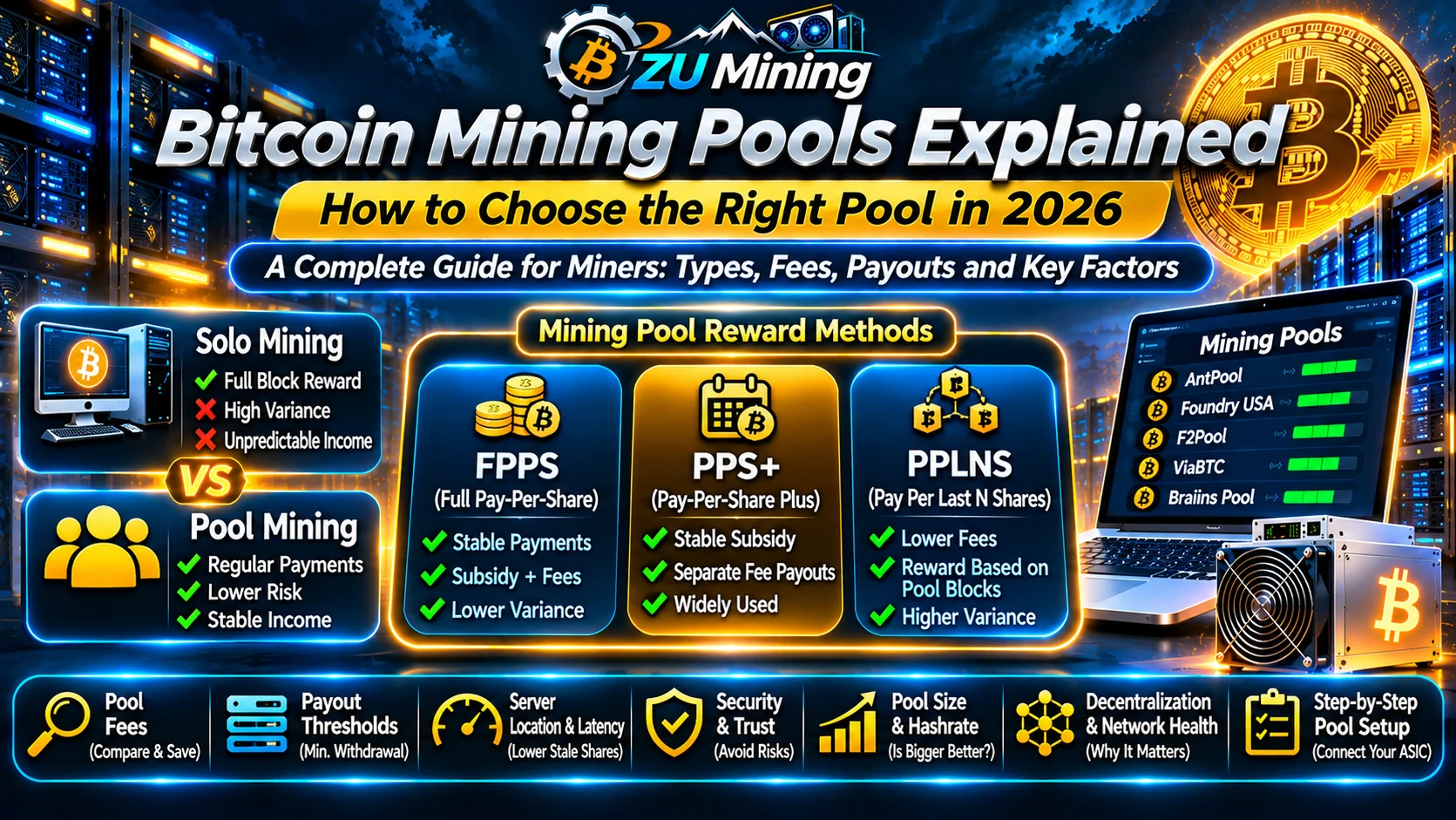
For most small miners, pool mining provides more regular payouts than attempting to find blocks independently. You can research verified pools, stratum latency, and payout schemes in our Verified Mining Pools Directory.
When evaluating an ETC pool, check more than its headline fee.
Important factors include:
pool hashrate,
payout method,
minimum payout,
pool fee,
server locations,
latency,
stale share rate,
payment history,
reliability,
and transparency.
A geographically closer server may reduce communication delay, although latency is only one part of overall mining performance.
Use the ZU Mining Mining Pools Directory to compare available mining pools and their supported coins.
Understanding Mining Shares
When mining through a pool, your GPU does not wait until it independently discovers an entire network block before proving that it has performed work.
Pools assign easier work targets.
When a miner produces results meeting the pool's required target, those results can be submitted as shares.
Shares help the pool estimate how much work each miner contributed.
They are therefore important for payout calculations.
A share is not the same thing as independently mining an ETC block.
Accepted, Rejected and Stale Shares
Mining software often reports different share statistics.
Accepted Shares
The pool accepted the submitted work.
Rejected Shares
The submitted work was rejected.
This can occur for different reasons, including invalid calculations or configuration problems.
Stale Shares
A stale share may occur when work arrives too late because the pool has already moved on to newer work.
Occasional stale shares can occur, but a consistently high stale rate deserves investigation.
Possible causes include poor network connectivity, excessive latency or unstable hardware.
Solo Mining vs Pool Mining
Solo mining and pool mining have different reward characteristics.
A solo miner receives the reward associated with a successfully mined block according to the network's rules, but finding one can be extremely unpredictable for a small miner.
A pool combines the work of many participants and distributes revenue according to its payout system.
This generally reduces payout variance for individual miners.
Neither option changes the physical hashrate of your GPU.
The difference is how mining work and rewards are organized.
Mining Software Matters
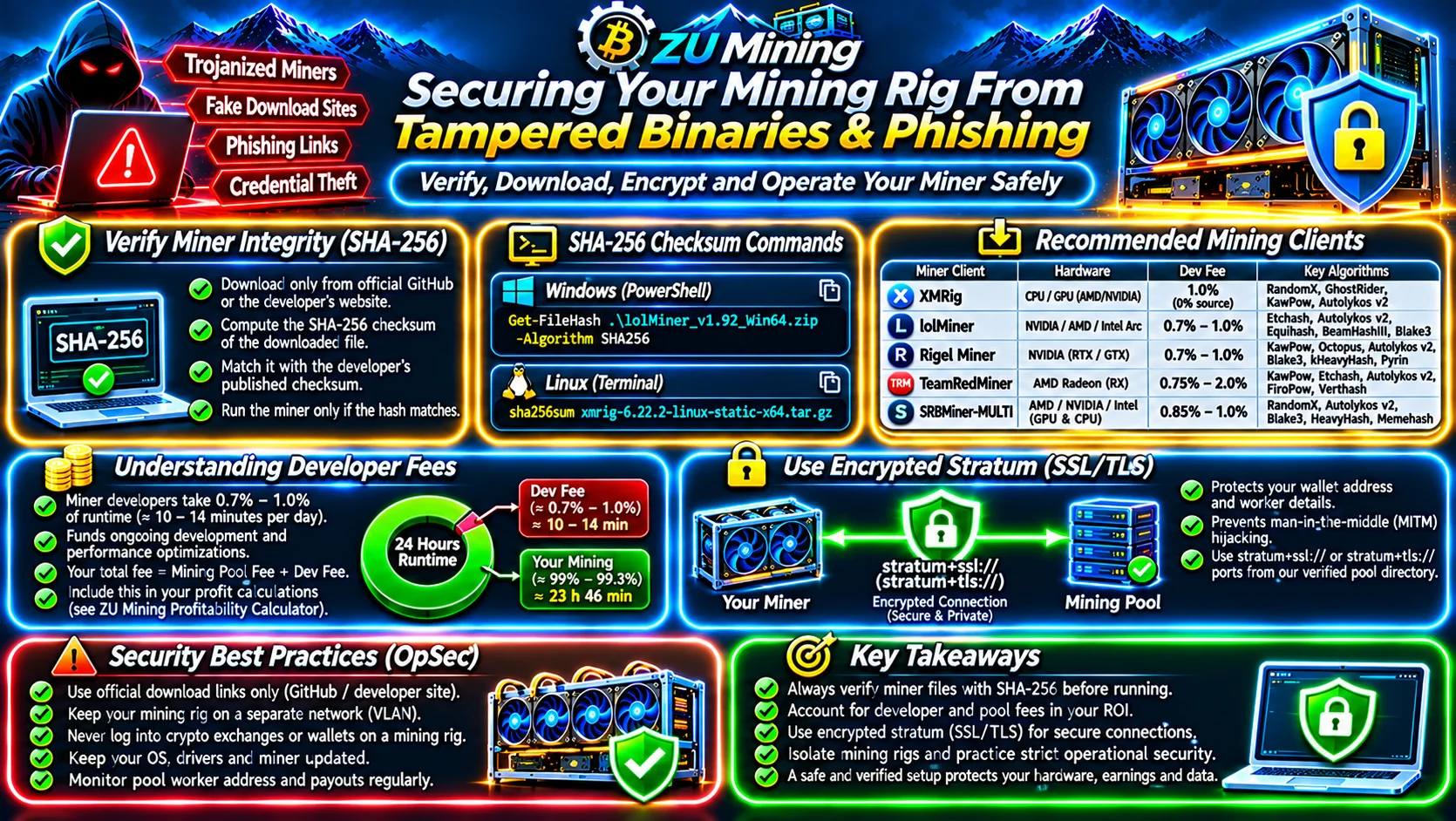
Hardware alone does not mine ETC. A verified, secure mining client is essential; explore vetted software clients and checksum verification details in our Verified Mining Software & Firmware Directory.
A complete setup also requires compatible mining software.
When evaluating mining software, consider:
Etchash support,
developer fees,
GPU compatibility,
operating-system support,
stability,
monitoring features,
and security.
Download mining software from trusted official sources whenever possible.
Modified or fake mining applications can present serious security risks.
Our Mining Software Security Guide covers checksum verification, developer fees and safer software practices.
Do Not Ignore Developer Fees
Some mining applications charge a developer fee.
For example, software might periodically mine for the developer for a small percentage of operating time.
A 1% fee may sound insignificant, but miners should include it when comparing software and calculating long-term economics.
Pool fees and miner software fees are separate costs.
Always check both.
GPU Temperature and Long-Term Stability
A mining rig may operate continuously for days or weeks.
That makes thermal stability important.
Monitor:
GPU core temperature,
memory temperature where available,
fan speed,
room temperature,
power draw,
and rejected-share rates.
Running the absolute highest overclock is not always the best strategy.
A slightly lower hashrate with stable temperatures and fewer errors can be preferable to an unstable configuration producing marginally higher headline performance.
Undervolting for ETC Mining
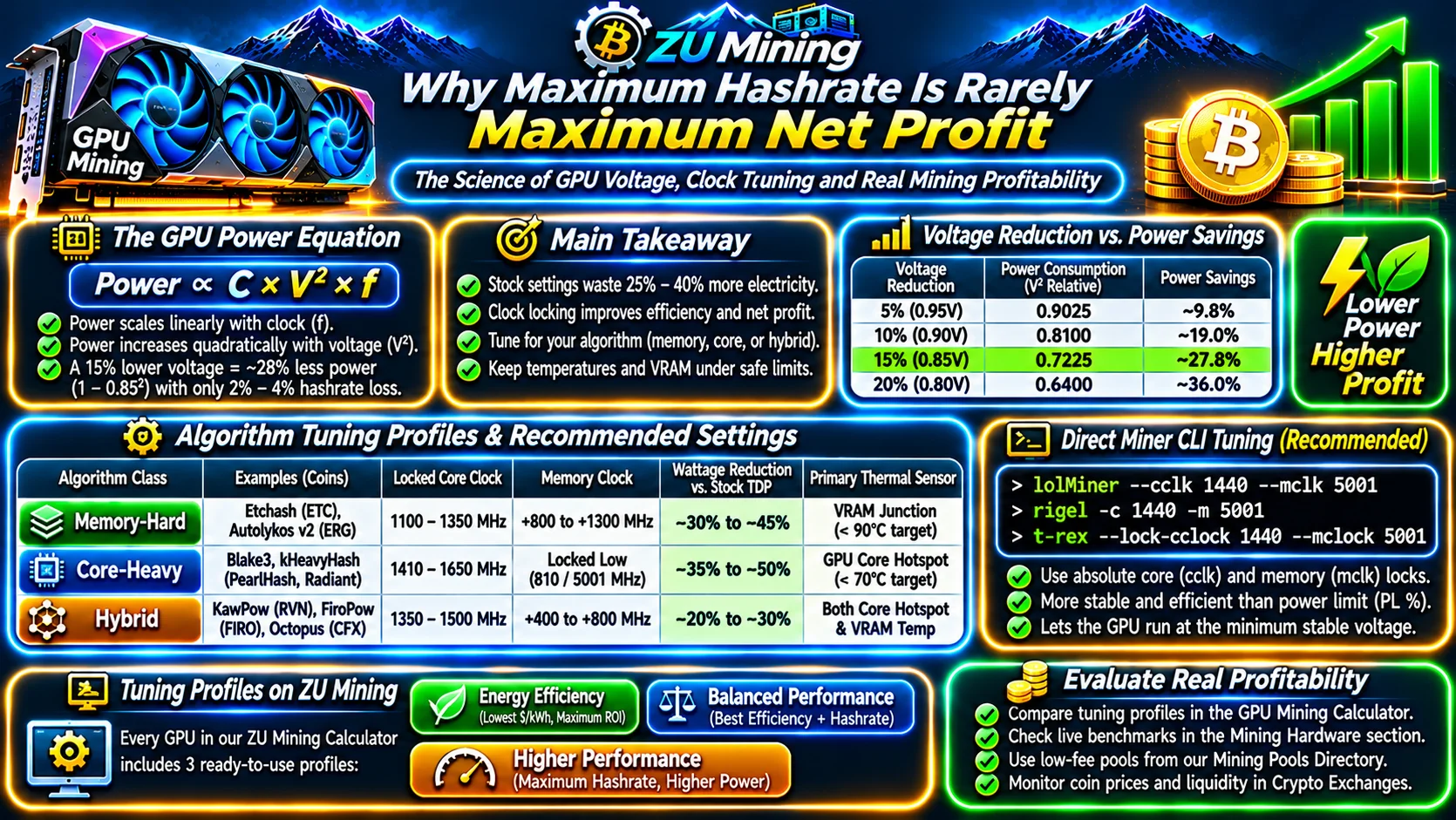
Undervolting attempts to reduce the voltage supplied to the GPU while maintaining stable mining performance. For step-by-step clock locking and power-limit methods, explore our GPU Mining Undervolting & Efficiency Tuning Guide.
When performed appropriately, it can reduce power consumption and heat.
The goal is not simply minimum voltage.
The goal is the lowest practical power configuration that remains stable at the desired hashrate.
An unstable undervolt can cause:
driver crashes,
invalid shares,
system restarts,
and lost mining time.
Efficiency tuning should therefore be tested gradually.
Our GPU Mining Efficiency Tuning Guide provides a broader explanation of power limits, core clocks and memory tuning.
Should You Buy GPUs Specifically for ETC Mining?
This requires much more caution than asking whether existing hardware can mine ETC.
Buying new hardware introduces capital risk.
Suppose a GPU generates a calculated $0.50 per day in operating profit.
A $400 purchase price would theoretically require:
$400 ÷ $0.50 = 800 days
to recover the purchase price.
But that assumes profitability remains unchanged for 800 days.
It almost certainly will not.
Network difficulty, ETC price, electricity costs and hardware performance can all change.
Therefore a simple static payback calculation should be treated as a starting point rather than a prediction.
Existing Hardware vs New Hardware
The economics can be very different.
If you already own a GPU, your decision may primarily involve whether expected revenue exceeds ongoing electricity and operating expenses.
If you are buying a GPU specifically to mine, you must also recover the hardware purchase price.
That is a much higher hurdle.
A miner who already owns paid-off equipment may therefore continue operating under conditions where buying identical hardware new would make little financial sense.
Mining During Unprofitable Periods
Some miners continue mining even when current electricity costs exceed immediate mining revenue because they expect the mined coin to appreciate later.
That is a speculative strategy.
It should not be confused with current mining profitability.
If electricity costs $3 per day and the mined ETC is worth $2 per day at current prices, the operation is producing a negative current cash margin.
The future price of ETC might rise or fall.
A miner should distinguish clearly between:
profitable mining today
and
mining at a current loss while speculating on future price appreciation.
Selling ETC After Mining
Mining revenue is not necessarily spendable cash immediately.
A miner may need to:
receive the pool payout,
transfer ETC,
use a compatible wallet,
deposit it to an exchange,
trade it,
and withdraw funds.
Each step can introduce fees, minimums or other considerations.
Miners should also verify that the services they use support ETC and the correct blockchain network before transferring funds.
Wallet Security Matters
Mining rewards need a secure destination.
Do not select a wallet simply because an address can be generated quickly.
Consider:
private-key control,
backup procedures,
wallet reputation,
device security,
and recovery methods.
Never expose a seed phrase or private key to mining software, pool websites or anyone claiming they need it to configure payouts.
A mining pool normally needs a payout address, not access to your private keys.
Risks of ETC Mining
Ethereum Classic mining carries several categories of risk.
Market Risk
ETC price can move sharply.
Difficulty Risk
Additional mining competition can reduce expected coin production.
Electricity Risk
Energy prices can rise.
Hardware Risk
GPUs, fans, power supplies and other components can fail.
Liquidity Risk
Market conditions can affect the ability to sell mined coins at expected prices.
Protocol Risk
Blockchain rules and development direction can change.
Operational Risk
Downtime, overheating, software problems and internet failures reduce effective mining performance.
Mining profitability should always be viewed alongside these risks.
A Practical ETC Mining Checklist
Before starting, answer these questions:
What is my GPU's realistic Etchash hashrate?
What is the complete rig's wall power?
What is my actual electricity rate?
Does the GPU have sufficient VRAM?
Which pool will I use?
What are its fees and payout rules?
Which mining software will I run?
What developer fee does it charge?
Where will ETC payouts be stored?
What happens to profitability if revenue falls 20%, 30% or 50%?
If a mining plan only works under today's most optimistic assumptions, it has very little margin for error.
Frequently Asked Questions
Is Ethereum Classic still mineable?
Yes. Ethereum Classic continues to use Proof of Work.
Can I mine ETC with a GPU?
Yes, compatible GPUs can mine Ethereum Classic using Etchash.
Can I mine ETH with the same GPU?
No. Ethereum ended Proof-of-Work mining in September 2022.
Is ETC mining profitable?
It depends on your hardware, hashrate, power consumption, electricity price, network conditions, ETC market value and other costs.
How much VRAM is required?
The requirement depends on the current Etchash DAG and usable GPU memory. Miners should check current requirements before configuring older cards.
Is pool mining better than solo mining?
Pools generally provide more regular payouts for smaller miners, while solo mining has much greater reward variance.
Does a higher hashrate always mean a better GPU?
No. Efficiency and electricity consumption can be equally important.
Should I buy a GPU just to mine ETC?
Calculate hardware payback and test less favorable profitability scenarios first. Current profitability does not guarantee future profitability.
Final Thoughts
Ethereum Classic became particularly relevant to GPU miners after Ethereum ended Proof-of-Work mining.
It offers something Ethereum no longer does: a blockchain where compatible mining hardware can still participate directly in Proof-of-Work consensus.
But that does not make ETC an automatic replacement for old Ethereum mining profits.
The mining environment changed.
More competition, changing cryptocurrency prices, electricity costs and hardware efficiency all influence whether operating a GPU rig makes financial sense.
A serious ETC mining decision therefore begins with numbers, not nostalgia for the old Ethereum mining era.
Measure the hardware.
Measure the electricity.
Check current network conditions.
Include fees.
Then calculate the result.
Use the ZU Mining GPU Mining Calculator to estimate current GPU economics, explore other Proof-of-Work assets through the Mineable Coins Directory, compare services in the Mining Pools Directory, and use the Mining Guides Hub for additional hardware and profitability research.
Sources and Further Reading
Ethereum Classic official documentation and network resources.
Ethereum Classic documentation covering Proof of Work and Etchash.
Ethereum documentation covering The Merge and Ethereum's transition to Proof of Stake.
Mining software documentation for supported Etchash miners.
Hardware manufacturer specifications for GPU power and memory characteristics.