What Is Auxiliary Proof-of-Work (AuxPoW) Merged Mining?
Auxiliary Proof-of-Work (AuxPoW) is a cryptographic consensus mechanism that allows a miner's valid computational work on a parent blockchain to be accepted simultaneously as valid proof of work on one or more auxiliary child blockchains that use the same hashing algorithm. In the Scrypt Proof-of-Work ecosystem, Litecoin (LTC) functions as the parent chain, while Dogecoin (DOGE) (which activated AuxPoW at block 371,337 in September 2014) and additional Scrypt chains validate parent block headers.
Instead of splitting Scrypt hashpower across competing blockchains—which would leave lower-market-cap chains vulnerable to 51% hash rentals—AuxPoW allows every Scrypt ASIC in our Mining Hardware Directory to secure both Litecoin and Dogecoin simultaneously.
1. How AuxPoW Block Headers Work at the Protocol Level
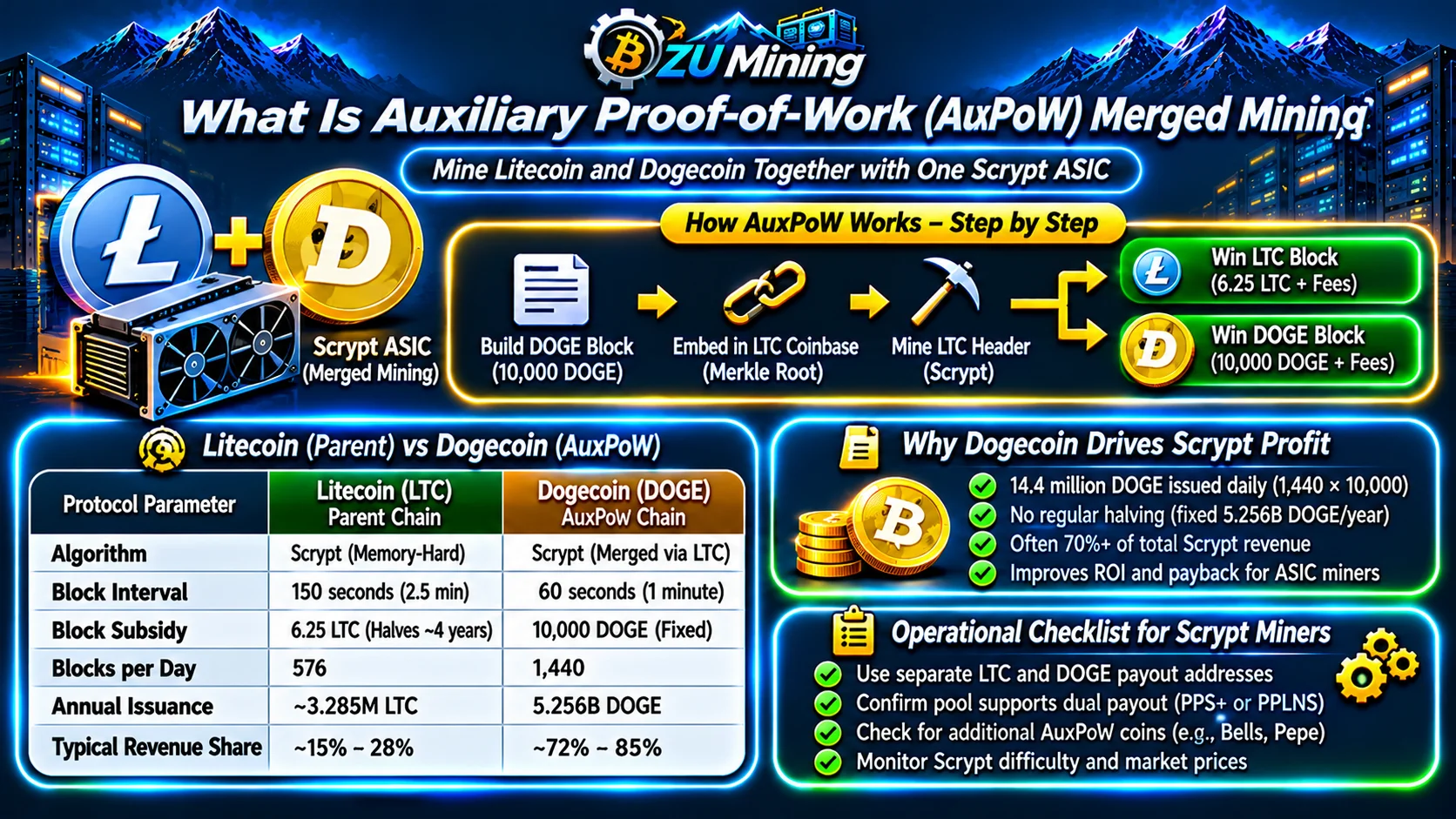
When a Scrypt ASIC miner (such as the Bitmain Antminer L9, Antminer L7, or ElphaPex DG1+) connects to a merged-mining pool, the pool's stratum coordinator constructs two block templates in parallel:
- The pool builds a candidate Dogecoin auxiliary block (containing pending DOGE transactions and a 10,000 DOGE coinbase reward) and hashes its header.
- The pool embeds the 32-byte Merkle root hash of that Dogecoin candidate block inside the
scriptSigcoinbase transaction of a candidate Litecoin parent block. - Your Scrypt ASIC hashes only the 80-byte Litecoin parent block header at its standard wall wattage—requiring zero additional electricity or silicon overhead.
Every nonce solution returned by your ASIC is checked against both difficulty targets: if the hash meets the Litecoin difficulty target, the pool broadcasts the block to the Litecoin network (winning 6.25 LTC + fees); if the hash meets the Dogecoin difficulty target, the pool broadcasts the parent coinbase proof plus the Dogecoin block to the Dogecoin network (winning 10,000 DOGE + fees); and if a hash is strong enough to satisfy both targets, it wins both blocks simultaneously.
| Protocol Parameter | Litecoin (LTC — Parent Chain) | Dogecoin (DOGE — Primary AuxPoW Chain) |
|---|---|---|
| Proof-of-Work Algorithm | Scrypt (Memory-Hard Key Derivation Function) | Scrypt (AuxPoW Merged Mined via Litecoin Header) |
| Target Block Interval | 150 seconds (2.5 minutes / 576 blocks per day) | 60 seconds (1.0 minute / 1,440 blocks per day) |
| Current Block Subsidy | 6.25 LTC (Halves every 840,000 blocks / ~4 years) | 10,000 DOGE per block (Fixed 5.256B DOGE/year issuance) |
| Typical Share of Miner Revenue | ~15% – 28% of daily Scrypt USD yield | ~72% – 85% of daily Scrypt USD yield |
Evaluating Scrypt ASIC Efficiency & Dual-Payout Pools
2. Why Dogecoin Drives Scrypt ASIC Cashflow
Because Dogecoin issues 1,440 blocks/day × 10,000 DOGE = 14,400,000 DOGE every 24 hours without quadrennial halvings, DOGE typically contributes three-quarters or more of a Scrypt miner's daily USD revenue. When modeling hardware payback in the ASIC Mining Profitability Calculator, always evaluate combined LTC + DOGE revenue rather than standalone Litecoin yield (see Litecoin Calculator and Dogecoin Calculator).
3. Comparing Scrypt ASICs and Pool Payout Policies
Modern Scrypt ASICs such as the 16 GH/s Bitmain Antminer L9 (`~0.21 J/MH`) and 14.4 GH/s ElphaPex DG1+ significantly outperform older 9.5 GH/s Antminer L7 units (`~0.36 J/MH`) in watts per megahash. Before connecting your workers, check our Verified Mining Pools Directory and read How to Choose a Crypto Mining Pool to confirm whether the pool credits dual LTC and DOGE via PPS+ or PPLNS.
1) Configure separate self-custody payout addresses for both Litecoin (ltc1q...) and Dogecoin (D...) in your pool account; 2) Verify whether your pool also distributes secondary Scrypt AuxPoW coins (such as Bellscoin or Pepecoin); 3) Monitor live Scrypt difficulty in the Mineable Coins Directory and compare native LTC/DOGE spot markets in our Crypto Exchanges Directory.