How RandomX Preserves CPU Mining Competitiveness
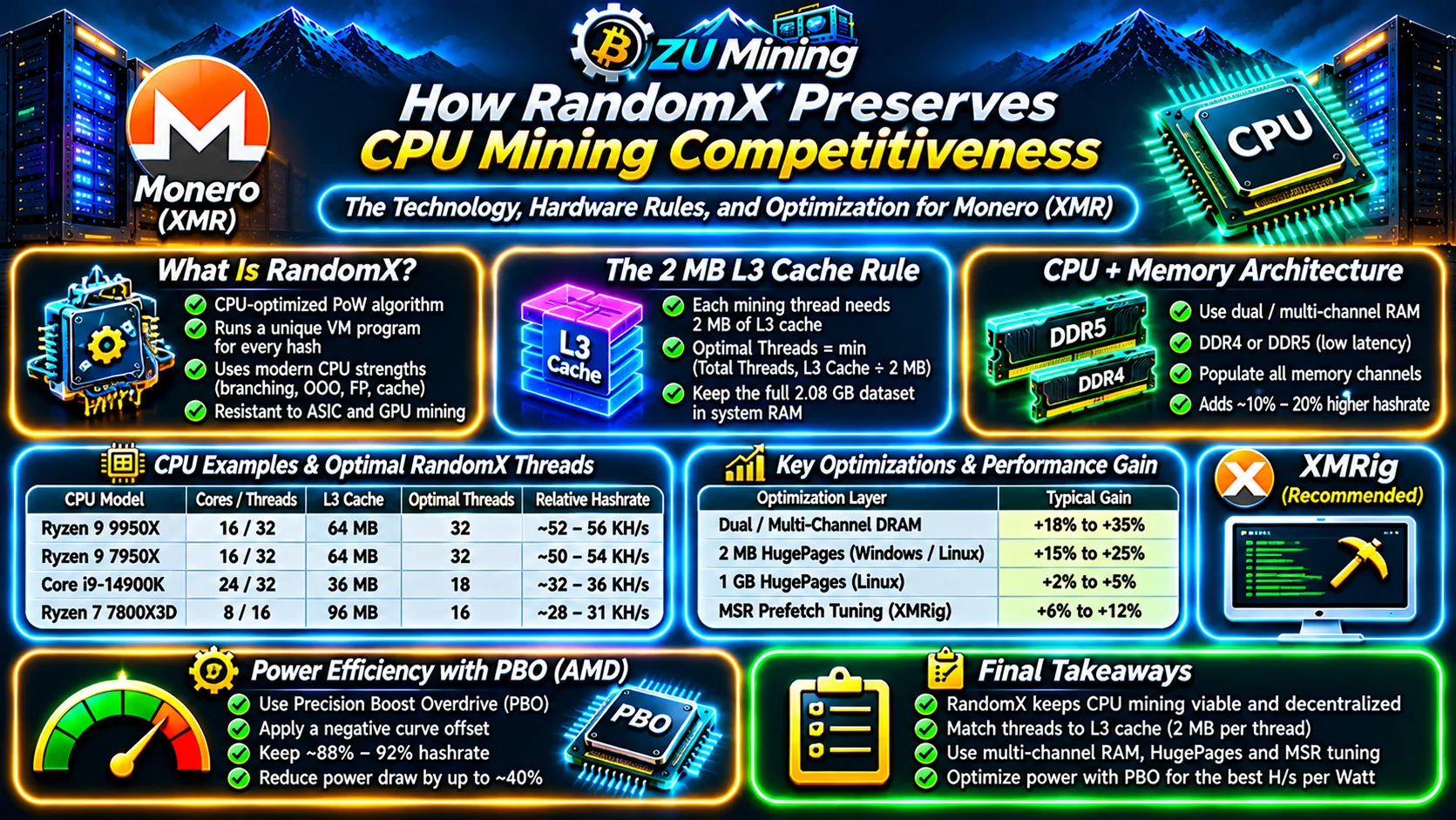
RandomX is the Proof-of-Work algorithm securing Monero (XMR) and several CPU-mineable networks tracked in our Mineable Coins Directory. Unlike fixed hash functions that can be etched into an ASIC or parallelized across thousands of simple GPU shader cores, RandomX generates a unique, randomized Virtual Machine (VM) program for every hash iteration.
Executing a RandomX program stresses the exact silicon subsystems where modern x86_64 and ARM general-purpose CPUs excel: speculative branch prediction, out-of-order superscalar execution, integer and IEEE 754 floating-point math, and ultra-low-latency L3 cache and DRAM access.
1. Hardware Sizing: The 2 MB L3 Cache & Memory Channel Rules
Every active RandomX mining thread requires a dedicated 2 MB scratchpad inside CPU L3 cache, while all threads share read access to a 2,080 MB (~2.08 GB) RandomX dataset stored in system RAM (plus a 256 MB cache):
Optimal RandomX Threads = min( Total CPU Logical Threads, Floor( Total L3 Cache [MB] ÷ 2 MB ) )
- AMD Ryzen 9 7950X / 9950X (16 Cores / 32 Threads, 64 MB L3 Cache):
64 MB ÷ 2 MB = 32slices—allowing all 32 threads to run at full speed. - Intel Core i9-14900K (24 Cores / 32 Threads, 36 MB L3 Cache):
36 MB ÷ 2 MB = 18slices—XMRig automatically restricts mining to 18 threads because running 32 threads would overflow L3 cache into slow system RAM and reduce total hashrate. - Multi-Channel DDR4/DDR5 RAM: Because every thread continuously fetches random lines from the 2.08 GB dataset in RAM, populating all memory channels (dual-channel on desktop AM4/AM5; quad-, 8-, or 12-channel on Threadripper and EPYC servers) with tight CAS latency timings adds 10%–20% to total KH/s.
| Optimization Layer | Operating System / Hardware Action | Measured Hashrate Gain |
|---|---|---|
| Dual/Multi-Channel DRAM | Populate matched DIMM slots (never mine RandomX on single-channel RAM) | +18% to +35% vs. Single-Channel |
| 2 MB HugePages (Windows / Linux) | Enable Windows Lock Pages in Memory or Linux vm.nr_hugepages=1280 |
+15% to +25% vs. 4 KB standard pages |
| 1 GB HugePages (Linux Kernel) | Enable 1gb_pages: true in XMRig with kernel hugepagesz=1G |
+2% to +5% additional TLB reduction |
| MSR Hardware Prefetch Tuning | Run XMRig as Administrator / root with wrmsr enabled |
+6% to +12% on AMD Zen 2/3/4/5 |
Configuring HugePages, MSR Registers & CPU Undervolting
2. Enabling HugePages and MSR Mods in XMRig
By default, operating systems allocate memory in tiny 4 KB virtual pages—requiring over 530,000 page table entries to map the 2.08 GB RandomX dataset and causing constant CPU Translation Lookaside Buffer (TLB) misses. Enabling 2 MB HugePages (on Windows or Linux) or 1 GB HugePages (on Linux) maps the entire dataset into just a few page descriptors. Running XMRig from our Verified Mining Software Directory with Administrator or sudo privileges also applies Model Specific Register (MSR) prefetch tweaks automatically.
Running an AMD Ryzen 9 processor at stock boost voltages often draws 170W–230W at the wall. Using BIOS Precision Boost Overdrive (PBO) negative curve offsets or fixing PPT/TDC/EDC power limits (`e.g. 95W–115W Eco Mode`) typically retains ~88%–92% of peak RandomX hashrate while cutting wall wattage by nearly 40%. Model your exact CPU wattage and hashrate in the CPU Mining Profitability Calculator, check compatible motherboards in the Smart Mining Rig Builder, and compare low-fee pools and exchanges in our Mining Pools Directory and Crypto Exchanges Directory.