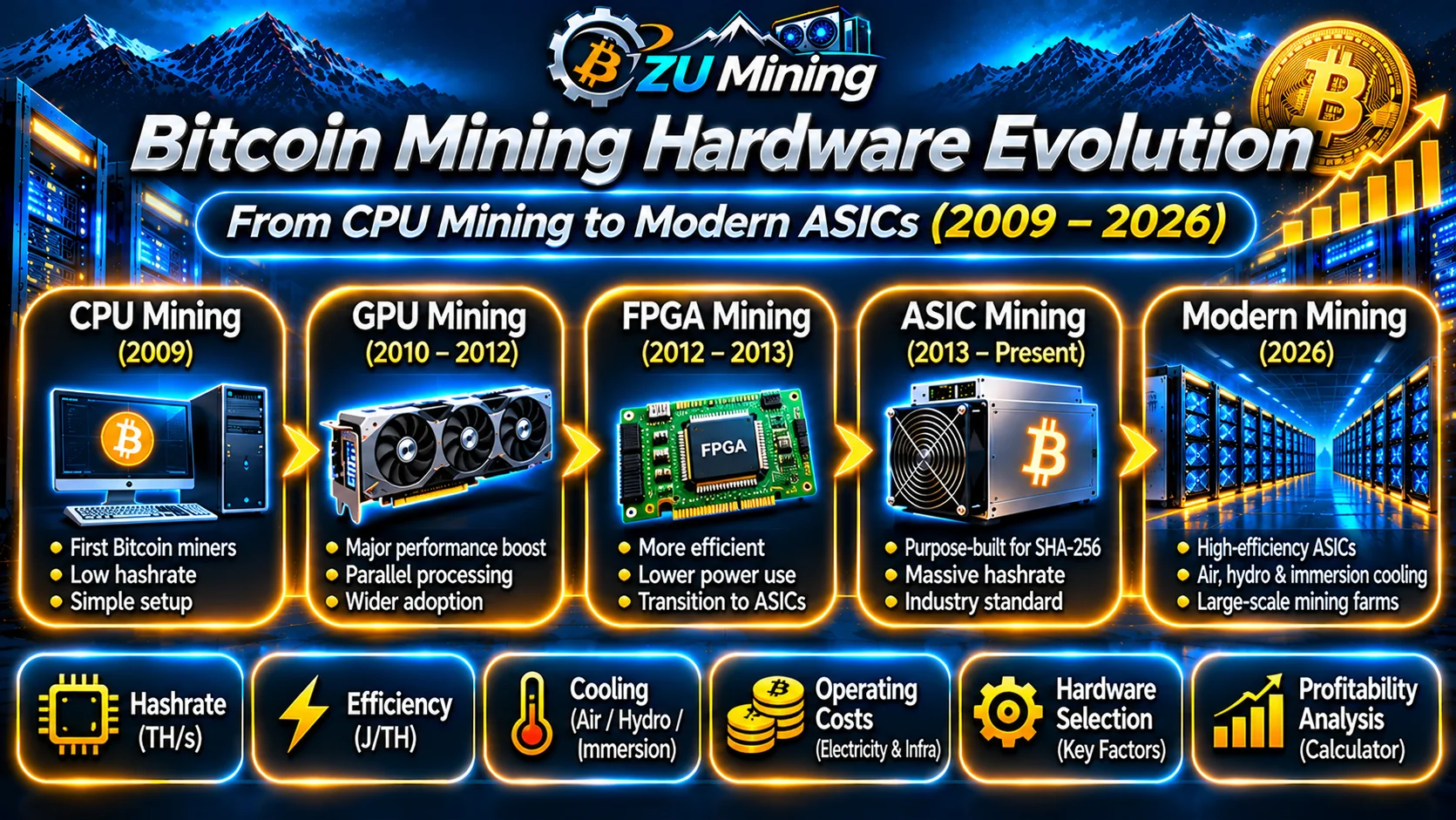
Bitcoin Mining Hardware Benchmark & Efficiency Evolution (2009–2026)
Bitcoin mining in 2026 looks almost nothing like it did when the network started.
Today, a competitive Bitcoin miner is usually a purpose-built machine containing specialized chips, powerful cooling fans and a power supply designed to operate continuously. Modern mining facilities can contain hundreds or thousands of these machines running around the clock.
Go back to 2009 and the situation was dramatically different.
Bitcoin could be mined on an ordinary computer using its CPU. There were no commercial Bitcoin ASIC miners, no enormous industrial mining farms and no mature global market for mining equipment.
While our companion guide on The Evolution of Bitcoin Mining Hardware details the chronological history of mining milestones, this analysis benchmarks the quantitative performance metrics, electrical efficiency ratings (measured in Joules per Terahash, J/TH), and cooling innovations that transformed mining from desktop hobbyist rigs into an industrial-scale computing discipline.
Understanding this benchmark trajectory explains why raw hashrate alone never guarantees profitability. Instead, energy efficiency per hash, power delivery constraints, and thermal dissipation architectures dictate long-term operational viability across shifting difficulty cycles.
CPU Era Benchmarks (2009): The Kh/s Baseline and Initial Power Draw
When the Bitcoin network launched in January 2009, mining was performed using general-purpose computer processors.
CPU stands for Central Processing Unit.
It is the main processor responsible for executing general computing instructions inside a computer.
Early Bitcoin software allowed users to participate in mining directly from their computers. At the time, network competition was extremely small compared with today's network.
Bitcoin.org notes that in Bitcoin's early days, users could find blocks using their computer CPUs.
This worked because Bitcoin mining had not yet become a specialized industry.
There were relatively few miners competing for blocks, and the amount of computational power securing the network was tiny by modern standards.
What did early miners receive?
During Bitcoin's first reward era, a successfully mined block carried a 50 BTC block subsidy.
That sounds enormous when viewed through later Bitcoin prices, but those early bitcoins did not have anything resembling today's established market value.
Early mining was largely experimental.
People were running the software, testing the network and participating in a new peer-to-peer monetary system whose future was highly uncertain.
Why CPUs Eventually Became Too Slow
Bitcoin uses SHA-256 proof of work.
Mining involves repeatedly hashing candidate block headers while changing values such as the nonce in an attempt to produce a hash that satisfies Bitcoin's current proof-of-work target.
There is no shortcut that lets a miner calculate the winning hash directly.
Mining equipment performs enormous numbers of hashing attempts.
That means mining naturally rewards hardware capable of calculating hashes faster and more efficiently.
As additional miners joined Bitcoin, competition increased.
An ordinary CPU was no longer competing only with other ordinary CPUs.
A new type of hardware soon demonstrated that it could perform Bitcoin's hashing workload much faster.
That hardware was the GPU.
GPU Mining Performance Benchmarks (2010): The Shift to Megahashes and Parallel Efficiency
GPU stands for Graphics Processing Unit.
GPUs were originally developed primarily for graphics workloads. Rendering computer graphics requires performing large numbers of calculations in parallel.
That parallel-processing capability also made GPUs useful for certain computational workloads.
Bitcoin's SHA-256 mining workload could take advantage of this architecture far more effectively than general-purpose CPUs available at the time.
The result was a major jump in mining performance.
A miner using optimized GPU hardware could potentially calculate far more hashes per second than someone relying on a CPU.
This created an obvious competitive advantage.
As GPU mining became established, CPU mining rapidly lost its practical competitiveness for Bitcoin.
CPU vs GPU Bitcoin Mining
The transition can be understood by comparing the design philosophy of the two processors.
A CPU is designed to handle a broad variety of computing tasks.
A GPU contains many processing units designed to perform large amounts of parallel work. For a detailed comparison of processing architectures, see our ASIC vs. GPU vs. CPU Mining Hardware Guide.
For Bitcoin mining, the ability to repeat hashing calculations at high speed was more valuable than the CPU's general-purpose flexibility.
| Hardware | Primary Purpose | Bitcoin Mining Role |
|---|---|---|
| CPU | General computing | Early Bitcoin mining |
| GPU | Parallel computing and graphics | Major early performance upgrade |
| FPGA | Configurable specialized logic | Efficiency-focused transition |
| ASIC | Dedicated SHA-256 mining | Modern Bitcoin mining standard |
The table represents the broad technological progression rather than exact dates when every miner changed hardware.
Mining generations overlapped as new technology became available.
The Mining Arms Race Begins
GPU mining changed more than performance.
It changed the economics of Bitcoin mining.
Once some miners could produce significantly more hashes than others, remaining competitive required better hardware.
Miners started paying closer attention to:
hashrate,
electricity consumption,
hardware prices,
cooling,
equipment reliability,
and mining difficulty.
Bitcoin mining was gradually moving away from a casual background process on an ordinary computer and toward a specialized computing activity.
That transition accelerated with the arrival of FPGA miners.
FPGA Efficiency Metrics: The Bridge to Specialized Hash-Per-Watt Architecture
FPGA stands for Field-Programmable Gate Array.
An FPGA is a semiconductor device whose internal logic can be configured for specific computational workloads after manufacturing.
For miners, this offered an important advantage.
Instead of using a processor designed primarily for general computing or graphics, an FPGA could be configured much more specifically for SHA-256 hashing.
FPGA mining therefore represented another step toward specialized Bitcoin hardware.
Why FPGAs mattered
The major attraction was not simply raw hashrate.
Efficiency was becoming increasingly important.
A miner wants to perform as much useful hashing work as possible while consuming as little electricity as practical.
FPGAs demonstrated that specialized hardware could provide meaningful improvements in performance per watt.
But they were not the final stage.
If configurable hardware could outperform general-purpose processors, a chip designed specifically and permanently for Bitcoin's hashing workload could potentially perform even better.
That led to ASIC mining.
ASIC Benchmark Breakthrough: From Gigahashes to Terahashes Per Watt
ASIC stands for Application-Specific Integrated Circuit.
Unlike CPUs and GPUs, an ASIC is designed for a particular purpose.
Bitcoin mining ASICs are built specifically to perform SHA-256 proof-of-work calculations efficiently.
This specialization changed Bitcoin mining permanently.
Bitcoin.org describes modern Bitcoin mining as a competitive activity using specialized hardware.
Once commercially viable ASIC miners entered the market, GPUs could no longer realistically compete in Bitcoin SHA-256 mining on efficiency.
ASICs delivered vastly more hashing performance while improving the amount of work produced per unit of electricity.
Bitcoin mining had entered the specialized-hardware era.
Why ASICs Beat GPUs at Bitcoin Mining
A GPU must remain flexible.
It needs to support graphics rendering, compute workloads and many different operations.
A Bitcoin ASIC does not need that flexibility.
Its circuitry can be optimized around the SHA-256 hashing workload required for Bitcoin proof of work.
That specialization allows manufacturers to focus heavily on three important characteristics:
Hashrate
How many hashing calculations the machine can perform each second.
Power consumption
How much electrical power the miner draws while operating.
Efficiency
How much energy is required to produce a given amount of hashrate.
For modern Bitcoin miners, efficiency is particularly important.
Understanding TH/s
Modern Bitcoin ASIC performance is commonly expressed in terahashes per second.
One terahash represents one trillion hashes. You can calculate estimated yield across hashrate tiers with our ASIC Mining Profitability Calculator
Therefore:
1 TH/s = 1,000,000,000,000 hashes per second.
A 200 TH/s ASIC is theoretically performing approximately:
200,000,000,000,000 hashes every second.
Even that enormous number does not guarantee that the miner will discover a Bitcoin block.
Mining remains probabilistic.
Higher hashrate simply increases the miner's expected share of mining work relative to the network.
Why J/TH Matters So Much
Hashrate alone does not tell you whether a miner is efficient.
Suppose two machines both produce 200 TH/s.
Miner A consumes 4,000 watts.
Miner B consumes 3,000 watts.
Their electrical efficiencies are:
Miner A:
4,000 W ÷ 200 TH/s = 20 J/TH
Miner B:
3,000 W ÷ 200 TH/s = 15 J/TH
Miner B performs the same amount of hashing while consuming considerably less electrical power.
That difference becomes extremely important when machines operate 24 hours a day.
The Electricity Cost Example
Consider the same 3,000-watt miner.
3,000 watts equals 3 kW.
Operating continuously:
3 kW × 24 hours = 72 kWh per day
At $0.06 per kWh:
72 × $0.06 = $4.32 per day
At $0.10 per kWh:
72 × $0.10 = $7.20 per day
At $0.15 per kWh:
72 × $0.15 = $10.80 per day
The machine itself has not changed.
Only the electricity tariff changed.
Yet the difference between $4.32 and $10.80 per day can fundamentally alter mining economics.
This is why mining hardware should never be evaluated solely by advertised hashrate.
Miners can compare hardware and electricity assumptions using the ZU Mining Profitability Calculator.
From Home Computers to Mining Farms
Early Bitcoin mining could take place on an ordinary personal computer.
Modern industrial Bitcoin mining can require an entirely different environment.
ASIC miners generate substantial heat.
They can also produce considerable noise because high-speed fans must move large volumes of air through the machines.
Running large numbers of ASICs therefore requires infrastructure.
A professional operation may need:
high-capacity electrical distribution,
ventilation,
airflow engineering,
network connectivity,
equipment monitoring,
fire protection,
maintenance procedures,
and sometimes specialized cooling systems.
At larger scales, mining becomes an infrastructure and energy-management operation as much as a computing operation.
Air Cooling
Traditional Bitcoin ASIC miners commonly use high-speed fans.
Cooler air enters the machine, passes across heatsinks attached to mining chips and exits carrying the generated heat.
The principle is straightforward, but operating hundreds of miners makes airflow management much more complicated.
Poor airflow can cause hot exhaust air to recirculate into miner intakes.
This raises operating temperatures and can reduce equipment stability.
Facilities therefore often separate cooler intake areas from hotter exhaust areas.
Immersion Cooling
Some mining operations use immersion cooling.
Instead of cooling the equipment directly with large volumes of air, compatible mining hardware is immersed in a non-conductive dielectric fluid.
Heat transfers from the mining components into the fluid.
A cooling system then removes that heat.
Immersion can reduce dependence on the small high-speed fans normally installed on air-cooled miners and can offer different approaches to heat management.
However, immersion systems require additional equipment and engineering.
They are not automatically the best option for every miner.
Capital cost, maintenance, climate and facility design all matter.
Hydro-Cooled ASIC Miners
Another development in modern Bitcoin mining is liquid-cooled ASIC hardware.
These systems circulate coolant through dedicated cooling components associated with the miner.
Liquid can transport heat efficiently and may allow manufacturers to operate dense mining hardware at high performance levels.
However, hydro mining introduces additional infrastructure requirements.
Operators may need pumps, heat exchangers, plumbing, coolant management and appropriate monitoring.
The miner should therefore be evaluated as part of the entire system rather than as a standalone box.
Why Newer Hardware Does Not Automatically Mean More Profit
A common mistake is assuming that the newest ASIC must be the most profitable purchase.
That is not necessarily true.
Suppose an older miner is already owned and fully paid for.
A newer machine might deliver much better efficiency but require a large upfront investment.
The miner must determine whether the electricity savings and additional revenue justify the acquisition cost.
Important factors include:
purchase price,
shipping,
import costs,
electricity rate,
expected uptime,
network difficulty,
pool fees,
maintenance,
cooling infrastructure,
and potential resale value.
Mining profitability is the result of the entire operating model.
Hardware Price vs Efficiency
Imagine two ASIC options.
| Metric | ASIC A | ASIC B |
|---|---|---|
| Hashrate | 150 TH/s | 220 TH/s |
| Power | 3,300 W | 3,300 W |
| Efficiency | 22 J/TH | 15 J/TH |
| Purchase Cost | $1,500 | $4,500 |
ASIC B is clearly more efficient and provides substantially more hashrate.
But it also costs three times as much in this hypothetical example.
Whether it is the better investment depends on expected revenue and operating conditions over the machine's useful life.
This is why miners should calculate payback scenarios rather than buying equipment based only on headline hashrate.
Network Difficulty Changes the Hardware Equation
Bitcoin automatically adjusts mining difficulty as computational power enters or leaves the network.
When more hashrate competes for the same block rewards, an individual machine's expected share of Bitcoin production can decrease.
A machine that appears profitable when purchased may produce less BTC per day later if mining competition rises.
This does not mean the hardware became defective.
The competitive environment changed.
Miners should therefore model more than today's conditions.
ZU Mining's mining calculator can help compare hardware under different electricity and profitability assumptions.
Halvings Put Additional Pressure on Hardware
Bitcoin's block subsidy began at 50 BTC and is reduced every 210,000 blocks. The current subsidy following the 2024 halving is 3.125 BTC.
Each halving reduces the newly issued Bitcoin available per block.
For mining operations, this can make efficiency even more important.
Older hardware with high electricity consumption may become difficult to operate economically unless electricity is inexpensive or other conditions are favorable.
More efficient equipment can potentially survive narrower operating margins.
This is one reason Bitcoin's hardware evolution continues.
Why GPUs Still Matter in Cryptocurrency Mining
ASIC dominance in Bitcoin does not mean GPUs became useless.
GPUs continue to have applications in other computational workloads and several active Proof-of-Work networks. You can explore mineable GPU cryptocurrencies in our Mineable Coins Directory.
The important distinction is that Bitcoin uses SHA-256 and has an established market of specialized SHA-256 ASIC hardware.
A GPU cannot economically compete with a modern Bitcoin ASIC simply because both devices can technically perform calculations.
For miners evaluating other proof-of-work coins, the hardware situation may differ.
Visit the ZU Mining GPU Mining Calculator to compare supported GPU-mined assets and estimated operating economics.
Can You Still Mine Bitcoin With a CPU?
Technically, a CPU can perform SHA-256 hashing.
Economically competitive Bitcoin mining is a different question.
Modern specialized hardware performs vastly more hashing work than ordinary consumer CPUs.
Bitcoin.org explains that increasing competition made specialized hardware the cost-effective approach to Bitcoin mining.
A CPU miner's chance of independently finding a block on today's Bitcoin network would therefore be extraordinarily small.
CPU mining remains historically important because that is where Bitcoin mining began.
It is no longer representative of modern competitive Bitcoin mining.
Can You Mine Bitcoin With a Gaming GPU in 2026?
A GPU can technically calculate SHA-256 hashes.
That does not make it economically competitive with purpose-built Bitcoin ASIC hardware.
Modern SHA-256 ASICs are specifically optimized for the workload.
Someone with a gaming PC should not compare its general computing specifications directly with an ASIC's mining specifications.
They are fundamentally different types of hardware.
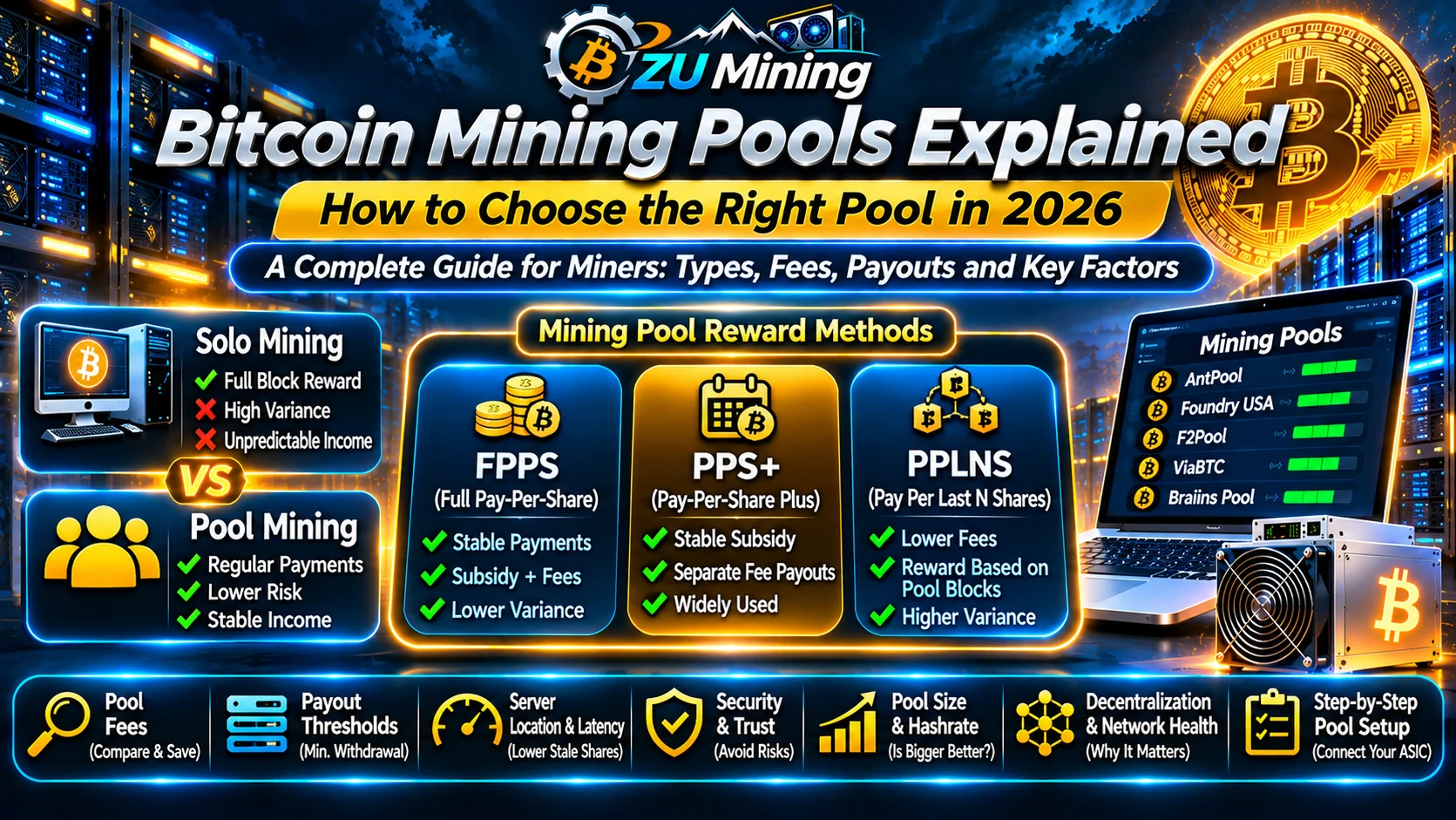
Why Mining Pools Became Important
As Bitcoin difficulty and total network hashrate grew, finding a block became increasingly difficult for individual miners.
Mining pools allow many miners to contribute hashrate together.
When the pool earns mining revenue, payments can be distributed according to its payout system and participants' contributed work.
A pool does not make an ASIC faster.
It changes the way mining revenue and variance are distributed.
Solo mining can produce highly irregular outcomes, particularly for miners with a tiny fraction of network hashrate.
Pool mining can provide more frequent payments, although fees and payout rules vary.
Miners can compare available services through the ZU Mining Mining Pools Directory.
What to Check Before Buying an ASIC
Hashrate is only the beginning.
Before evaluating a Bitcoin ASIC, operators can research verified specifications and efficiency benchmarks in the Mining Hardware Directory & Smart Rig Builder. Always check:
Power Consumption
Determine the machine's actual wattage.
Efficiency
Calculate or verify its J/TH rating.
Electricity Price
Use your actual all-in electricity tariff where possible.
Electrical Capacity
A high-powered ASIC may require electrical infrastructure different from an ordinary household device.
Noise
Industrial mining hardware can be very loud.
Heat
Nearly all electrical power consumed by a miner ultimately becomes heat that must be managed.
Cooling Requirements
Determine whether the machine uses air, hydro or another cooling architecture.
Pool Compatibility
Confirm the mining setup is compatible with the pool and firmware you intend to use.
Seller Reputation
Mining equipment can represent a substantial investment. Verify sellers carefully before making purchases.
Expected Economics
Estimate revenue using current network conditions and test less favorable scenarios as well.
The Hardware Efficiency Race: Analyzing J/TH Benchmarks Across Node Shrinks
Bitcoin mining hardware evolution can be viewed as a continuing search for more hashes per unit of energy.
CPU mining demonstrated that ordinary computers could secure the network.
GPU mining introduced large-scale parallel computation.
FPGAs demonstrated the value of increasingly specialized logic.
ASICs took specialization much further.
Modern hardware development continues to focus on semiconductor processes, chip design, power delivery, thermal management and system-level efficiency.
The fundamental economic pressure remains simple:
produce more useful hashing work while spending less money doing it.
What Comes After Today's ASICs?
Predicting future mining hardware precisely is difficult.
ASICs already represent highly specialized hardware for Bitcoin's SHA-256 proof of work.
Future improvements are therefore likely to depend on several areas rather than a completely different general-purpose processor replacing ASICs.
Potential improvements include:
more efficient semiconductor designs,
better chip packaging,
improved power delivery,
more advanced cooling,
higher equipment density,
firmware optimization,
and better facility-level energy management.
Not every experimental technology will become commercially successful.
Bitcoin's mining industry ultimately rewards solutions that can deliver reliable hashing performance at economically sustainable costs.
Bitcoin Mining Hardware Benchmark & Efficiency Evolution Matrix (2009–2026)
| Era / Year | Hardware Architecture | Typical Benchmark Hashrate | Typical Power Draw | Energy Efficiency (J/TH or equiv.) | Benchmark Significance |
|---|---|---|---|---|---|
| 2009 | Desktop CPU (e.g. Core 2 Duo) | 1 – 5 KH/s | 65W – 115W | ~20,000,000 J/GH | Initial software baseline on general-purpose x86 compute |
| 2010–2011 | Discrete GPU (e.g. Radeon 5870) | 300 – 450 MH/s | 180W – 250W | ~500,000 J/GH | 100x efficiency jump via massively parallel SIMD execution |
| 2011–2012 | FPGA Array (e.g. Spartan-6) | 200 – 800 MH/s | 20W – 45W | ~50,000 J/GH | Configurable logic slashed power per hash by 3x–5x |
| 2013–2015 | Early ASIC (130nm – 28nm) | 100 GH/s – 1 TH/s | 300W – 1,000W | 1,000 – 2,000 J/TH | Fixed SHA-256 state machines replaced programmable logic |
| 2016–2019 | Mature ASIC (16nm – 7nm) | 14 – 50 TH/s | 1,300W – 2,200W | 40 – 100 J/TH | Industrial consolidation; Antminer S9 set the 100 J/TH standard |
| 2020–2023 | High-Density ASIC (7nm – 5nm) | 90 – 140 TH/s | 3,000W – 3,500W | 20 – 35 J/TH | Thermal engineering and custom microcode enabled sustained sub-30 J/TH |
| 2024–2026 | Sub-3nm & Liquid ASICs | 200 – 450+ TH/s | 3,500W – 5,800W | 11 – 17.5 J/TH | Hydro and immersion loops push density beyond 400 TH/s per chassis |
The dates represent broad technological eras. Different hardware generations overlapped during transitions.
Frequently Asked Questions
What hardware was originally used to mine Bitcoin?
Bitcoin was originally mined using ordinary computer CPUs.
Why did miners switch from CPUs to GPUs?
GPUs could perform Bitcoin's repetitive hashing workload much faster than general-purpose CPUs available at the time.
What came after GPU mining?
FPGA mining became an important transitional stage before dedicated ASIC miners became dominant.
What is a Bitcoin ASIC?
A Bitcoin ASIC is an Application-Specific Integrated Circuit designed specifically for Bitcoin's SHA-256 mining workload.
What is the primary benchmark metric for modern Bitcoin mining hardware?
In modern mining, Joules per Terahash (J/TH) is the definitive efficiency benchmark. While total terahashes (TH/s) indicates hashing throughput, J/TH measures how many joules of electrical energy are consumed to compute one terahash. A miner running at 15 J/TH can survive higher difficulty levels and lower hashprices far longer than a higher-hashrate unit running at 30 J/TH.
Is a higher TH/s number always better?
Not by itself. Power consumption, J/TH efficiency, equipment price and operating expenses must also be considered.
What does J/TH mean?
Joules per terahash measures how much energy mining hardware requires to perform a given amount of hashing work. Lower values generally indicate greater electrical efficiency. To understand power supply efficiency and tariff calculations in detail, see our guide on Mining Electricity Costs and Power Efficiency.
Can Bitcoin still be mined with GPUs?
A GPU can technically perform SHA-256 calculations, but modern Bitcoin mining is dominated by specialized ASIC hardware.
What is the best Bitcoin miner?
There is no universally best miner. The answer depends on electricity cost, equipment price, efficiency, infrastructure and network conditions.
Final Thoughts
Bitcoin mining's journey from CPUs to modern ASICs shows how quickly competition can transform a technology.
In 2009, an ordinary computer could participate meaningfully in Bitcoin mining.
GPU miners then demonstrated the advantage of parallel computing.
FPGAs pushed mining toward specialized hardware.
ASICs completed the transition into an industry built around machines designed specifically for SHA-256 proof of work.
Today, raw hashrate is only part of the story.
Electrical efficiency, cooling, infrastructure, acquisition cost and network difficulty can determine whether a powerful miner is economically useful.
That is why comparing Bitcoin mining hardware requires more than asking which machine has the highest TH/s.
The better question is how much productive hashrate the machine can deliver for its total cost over time.
Use the ZU Mining Profitability Calculator to test hardware and electricity assumptions, explore the ZU Mining Hardware Directory to compare mining equipment, and review the Mining Pools Directory when evaluating pool-based mining.
References and Further Reading
Bitcoin.org, Frequently Asked Questions: Bitcoin Mining.
Bitcoin.org, Bitcoin Halving and Block Reward Schedule.
Bitcoin Developer Documentation, Mining and Proof of Work.
Satoshi Nakamoto, Bitcoin: A Peer-to-Peer Electronic Cash System.