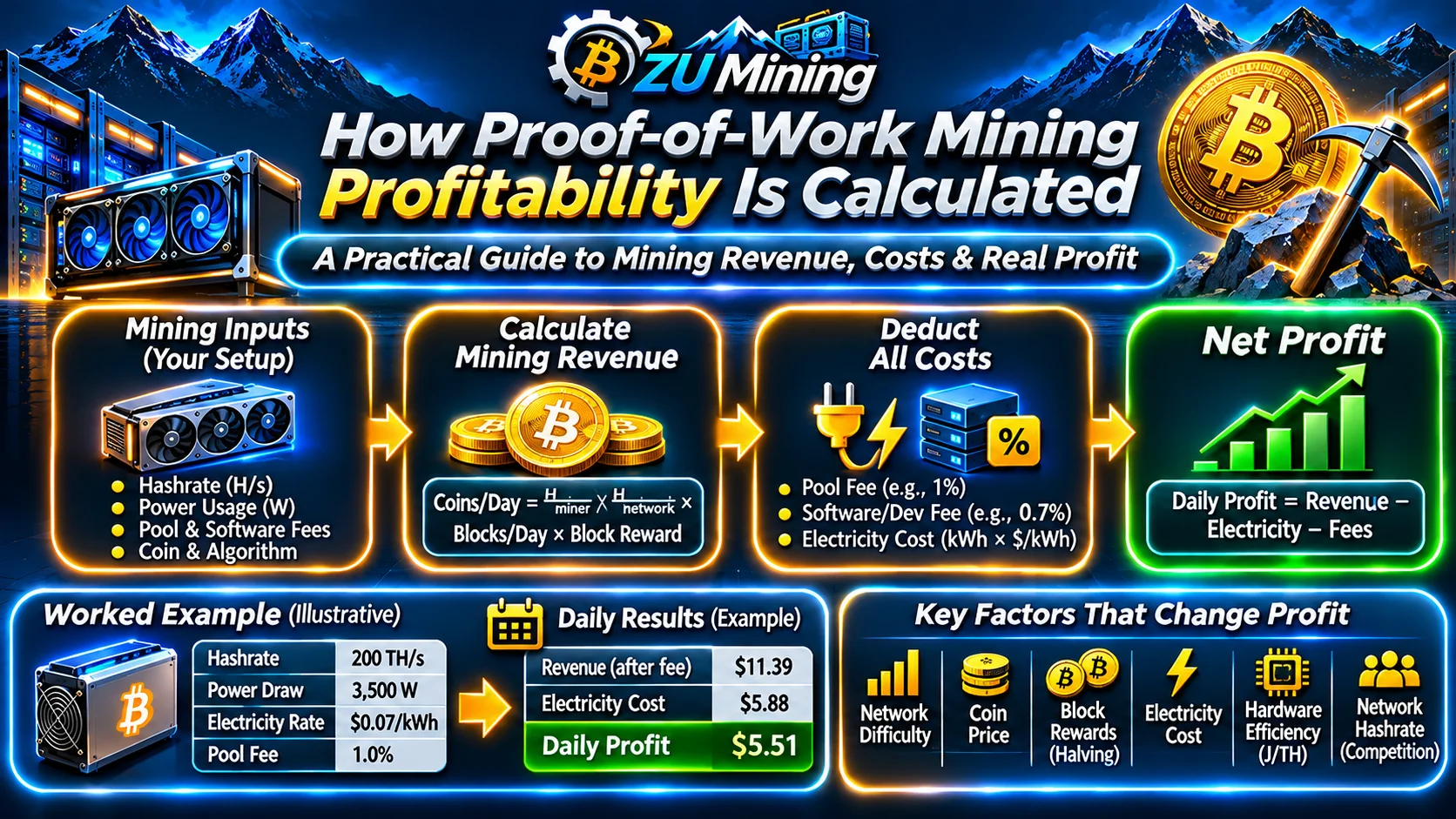
How Proof-of-Work Mining Profitability Is Calculated
Mining profitability is not simply the value of the coins a miner produces. A machine can generate cryptocurrency every day and still operate at a loss once electricity, pool fees, software fees, and other operating costs are included.
For Bitcoin ASICs, Scrypt miners, GPU rigs, and CPU miners, the basic calculation follows the same principle: estimate how much of the network's mining work your hardware contributes, calculate the expected mining reward, convert that reward into a monetary value, and subtract the cost of running the equipment.
The easiest way to test these variables with current network and hardware data is the ZU Mining Profitability Calculator. Understanding the calculation behind the result, however, is important before buying hardware or committing to a long-term hosting contract.
The Basic Mining Profitability Formula
At its simplest, daily mining profit can be expressed as:
Daily Mining Profit = Mining Revenue − Electricity Cost − Mining Fees
That looks straightforward, but each part depends on several variables.
Mining revenue changes with network difficulty, network hashrate, block rewards, transaction fees, coin price, and the miner's own hashrate. Electricity cost depends on actual wall power rather than the manufacturer's ideal specification. Pool and software fees reduce the amount that ultimately reaches the miner.
This is why comparing miners only by hashrate can be misleading.
A faster machine is not automatically a more profitable machine.
Step 1: Estimate Your Share of the Network Hashrate
One practical way to understand expected mining output is to compare your miner's hashrate with the total network hashrate.
The simplified relationship is:
Miner Share = Miner Hashrate ÷ Network Hashrate
If a miner represents 0.001% of the total computational work being performed by a network, its long-term expected share of mining rewards is also approximately 0.001%, before pool fees and other deductions.
Expected daily coin production can then be estimated as:
Gross Coins per Day = Miner Hashrate ÷ Network Hashrate × Blocks per Day × Reward per Block
The number of blocks expected each day is:
Blocks per Day = 86,400 ÷ Average Block Time in Seconds
This approach is particularly useful because it makes the economics easy to visualize. When the network hashrate increases while your miner remains unchanged, your share of the network becomes smaller.
That generally means fewer coins produced by the same machine.
Step 2: Calculate Output From Network Difficulty
Mining calculators may also derive expected output directly from network difficulty.
For Bitcoin-style difficulty calculations, a commonly used approximation is:
Expected Coins per Day = Miner Hashrate × 86,400 × Block Reward ÷ (Difficulty × 2³²)
The value 2³², equal to 4,294,967,296, is part of the relationship between Bitcoin's published difficulty and the expected number of hashes required to find a valid block.
This formula should not be copied blindly to every Proof-of-Work blockchain.
Different networks define and expose difficulty differently. Algorithms such as SHA-256, Scrypt, RandomX, KawPow, Etchash, and kHeavyHash can require different network-specific handling when converting published difficulty into expected mining output.
For that reason, a profitability calculator should use the difficulty convention of the specific blockchain rather than assuming that every network uses Bitcoin's difficulty representation.
Hashrate Units Must Be Converted Correctly
One of the easiest ways to produce a completely incorrect mining estimate is to mix hashrate units.
Common units include:
| Unit | Symbol | Hashes per Second | Common Use |
|---|---|---|---|
| Kilohash | KH/s | 1,000 | Some CPU-oriented workloads |
| Megahash | MH/s | 1,000,000 | Many GPU mining algorithms |
| Gigahash | GH/s | 1,000,000,000 | Scrypt ASICs and some specialized hardware |
| Terahash | TH/s | 1,000,000,000,000 | Bitcoin SHA-256 ASICs and other high-throughput ASICs |
| Petahash | PH/s | 10¹⁵ | Large mining operations and network statistics |
| Exahash | EH/s | 10¹⁸ | Large blockchain network hashrates |
A 200 TH/s Bitcoin miner therefore represents:
200 × 10¹² H/s
The miner's hashrate and the network hashrate must be converted to compatible units before comparing them.
Step 3: Account for Pool Fees
Most individual miners do not mine blocks completely on their own.
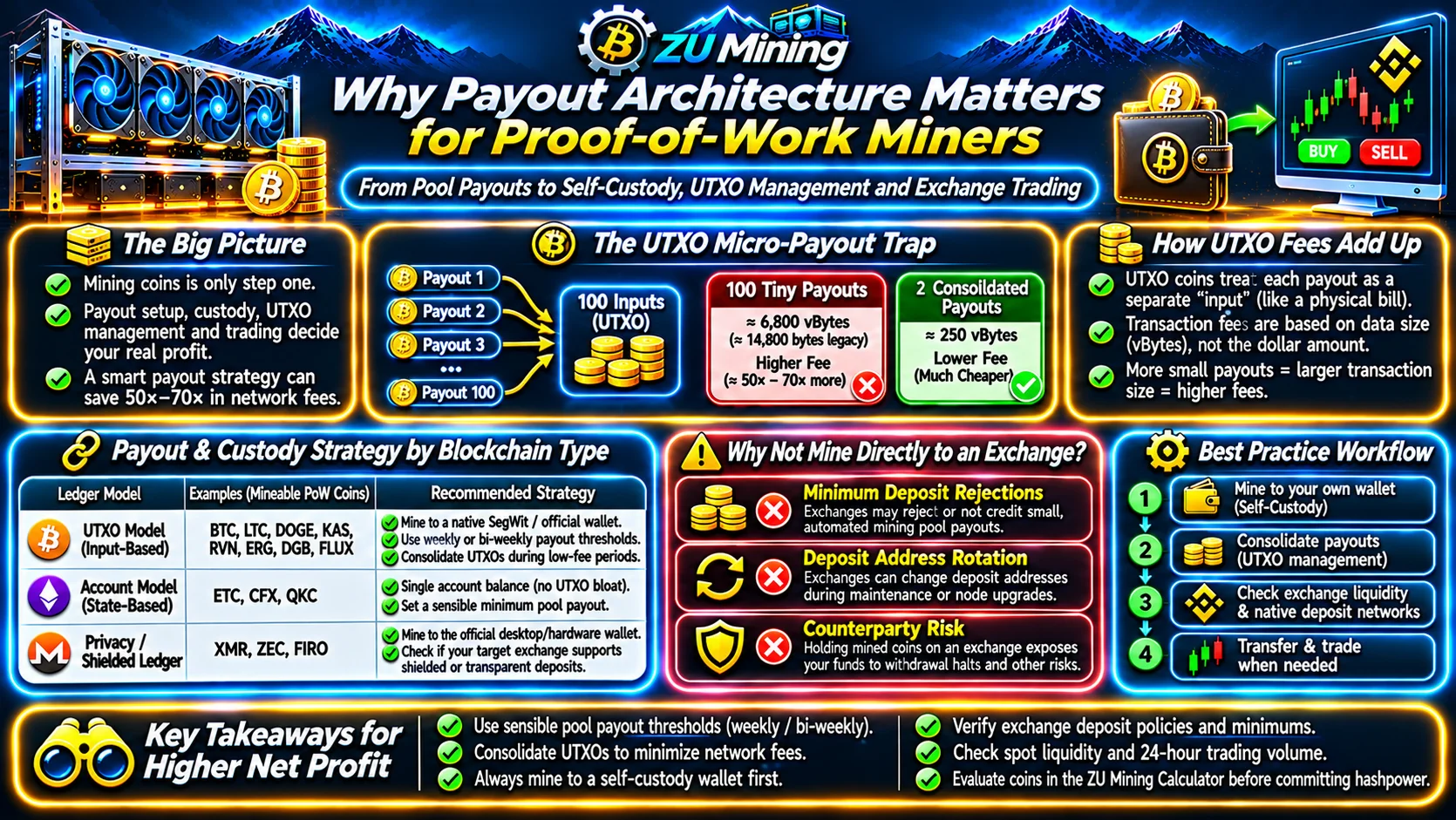
Solo mining exposes a small miner to enormous payout variance because finding a block is probabilistic. Instead, miners commonly contribute their hashrate to a pool and receive smaller, more frequent payouts according to the pool's reward system.
You can compare operators in the ZU Mining Pools Directory.
If a pool charges a 1% fee:
Revenue After Pool Fee = Gross Mining Revenue × 0.99
A miner producing $10.00 of gross revenue would therefore retain approximately $9.90 before considering electricity and other costs.
The actual payout can also depend on the pool's payment model. FPPS, PPS+, PPLNS, and similar systems handle block rewards, transaction fees, and mining variance differently.
Our Cryptocurrency Mining Pool Guide explains these payout models in more detail.
Step 4: Include Mining Software Fees Where Applicable
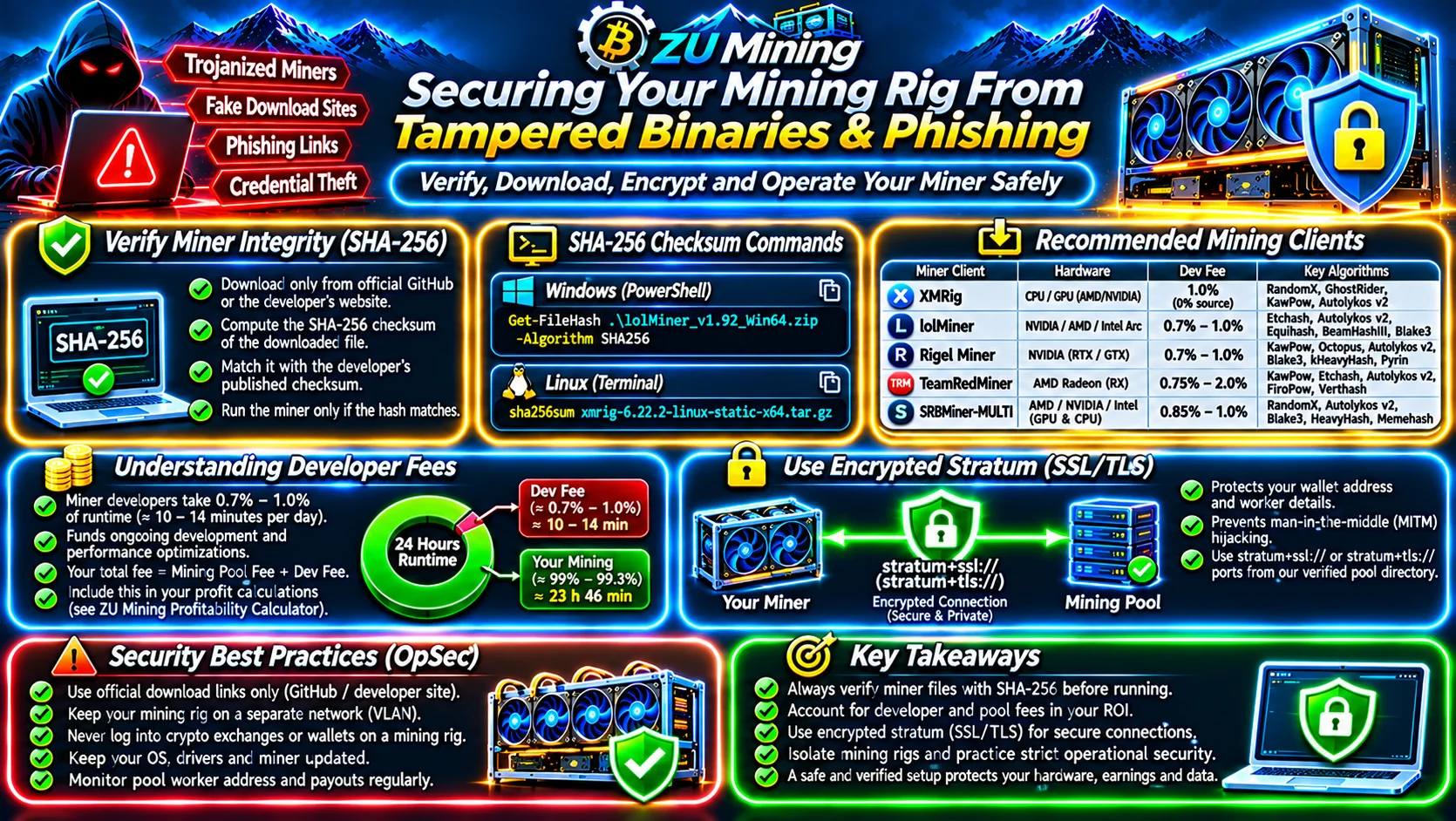
Some mining applications charge a developer fee.
This is more common with certain GPU and CPU mining programs than with dedicated ASIC firmware, although fee structures vary by software and vendor.
Suppose a miner has:
Pool fee: 1%
Software developer fee: 0.7%
A simplified estimate would be:
Net Coins = Gross Coins × (1 − 0.01) × (1 − 0.007)
Do not automatically assume that every miner has a developer fee. Check the actual software or firmware being used.
The ZU Mining Software & Firmware Directory can be used when comparing mining applications and supported hardware.
Step 5: Calculate the Real Electricity Cost
Electricity is often the largest recurring expense in Proof-of-Work mining.
The daily energy consumption of a miner is:
Daily Energy (kWh) = Wall Power in Watts × 24 ÷ 1,000
Daily electricity expense is then:
Daily Electricity Cost = Daily Energy × Electricity Rate per kWh
Consider an ASIC drawing 3,500 watts.
Its daily consumption is:
3,500 × 24 ÷ 1,000 = 84 kWh per day
At an electricity rate of $0.07/kWh:
84 × $0.07 = $5.88 per day
Over 30 days, that becomes approximately:
$5.88 × 30 = $176.40
This expense exists regardless of whether the cryptocurrency price rises or falls.
For a deeper look at electricity tariffs, efficiency, and break-even calculations, see Understanding Mining Electricity Costs and Break-Even Rates.
A Practical ASIC Profitability Example
Consider a hypothetical SHA-256 ASIC with the following specifications:
Hashrate: 200 TH/s
Wall power: 3,500 W
Efficiency: 17.5 J/TH
Electricity rate: $0.07/kWh
Pool fee: 1%
For illustration, assume current network conditions and coin price result in an estimated gross mining revenue of $11.50 per day.
This $11.50 figure is only an example. It is not intended to represent a current Bitcoin mining revenue estimate.
First calculate the pool deduction:
$11.50 × 0.99 = $11.385
The miner therefore retains approximately $11.39 in revenue after the 1% pool fee.
Its electricity expense is:
3,500 W × 24 ÷ 1,000 = 84 kWh
84 kWh × $0.07 = $5.88
Estimated daily operating profit becomes:
$11.385 − $5.88 = $5.505
Rounded to the nearest cent:
Estimated Daily Profit = $5.51
Under these assumptions, the machine is profitable before considering additional expenses such as hosting charges, maintenance, downtime, cooling, taxes, financing, or hardware depreciation.
Finding the Electricity Break-Even Rate
The same example can be used to calculate the maximum electricity rate the miner could theoretically pay before electricity alone consumes all mining revenue.
The formula is:
Break-Even Electricity Rate = Daily Revenue After Fees ÷ Daily kWh Consumption
Using the example:
$11.385 ÷ 84 = approximately $0.1355/kWh
At roughly 13.6 cents per kWh, electricity would consume the entire estimated mining revenue.
That does not mean 13.6 cents is a sensible operating rate. A real mining business needs margin for hardware costs, failures, cooling, maintenance, downtime, and changing network conditions.
Why Mining Profitability Changes
A profitability result should be treated as a snapshot rather than a guaranteed future return.
Several important variables are constantly moving.
Network Difficulty
When more mining power joins a network, protocols with difficulty adjustment mechanisms eventually make block discovery harder.
Your machine may continue producing exactly the same hashrate while earning fewer coins.
Cryptocurrency Price
Mining revenue is earned in cryptocurrency, while electricity bills are normally paid in fiat currency.
A change in market price can therefore turn a profitable machine into an unprofitable one without any change to its hashrate or electricity consumption.
Block Rewards
Proof-of-Work networks can change issuance according to their protocol rules.
Bitcoin's block subsidy, for example, is reduced during scheduled halving events.
Transaction Fees
Some networks include transaction fees as an important part of miner revenue. Their contribution can vary significantly depending on network activity.
New Mining Hardware
A new generation of ASICs can provide more hashrate per watt than older equipment.
When efficient hardware enters the network at scale, older miners can become less competitive even if they remain technically functional.
Efficiency Can Matter More Than Raw Hashrate
Two miners should not be compared only by their advertised hashrate.
For ASIC mining, efficiency is commonly expressed in joules per terahash:
J/TH = Power Consumption in Watts ÷ Hashrate in TH/s
Our hypothetical 3,500 W, 200 TH/s machine operates at:
3,500 ÷ 200 = 17.5 J/TH
Lower J/TH generally means less electricity is required for the same amount of SHA-256 computation.
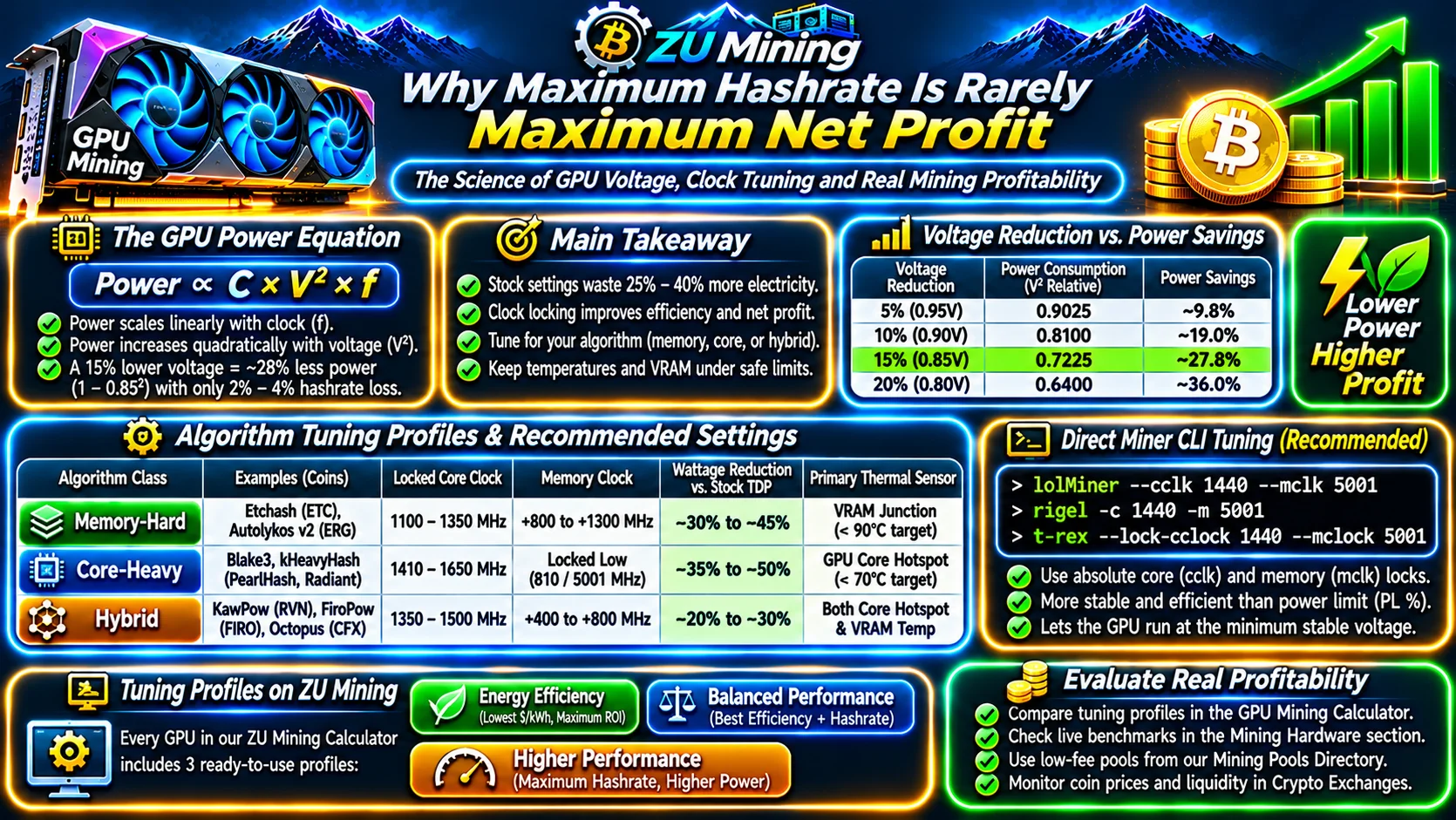
For GPU mining, miners often compare watts consumed against algorithm-specific MH/s or another appropriate hashrate unit.
This becomes particularly important in regions where electricity is expensive.
You can compare mining equipment and specifications through the ZU Mining Hardware & Smart Rig Builder.
Don't Ignore Costs Outside the Calculator
A basic profitability calculator normally focuses on mining revenue and electricity, but a real operation can have additional expenses.
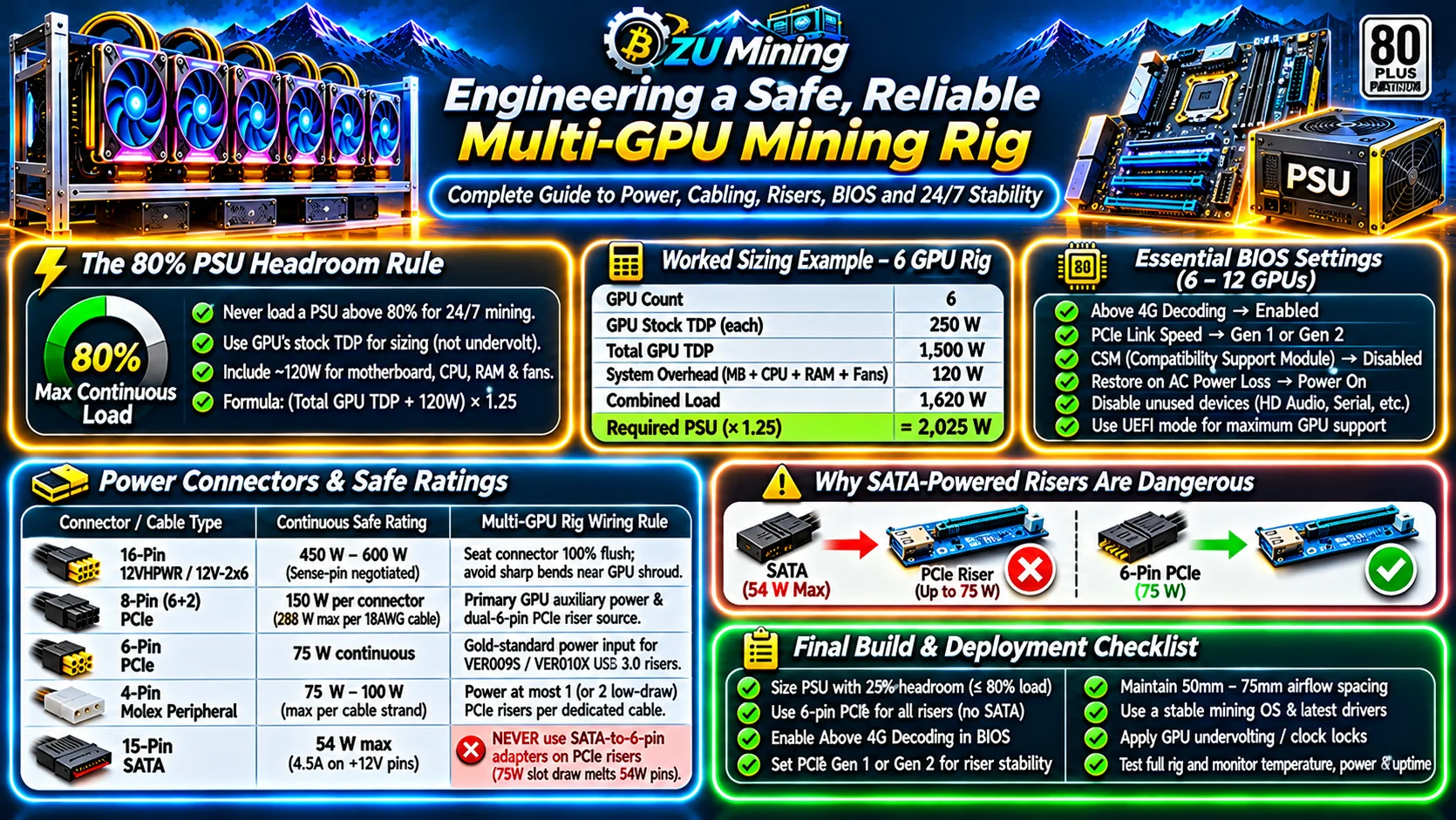
These may include hosting fees, cooling and ventilation, power distribution equipment, pool withdrawal fees, replacement fans, power supplies, internet connectivity, facility rent, maintenance labor, import costs, and hardware depreciation.
ASIC miners can also become economically obsolete long before they physically stop working.
A machine that still hashes correctly may no longer generate enough revenue to justify its electricity consumption.
Why a Profitable Miner Today May Not Be Profitable Next Month
Suppose your miner produces $5 per day in operating profit today.
That result does not imply:
$5 × 365 = guaranteed $1,825 annual profit
Network difficulty can increase. Coin prices can fall. Transaction-fee revenue can decline. Pool conditions can change. Hardware can experience downtime.
The useful question is therefore not simply:
"How much does this miner make today?"
A better question is:
"Under what combinations of electricity price, network difficulty, coin price, and hardware efficiency does this miner remain profitable?"
That is the reason scenario testing is more useful than relying on a single daily profit number.
A Better Way to Evaluate Mining Hardware
Before buying a miner, calculate at least three scenarios.
Use current conditions as the baseline.
Then test a less favorable case with higher difficulty or lower coin prices.
Finally, calculate your electricity break-even point.
Check the relevant network in the Mineable Coins Directory, compare suitable equipment in the Mining Hardware Directory, review available Mining Pools, and then enter the final hardware and electricity assumptions into the Mining Profitability Calculator.
The result still cannot predict future mining income, but it gives you a much stronger basis for deciding whether the hardware makes economic sense.
Final Takeaway
Proof-of-Work mining profitability is determined by the relationship between your hardware's computational output and the economics of the network it is mining.
Hashrate determines how much work you contribute. Network difficulty determines how difficult rewards are to obtain. Block rewards and transaction fees determine how much cryptocurrency is available to miners. Market price determines the fiat value of those rewards. Pool and software fees reduce revenue, while electricity determines a large part of the operating cost.
A mining calculator brings those variables together, but the result should always be treated as an estimate based on current inputs.
The most useful profitability analysis is not the one that produces the largest number. It is the one that shows how quickly that number changes when electricity rates, difficulty, hardware efficiency, or market conditions move against you.