Why Electricity Tariff ($/kWh) Governs Mining Survival
In Proof-of-Work cryptocurrency mining, electrical energy is your largest recurring operational expense. Because every miner sells into the same global coin market and competes against the same network difficulty across all 92 coins in our Mineable Coins Directory, two variables determine which operators remain profitable during bear markets and post-halving cycles: utility tariff in dollars per kilowatt-hour ($/kWh) and hardware silicon efficiency (J/TH or J/MH).
1. Calculating Break-Even Electricity Rate ($/kWh)
Your hardware's break-even electricity rate is the maximum utility tariff at which daily net mining revenue exactly covers daily power consumption (yielding $0.00 net profit):
Daily Energy (kWh) = (Wall Power Consumption [Watts] × 24) ÷ 1,000
Break-Even Tariff ($/kWh) = Net Daily Mining Revenue (USD) ÷ Daily Energy (kWh)
If your residential, commercial, or colocation hosting tariff is below this break-even threshold in the ZU Mining Profitability Calculator, your rig generates positive daily cashflow. If your utility rate exceeds the break-even ceiling, operating the machine costs more in electricity than purchasing the equivalent coins directly on spot crypto exchanges.
| Miner Wall Load | Daily kWh (24h) | Monthly kWh (30d) | Cost @ $0.05/kWh | Cost @ $0.08/kWh | Cost @ $0.12/kWh | Heat Output (BTU/hr) |
|---|---|---|---|---|---|---|
| 300 W (Single GPU / CPU Rig) | 7.2 kWh | 216 kWh | $10.80 / mo | $17.28 / mo | $25.92 / mo | 1,024 BTU/hr |
| 850 W (Home Box ASIC / 3-GPU Rig) | 20.4 kWh | 612 kWh | $30.60 / mo | $48.96 / mo | $73.44 / mo | 2,900 BTU/hr |
| 1,650 W (6-GPU Open-Frame Rig) | 39.6 kWh | 1,188 kWh | $59.40 / mo | $95.04 / mo | $142.56 / mo | 5,630 BTU/hr |
| 3,500 W (Industrial Air-Cooled ASIC) | 84.0 kWh | 2,520 kWh | $126.00 / mo | $201.60 / mo | $302.40 / mo | 11,942 BTU/hr |
| 5,676 W (Hydro-Cooled SHA-256 ASIC) | 136.2 kWh | 4,087 kWh | $204.34 / mo | $326.94 / mo | $490.41 / mo | 19,366 BTU/hr |
Silicon Efficiency (J/TH) and True Wall Wattage
2. Why Joules per Terahash (J/TH) Doubles Break-Even Headroom
One Watt equals one Joule per second (1 W = 1 J/s). Dividing a miner's wall wattage by its hashrate yields its energy cost per hash:
- A legacy SHA-256 ASIC running
100 TH/sat3,000Woperates at30.0 J/TH(consuming72 kWh/day). - A modern SHA-256 ASIC running
234 TH/sat3,510Woperates at15.0 J/TH—producing2.34×the daily Bitcoin revenue per kWh and surviving at twice the electricity tariff of a `30 J/TH` unit.
You can compare how ASICs, GPUs, and CPUs scale across algorithms in our ASIC vs. GPU vs. CPU Hardware Architecture Guide and review the full revenue formulas in How Crypto Mining Profitability Works.
3. PSU Conversion Loss (80 PLUS Curves) and 120V vs. 240V AC Input
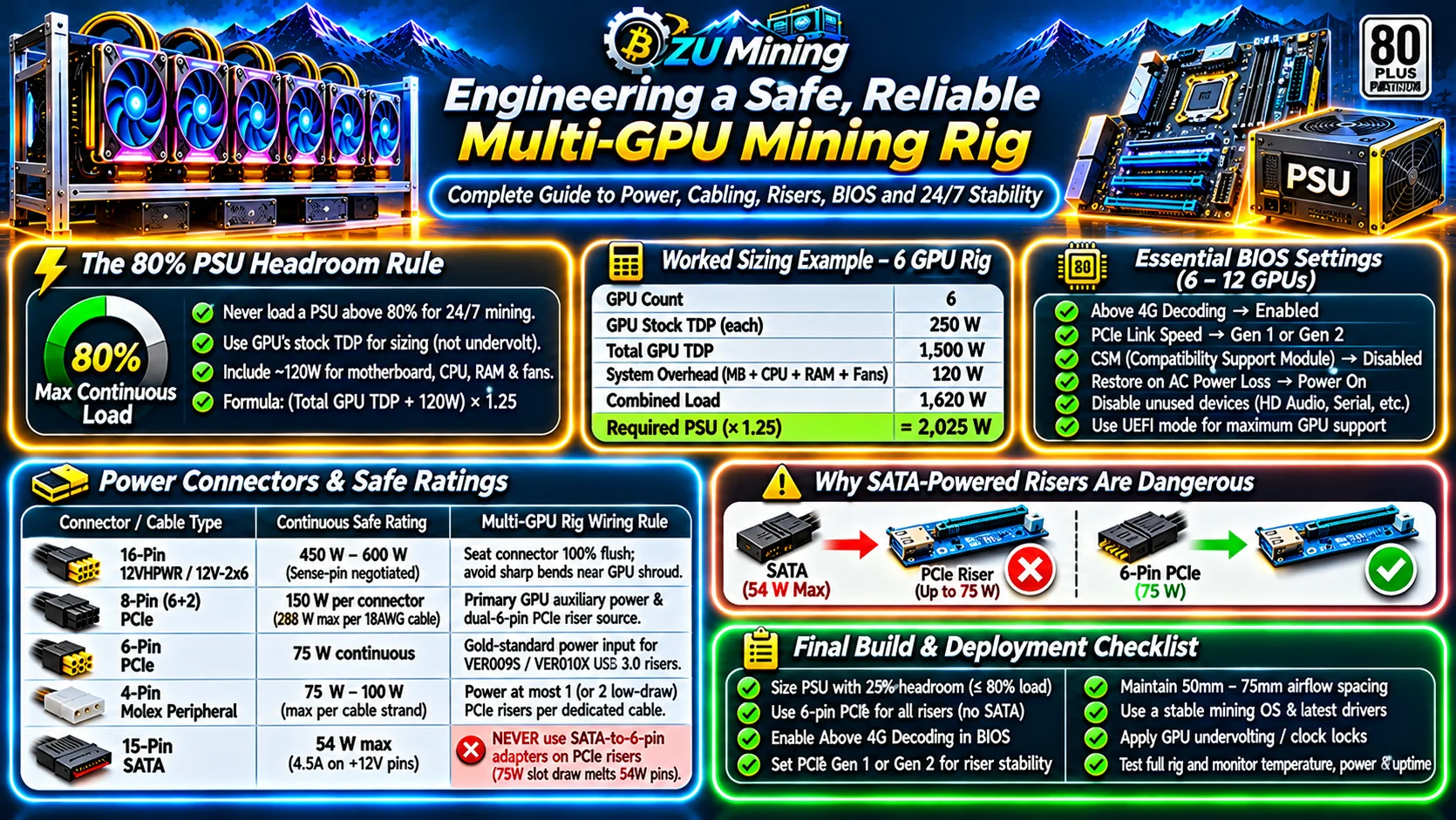
GPU diagnostic readouts inside mining software only report DC power drawn by the graphics card core/board—they omit power supply AC-to-DC conversion inefficiency (`6%–10%`), motherboard/CPU overhead (`45W–90W`), and high-RPM chassis fans. Running an 80 PLUS Platinum or Titanium PSU on a 240V AC circuit at 50%–75% load typically improves wall efficiency by 2%–3% compared to 120V AC input.
Always measure your rig's actual AC wall draw using a calibrated inline wattmeter or smart PDU, size your power supplies safely in the Mining Hardware & Smart Rig Builder, and pair your hardware with low-fee servers from our Verified Mining Pools Directory.