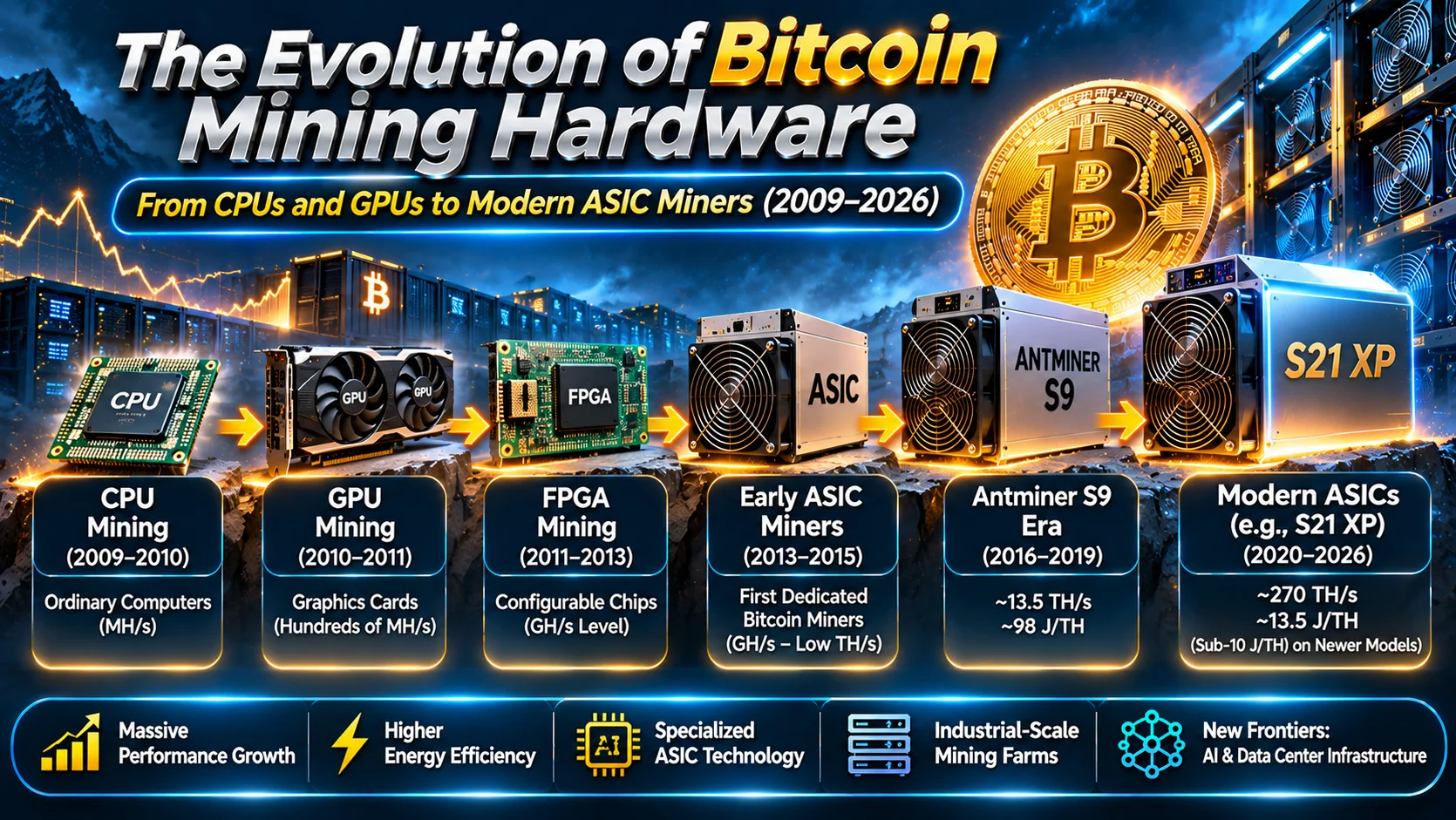
The Evolution of Bitcoin Mining Hardware: From CPUs and GPUs to Modern ASIC Miners (2009–2026)
Updated November 9, 2026
In January 2009, Bitcoin mining required little more than a personal computer running the Bitcoin software. There were no industrial mining farms, no specialized ASIC machines, and no companies competing to operate hundreds of thousands of devices.
The network was small enough for ordinary computer processors to participate.
Seventeen years later, the situation is dramatically different. Bitcoin mining has become a specialized computing industry built around purpose-designed silicon, sophisticated electrical infrastructure, and large-scale facilities.
The transition did not happen overnight. It unfolded through several distinct generations of hardware, each introducing new performance improvements and changing the economics of mining.
Understanding this history explains why modern Bitcoin mining is so competitive, why electricity efficiency matters, and why the hardware used to mine Bitcoin is fundamentally different from the equipment used to mine many other cryptocurrencies.
1. Bitcoin Mining Began With Ordinary CPUs in 2009
Bitcoin launched on January 3, 2009, when its creator, Satoshi Nakamoto, mined the genesis block.
The original Bitcoin software included mining functionality that could operate using a computer's central processing unit.
A CPU is a general-purpose processor designed to perform many different computing tasks.
It can run an operating system, execute applications, process instructions, and perform mathematical calculations.
In Bitcoin's earliest days, this flexibility was sufficient.
The network had very few participants, and mining difficulty was extremely low compared with modern levels.
Early miners did not need specialized equipment.
A personal computer could contribute to the network by repeatedly calculating SHA-256 hashes in an attempt to discover a valid block.
How early Bitcoin mining worked
Bitcoin miners construct candidate blocks containing transaction data and other required information.
Their hardware repeatedly hashes the block header while changing suitable fields.
A valid block is found when the resulting hash meets the network's current target.
In the early network, CPUs performed these calculations directly.
Today, the same fundamental Proof-of-Work mechanism remains in place, but the computing hardware has changed almost completely.
Why CPU mining was possible
The Bitcoin network was designed to adjust mining difficulty according to the computing power participating.
When few miners were active, difficulty remained low.
This allowed ordinary computers to participate during the network's earliest period.
As more computing power joined, the difficulty adjustment mechanism gradually made mining more competitive.
2. The First Bitcoin Mining Rewards
When Bitcoin launched, the block subsidy was 50 BTC.
That amount was paid to the miner who successfully produced a valid block.
Bitcoin's issuance schedule was designed to reduce the subsidy approximately every four years.
The first halving occurred in November 2012, reducing the subsidy to 25 BTC.
Further halvings reduced it to 12.5 BTC in 2016, 6.25 BTC in 2020, and 3.125 BTC in 2024.
The large numerical rewards of Bitcoin's earliest period should not be confused with modern financial value.
Bitcoin had no established liquid market price when the network first launched.
Early participants were primarily experimenting with a new decentralized electronic cash system.
Why the reward schedule mattered
The halving mechanism created a predictable reduction in newly issued Bitcoin.
However, mining equipment and electricity costs continued changing independently.
Over time, miners needed increasingly efficient hardware to remain competitive.
3. GPU Mining Changed Bitcoin's Early Network
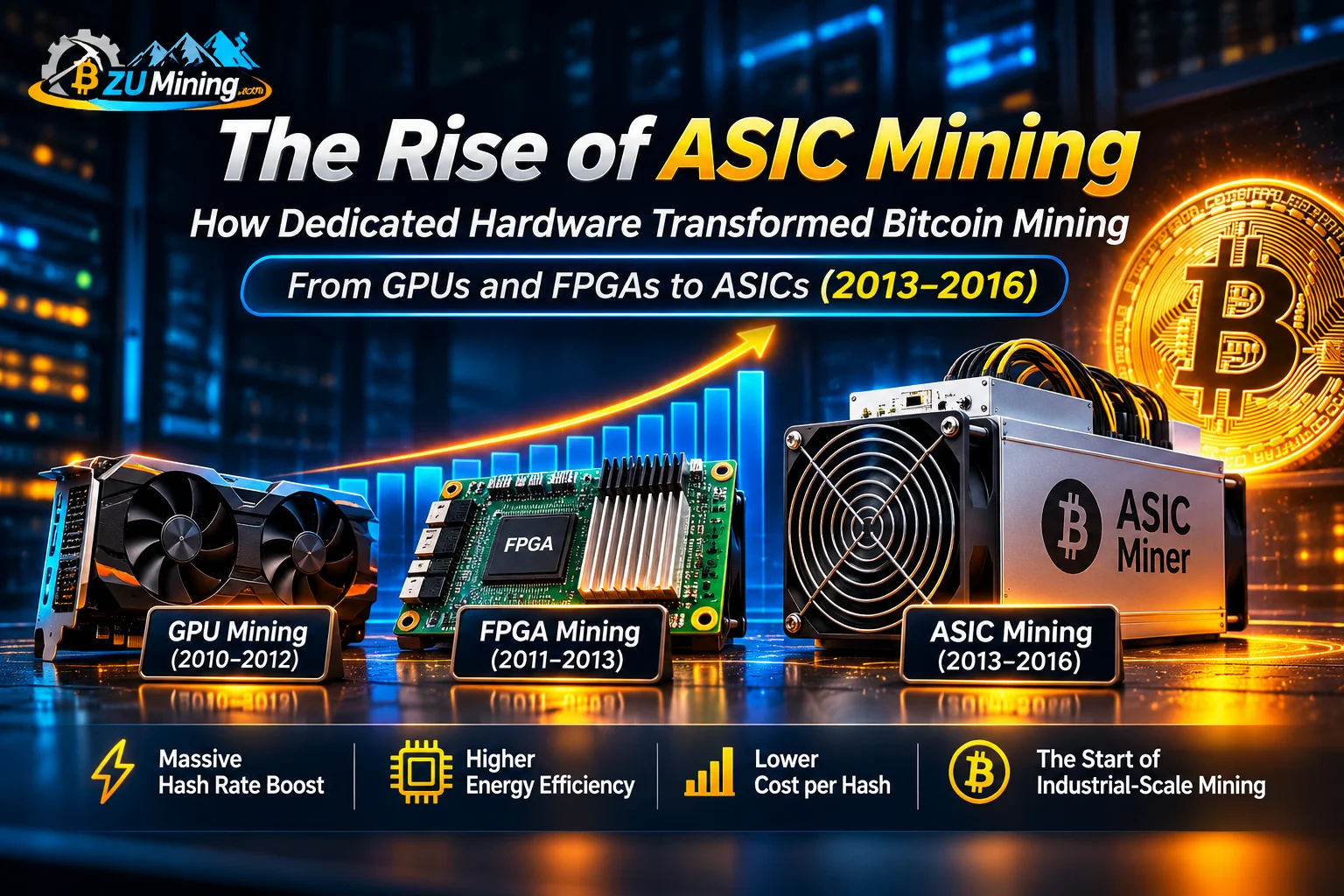
The first major hardware transition occurred when miners began using graphics processing units.
A GPU is designed to perform large numbers of parallel calculations.
Although GPUs are widely associated with gaming and graphics rendering, their architecture also makes them useful for certain computational workloads.
Bitcoin's SHA-256 calculations could be performed efficiently using GPU-based software.
By 2010, GPU mining had become an important development in the Bitcoin community.
Why GPUs outperformed CPUs
CPUs are optimized for flexible instruction processing and relatively complex tasks.
GPUs contain many processing units capable of handling large numbers of similar operations simultaneously.
This parallel architecture made GPUs significantly more effective at Bitcoin hashing than ordinary CPUs of the same era.
The exact performance advantage depended on the hardware and software used.
The importance of GPU mining
GPU mining marked the beginning of Bitcoin's hardware competition.
Mining was no longer simply about running the software on an available computer.
Participants increasingly selected equipment specifically for its hashing performance.
This change encouraged the development of mining software, hardware configurations, and specialized operating practices.
4. Early GPU Mining Hardware
During the early GPU era, miners experimented with consumer graphics cards.
AMD Radeon cards became particularly popular in some Bitcoin mining configurations because of their performance characteristics and available mining software.
Hardware such as the Radeon HD 5870 became associated with the early GPU mining period.
These cards were not manufactured specifically for Bitcoin.
They were consumer graphics processors adapted for cryptocurrency mining.
Why miners used multiple GPUs
As competition increased, miners began installing several graphics cards in a single computer.
A multi-GPU system could produce more total hashrate than a single card. GPU Mining Profitability Calculator
However, adding GPUs also increased electricity consumption, heat generation, and hardware costs.
Mining systems began requiring larger power supplies, improved cooling, and more careful component selection.
The limitations of GPU mining
GPUs remained general-purpose devices.
They contained hardware capabilities that were unnecessary for SHA-256 mining.
A specialized processor designed exclusively for Bitcoin hashing could potentially perform the same work using less energy.
That opportunity encouraged the next stage of mining hardware development.
5. FPGA Mining Appeared as an Intermediate Technology
Field-programmable gate arrays, commonly called FPGAs, became an important transitional technology around 2011 and 2012.
An FPGA is an integrated circuit whose logic can be configured after manufacturing.
Unlike a general-purpose CPU or GPU, an FPGA can implement a specialized digital circuit for a particular workload.
Bitcoin mining developers used this capability to build hardware configurations optimized for SHA-256 hashing.
Why FPGAs mattered
FPGAs generally offered improved energy efficiency compared with many contemporary GPU mining configurations.
They also helped demonstrate the benefits of dedicated hashing hardware.
However, FPGA systems were often more expensive or complicated to develop and configure.
Their commercial dominance was relatively short-lived because ASIC technology offered a more specialized solution.
The FPGA era's historical importance
FPGAs bridged the gap between consumer computing hardware and purpose-built mining silicon.
They showed that Bitcoin mining was moving away from flexible computing platforms toward dedicated hardware architectures.
This shift would permanently change the industry.
6. The ASIC Revolution Began in 2013
The introduction of commercially available Bitcoin ASIC miners around 2013 was one of the most important technological developments in the network's history.
ASIC stands for Application-Specific Integrated Circuit.
An ASIC is designed to perform a particular function efficiently.
Bitcoin mining ASICs are optimized for SHA-256 hashing.
Unlike GPUs, they do not need to support graphics rendering or a broad range of general-purpose workloads.
Their specialized design allows them to dedicate more of their circuitry to the calculations required for mining.
Early ASIC manufacturers
Companies such as Avalon and Butterfly Labs were associated with the first generation of commercial Bitcoin ASIC development.
Avalon delivered early ASIC mining equipment in 2013.
Other manufacturers followed as demand for dedicated mining hardware expanded.
Why ASICs changed everything
ASIC miners provided substantial improvements in hashing performance and energy efficiency.
As more ASIC equipment joined the network, mining difficulty increased.
CPU, GPU, and FPGA systems became progressively less competitive for Bitcoin's SHA-256 algorithm.
The transition was so significant that modern Bitcoin mining is overwhelmingly performed using ASIC hardware.
7. How ASIC Miners Differ From GPUs
ASICs and GPUs are designed for different purposes.
A GPU can perform many types of parallel computation.
It may be used for gaming, video rendering, scientific workloads, AI computing, or compatible cryptocurrency algorithms.
A Bitcoin ASIC has a much narrower function.
It is built to perform SHA-256 hashing.
Performance specialization
An ASIC can dedicate its hardware resources to a single algorithm.
This allows manufacturers to optimize the relationship between hashing performance and electricity consumption.
Flexibility
A GPU can be repurposed for other compatible workloads.
A Bitcoin ASIC generally cannot be converted into a general-purpose graphics processor or AI accelerator.
Financial implications
ASIC specialization creates advantages and risks.
The advantage is high efficiency for the intended mining algorithm.
The risk is limited flexibility if mining economics become unfavorable.
A GPU may retain value for other computing tasks, while a Bitcoin ASIC's usefulness depends heavily on demand for SHA-256 mining hardware.
8. Bitcoin Mining Became an Industrial Business
The rise of ASIC hardware changed more than the machines themselves.
Mining operations became increasingly focused on electricity, infrastructure, and scale.
A small collection of computers could be operated in an ordinary room.
Hundreds or thousands of ASIC machines required much more sophisticated facilities.
New infrastructure requirements
Industrial mining operations needed reliable electricity distribution, cooling, networking, equipment maintenance, and physical security.
The electricity load of a large facility could reach several megawatts.
Why location became important
Electricity prices vary significantly between regions.
A mining facility with affordable, reliable power can have a substantial operating advantage over one paying higher rates.
Climate, infrastructure availability, local regulations, and access to technical services also influence mining locations.
Over time, mining became closely connected to the economics of industrial electricity consumption.
9. Mining Hardware in the Mid-2010s
The years following the introduction of ASIC miners saw rapid improvements in equipment design.
Manufacturers developed new generations of chips, improved cooling systems, and increased the number of hashing units in each machine.
The Antminer S9, introduced in 2016, became one of the best-known Bitcoin mining machines of its era.
Typical configurations produced approximately 13.5 TH/s while consuming around 1,323 watts.
That corresponds to roughly 98 J/TH.
Actual specifications varied by model and operating conditions.
Why the S9 became important
The S9 combined relatively strong performance for its time with widespread commercial availability.
It was used in mining facilities around the world.
Its popularity helped establish the recognizable industrial ASIC form factor that became common in subsequent generations.
The limits of older hardware
As newer devices entered the market, older machines became less energy-efficient by comparison.
However, equipment age alone does not determine profitability.
Electricity costs, purchase prices, network difficulty, and maintenance expenses also matter.
10. The Transition to More Efficient ASIC Generations
During the late 2010s and early 2020s, manufacturers continued improving ASIC efficiency.
Advances in semiconductor design and manufacturing allowed more hashing work to be performed for each unit of electricity.
Machines increasingly delivered tens or hundreds of terahashes per second.
Why efficiency became a central metric
Hashrate measures the amount of hashing work a machine can perform.
Power consumption measures how much electricity it requires.
Efficiency combines those two measurements.
A machine with high hashrate may still be expensive to operate if it consumes excessive electricity.
This is why miners began comparing equipment using joules per terahash.
11. Understanding Joules per Terahash
Joules per terahash, abbreviated J/TH, is one of the most useful measurements for evaluating Bitcoin mining hardware.
The calculation is straightforward:
Efficiency (J/TH) = Power consumption (W) ÷ Hashrate (TH/s)
Example
Suppose a machine produces 100 TH/s and consumes 3,000 watts.
Its efficiency is:
3,000 ÷ 100 = 30 J/TH
Another machine produces 200 TH/s while consuming 3,000 watts.
Its efficiency is:
3,000 ÷ 200 = 15 J/TH
The second machine performs twice as much hashing work using the same electrical power.
Why this matters
Lower J/TH generally means lower electricity consumption for the same amount of hashing work.
This becomes particularly important when a facility operates hundreds of machines.
However, the purchase price and expected useful life of equipment must also be considered.
The most efficient machine is not automatically the most financially attractive purchase.
12. A Comparison of Historical Mining Hardware
The following examples illustrate the scale of hardware development.
| Hardware generation | Representative equipment | Approximate performance | Primary significance |
|---|---|---|---|
| CPU era | Ordinary desktop processors | MH/s range or lower, depending on hardware | Accessible early Bitcoin mining |
| GPU era | Radeon HD 5870 | Hundreds of MH/s in optimized configurations | Parallel processing advantage |
| FPGA era | Dedicated FPGA boards | Highly variable by implementation | Improved specialization and efficiency |
| Early ASIC era | Avalon first-generation systems | GH/s range | Dedicated SHA-256 silicon |
| 2016 ASIC era | Antminer S9 | Around 13.5 TH/s | Widespread industrial deployment |
| Modern ASIC era | Antminer S21 XP | 270 TH/s | Substantial efficiency improvement |
These figures are representative examples, not standardized laboratory comparisons.
Early CPU, GPU, and FPGA performance varied considerably depending on software, configuration, and operating conditions.
The table illustrates how mining hardware advanced through multiple orders of magnitude.
13. Modern ASIC Hardware: The Antminer S21 XP
The Antminer S21 XP provides a useful example of modern ASIC efficiency.
Bitmain's published specifications for the air-cooled model list:
Typical hashrate: 270 TH/s.
Typical power consumption: 3,645 watts.
Typical efficiency: 13.5 J/TH.
These are manufacturer specifications under defined operating conditions.
Actual results may differ.
Comparing the S21 XP with the S9
The S9's approximate efficiency was 98 J/TH.
The S21 XP's published efficiency is 13.5 J/TH.
Dividing 98 by 13.5 gives approximately 7.3.
This means the newer machine is roughly seven times as energy-efficient per terahash as the representative S9 configuration.
The comparison demonstrates how significantly Bitcoin mining hardware improved over less than a decade.
However, it does not mean the newer machine automatically produces seven times the financial return.
Profitability depends on network conditions, electricity costs, equipment prices, and other expenses.
14. The Move Toward Sub-10 J/TH Hardware
By 2026, industry research was discussing the commercial scaling of ASIC hardware with efficiency below 10 J/TH.
This represented another important stage in the development of specialized Bitcoin mining equipment.
A lower energy requirement per terahash can reduce operating costs for miners.
However, hardware specifications should be evaluated carefully.
Why published specifications require context
A manufacturer's advertised efficiency may depend on particular operating conditions.
Temperature, cooling, firmware, and power settings can affect performance.
Different product variants may also have different specifications.
Why new hardware does not replace everything immediately
Industrial equipment upgrades require capital.
An operator must consider whether electricity savings justify purchasing new machines.
Older equipment may continue operating economically in locations with particularly favorable electricity arrangements.
Consequently, several generations of ASIC hardware can remain active at the same time.
15. Air Cooling, Hydro Cooling and Immersion Cooling
As ASIC performance increased, cooling became an increasingly important part of mining infrastructure.
Mining machines convert much of their electrical energy into heat.
That heat must be removed to maintain suitable operating conditions.
Air cooling
Air-cooled miners use fans and airflow to remove heat.
This approach is common and relatively straightforward.
However, it can produce substantial noise and may be affected by high ambient temperatures.
Hydro cooling
Hydro-cooled mining systems use liquid-based thermal management.
They require compatible hardware and supporting infrastructure.
Immersion cooling
Immersion systems place compatible equipment in specially designed dielectric fluid.
Heat is transferred from the equipment to the fluid and then removed through a cooling system.
Choosing a cooling method
Each approach has advantages and disadvantages.
The appropriate choice depends on equipment compatibility, facility design, maintenance requirements, electricity costs, and available capital.
No single cooling technology is automatically the best choice for every mining operation.
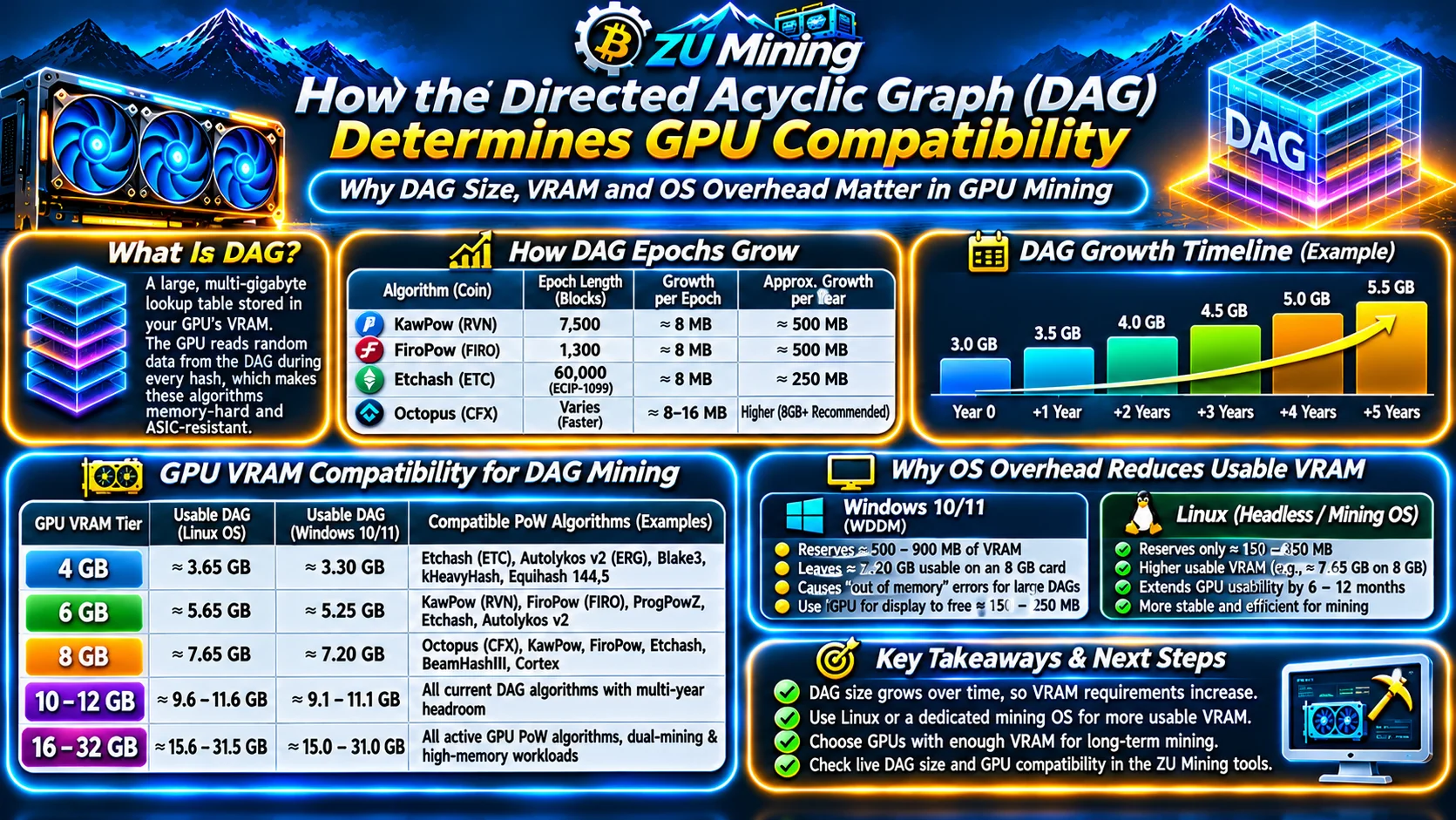
16. Why GPU Mining Did Not Disappear Completely
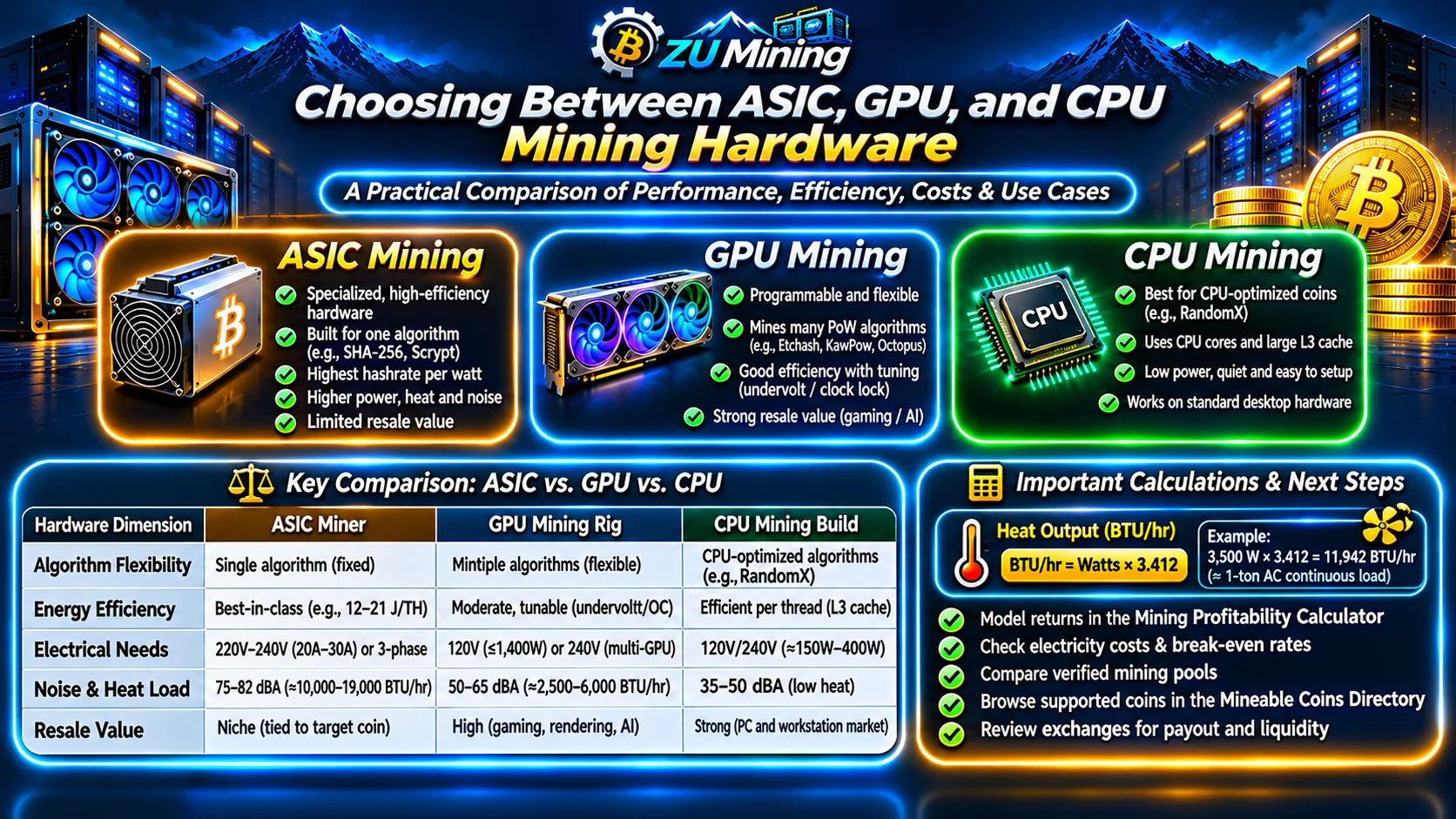
Bitcoin's transition to ASIC hardware did not eliminate GPU-based cryptocurrency mining.
Different cryptocurrencies use different consensus mechanisms and mining algorithms.
Some Proof-of-Work networks have algorithms that can be mined using GPUs.
Others use specialized hardware.
The importance of the mining algorithm
A machine designed for one algorithm cannot necessarily mine another efficiently.
Bitcoin ASICs are specialized for SHA-256.
A GPU can support a wider range of compatible computational workloads.
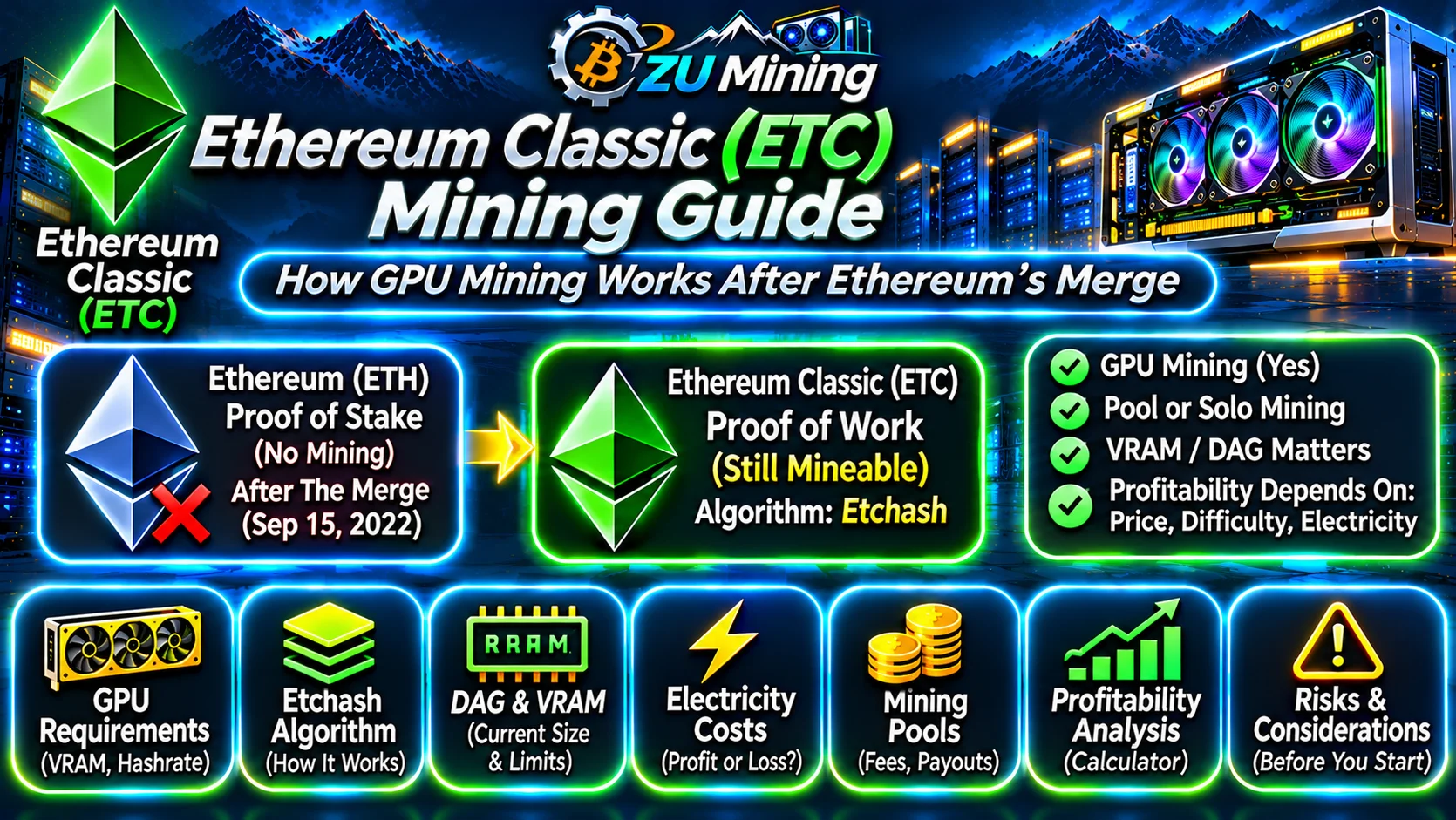
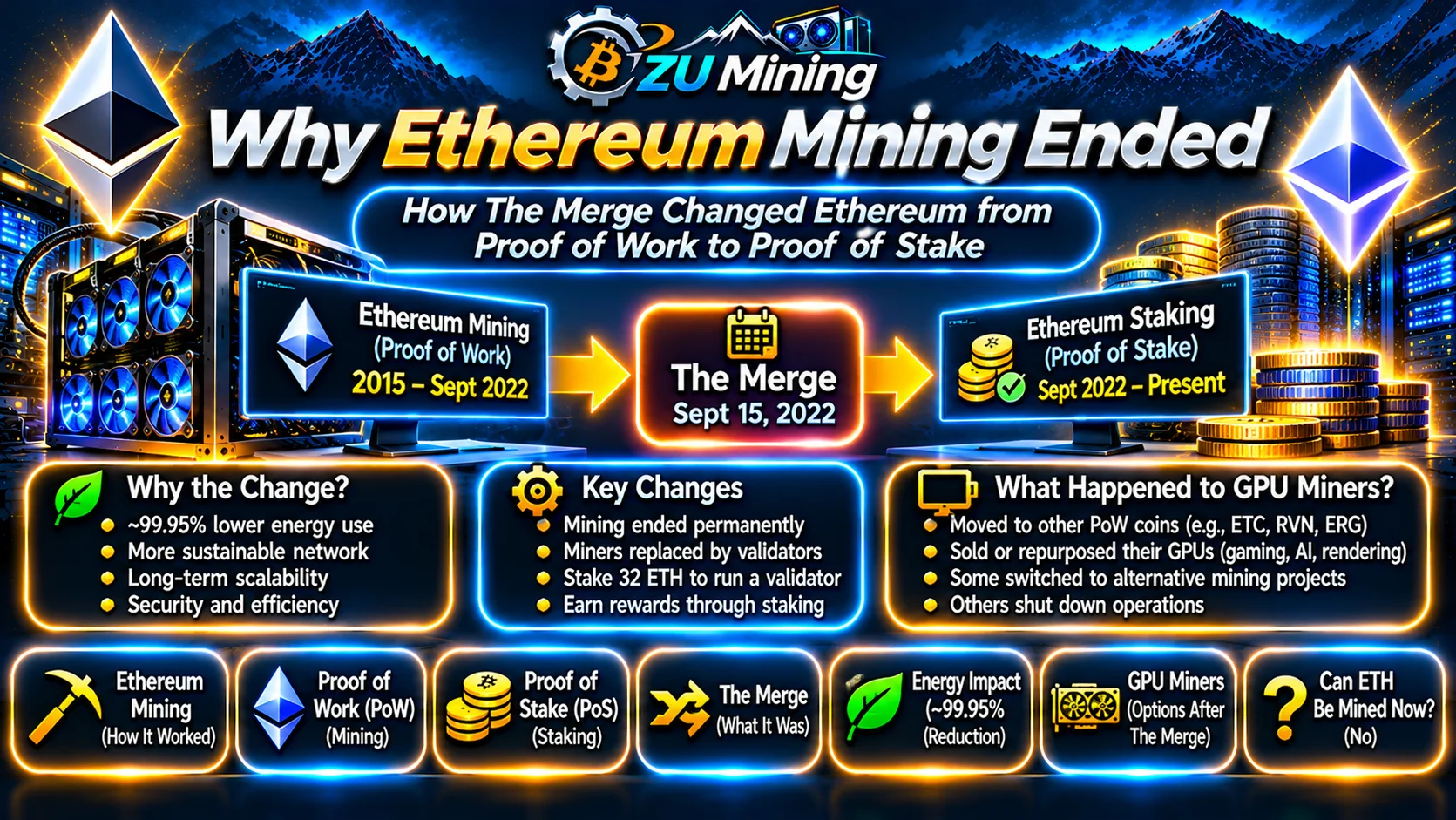
Ethereum's transition
Ethereum was historically an important GPU-mined cryptocurrency.
However, Ethereum completed its transition from Proof-of-Work to Proof-of-Stake in September 2022.
Ethereum is no longer mined using GPUs or ASICs.
This distinction is essential when comparing historical GPU mining with modern cryptocurrency mining.
Readers can explore supported hardware and coins through the ZU Mining Hardware Directory.
17. Mining Difficulty Changed the Value of Hardware
Bitcoin's difficulty adjustment mechanism is one of the main reasons mining hardware becomes less competitive over time.
Difficulty adjusts every 2,016 blocks to help maintain the network's target average block interval.
When additional computing power joins the network, difficulty can increase.
A miner with unchanged hashrate then represents a smaller share of the total network.
A simplified example
Suppose a machine produces 100 TH/s.
If the total network hashrate doubles while the machine's performance remains unchanged, its relative share of the network is cut in half.
Assuming other conditions remain comparable, its expected share of mining rewards also declines.
Why upgrading becomes important
Newer hardware can provide more hashrate or improved energy efficiency.
However, miners must evaluate the financial benefits of upgrading.
Purchasing expensive equipment without considering future network competition can create financial risks.
18. Electricity Costs Across Hardware Generations
Electricity consumption is one of the most important operating expenses in Bitcoin mining.
Consider two hypothetical machines.
Machine A produces 100 TH/s while consuming 3,000 watts.
Machine B produces 200 TH/s while consuming the same 3,000 watts.
Both consume:
3 kW × 24 hours = 72 kWh per day
At $0.08 per kWh, each machine costs approximately $5.76 per day in electricity.
However, Machine B produces twice as much hashrate for the same energy cost.
The economic advantage
The more efficient machine has a lower electricity cost per unit of hashing work.
This can provide an advantage when competing for mining rewards.
Nevertheless, a complete financial comparison must include equipment acquisition costs, maintenance, and expected operating life.
19. The Rise of Large Mining Facilities
Modern Bitcoin mining facilities can contain thousands of ASIC machines.
Operating at this scale requires infrastructure that resembles an industrial computing installation.
Facilities may include:
High-capacity electrical distribution.
Cooling and ventilation systems.
Networking equipment.
Monitoring and maintenance systems.
Physical security.
Specialized technical staff.
Why scale can help
Larger operations may negotiate equipment purchases or electricity arrangements more effectively.
They may also spread certain infrastructure expenses across more machines.
Why scale can create risks
Large facilities require substantial capital.
A decline in mining revenue can affect thousands of devices simultaneously.
Debt obligations, electricity contracts, and equipment depreciation can create additional financial pressure.
Therefore, operating more hardware does not necessarily mean achieving better financial results.
20. Bitcoin Mining Hardware and AI Computing
By 2025 and 2026, some mining companies were exploring opportunities in artificial intelligence and high-performance computing.
This development created confusion about whether Bitcoin ASIC machines could be used for AI workloads.
The distinction is important.
Bitcoin ASICs are specialized for SHA-256 hashing.
AI computing generally requires GPUs or other accelerators designed for different mathematical operations.
What can potentially be reused?
Mining companies may possess valuable infrastructure such as electricity connections, buildings, cooling systems, and operational expertise.
Some of these assets can support other types of computing.
However, converting a Bitcoin mining facility into an AI data center may require substantial engineering work and capital investment.
The opportunity lies primarily in infrastructure rather than converting Bitcoin ASIC chips into AI processors.
21. The Economics of Replacing Mining Equipment
A mining operator considering an equipment upgrade should compare the expected benefits with the total cost.
Important considerations include:
Purchase price.
Expected hashrate.
Energy efficiency.
Electricity cost.
Maintenance requirements.
Installation expenses.
Expected useful life.
Future mining difficulty.
Potential resale value.
A practical upgrade example
Suppose a newer machine saves $4 per day in electricity compared with an older machine performing the same amount of hashing work.
Over 365 days, the theoretical electricity saving would be:
$4 × 365 = $1,460
However, that figure assumes continuous operation and stable electricity pricing.
It does not include the purchase price, installation costs, downtime, or other expenses.
The calculation is useful for evaluating operating savings but is not sufficient on its own to justify an upgrade.
22. Why Mining Hardware History Matters Today
The history of Bitcoin mining hardware explains several features of the modern industry.
First, specialized hardware can rapidly make general-purpose equipment less competitive.
Second, energy efficiency becomes increasingly important as network competition grows.
Third, hardware performance must be evaluated alongside electricity costs and acquisition expenses.
Fourth, mining infrastructure becomes more complex as operations scale.
Finally, technological improvements do not eliminate economic uncertainty.
A new ASIC generation may improve efficiency, but network difficulty and market conditions continue changing.
Understanding these relationships helps readers evaluate mining equipment more realistically.
23. What Comes After Modern ASIC Mining?
Bitcoin mining hardware will likely continue evolving.
Manufacturers are expected to pursue improvements in chip design, power delivery, cooling, and operational reliability.
However, future performance gains are not guaranteed to follow the same pace as earlier generations.
Semiconductor development involves physical, engineering, and financial constraints.
The next challenges
Future mining equipment development may focus on:
Better energy efficiency.
Improved thermal management.
Higher equipment reliability.
More effective power management.
Lower infrastructure costs.
Better integration with industrial facilities.
The importance of mining economics
Even if future machines become substantially more efficient, profitability will still depend on network difficulty, Bitcoin's price, electricity costs, and transaction fees.
Technological progress changes the competitive environment, but it does not remove the fundamental economics of Proof-of-Work mining.
Conclusion
Bitcoin mining hardware has undergone one of the most remarkable transformations in modern computing.
In 2009, ordinary CPUs could participate in securing the network.
GPU mining introduced a major performance advantage in 2010.
FPGAs demonstrated the benefits of specialized digital logic.
The arrival of commercial ASIC miners in 2013 permanently changed Bitcoin mining.
During the following decade, manufacturers improved hashing performance and energy efficiency, while mining operations expanded into industrial facilities.
By 2026, the industry was discussing hardware efficiency below 10 J/TH, a level far beyond what early Bitcoin miners could have imagined.
Yet the central challenge remained the same.
Miners must perform computational work efficiently enough to earn rewards that justify their operating expenses.
The evolution from CPUs to modern ASICs is therefore more than a history of faster machines.
It is the story of how Bitcoin mining became a specialized global industry shaped by technology, electricity, and economic competition.
Frequently Asked Questions
What hardware was used to mine Bitcoin in 2009?
Bitcoin was originally mined using ordinary computer CPUs running early Bitcoin software.
When did GPU mining become popular?
GPU mining emerged around 2010 as miners discovered that graphics processors could perform SHA-256 hashing more efficiently than CPUs.
What is FPGA mining?
FPGA mining uses configurable integrated circuits to implement specialized hashing logic. It became an important transitional technology before ASIC miners dominated Bitcoin mining.
When did Bitcoin ASIC miners appear?
Commercial Bitcoin ASIC mining equipment began appearing around 2013.
Can Bitcoin still be mined with a CPU?
A CPU can technically perform Bitcoin's SHA-256 calculations, but it is not economically competitive with modern ASIC mining hardware under ordinary conditions.
Can GPUs mine Bitcoin profitably?
Modern Bitcoin mining is overwhelmingly dominated by ASICs. GPUs are generally not competitive for Bitcoin's SHA-256 algorithm.
What does J/TH mean?
J/TH stands for joules per terahash. It measures the energy required to perform a unit of hashing work. Lower values indicate better energy efficiency.
Why was the Antminer S9 important?
The Antminer S9 became one of the most widely recognized Bitcoin ASIC miners of the mid-2010s and helped define industrial mining equipment of that era.
What is an example of modern ASIC efficiency?
Bitmain lists the Antminer S21 XP at 270 TH/s, 3,645 watts, and 13.5 J/TH under specified operating conditions.
Can Bitcoin ASICs be used for artificial intelligence?
Bitcoin ASICs are specialized for SHA-256 hashing and are generally unsuitable for general-purpose AI workloads.
Does the newest ASIC always provide the best financial return?
No. Equipment purchase prices, electricity costs, maintenance, network difficulty, and expected operating life must also be considered.
What is the future of Bitcoin mining hardware?
Further improvements may occur in semiconductor efficiency, cooling, reliability, and power management, although future performance and profitability remain uncertain.
Historical References and Further Reading
Satoshi Nakamoto. Bitcoin: A Peer-to-Peer Electronic Cash System. https://bitcoin.org/bitcoin.pdf
Bitcoin Developer Documentation. Mining. https://developer.bitcoin.org/devguide/mining.html
Bitcoin Wiki. Mining Hardware Comparison. https://en.bitcoin.it/wiki/Mining_hardware_comparison
Bitmain Support. ANTMINER S21 XP Specifications. https://support.bitmain.com/hc/en-us/articles/35383015643673-S21-XP-Specifications
Cambridge Centre for Alternative Finance. Cambridge Digital Mining Industry Report 2025. https://www.jbs.cam.ac.uk/faculty-research/centres/alternative-finance/publications/cambridge-digital-mining-industry-report/
CoinShares Research. Bitcoin Mining Report, Q2 2026. https://coinshares.com/insights/research-data/bitcoin-mining-report-q2-2026/
Editorial note: Historical hardware specifications are representative and may vary by manufacturer, configuration, firmware, and operating conditions. The illustrative calculations in this article are not financial forecasts or guarantees of mining profitability.