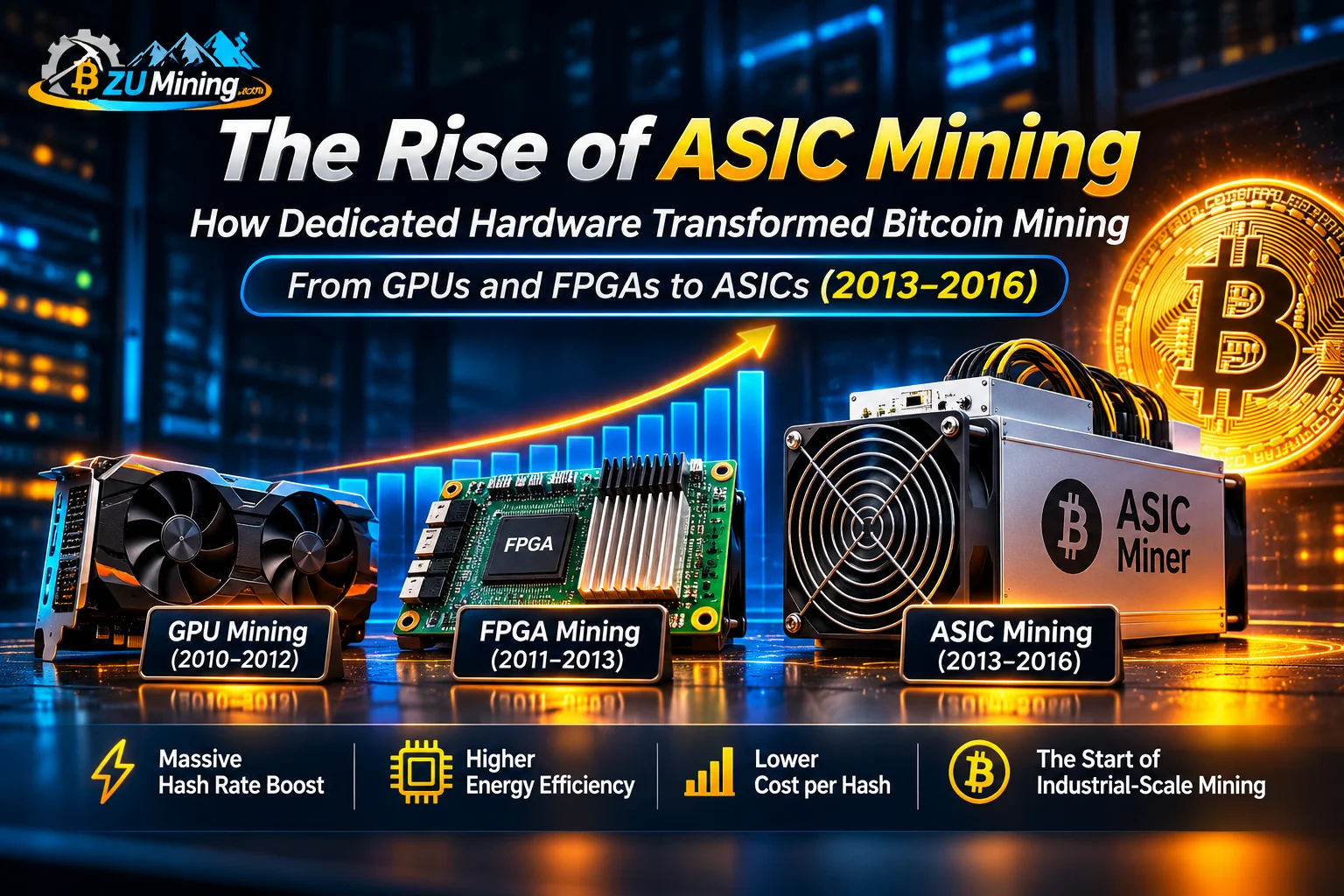
The Rise of ASIC Mining: How Dedicated Hardware Transformed Bitcoin Mining (2013–2016)
In just a few years, Bitcoin mining went from a hobby that could be pursued with graphics cards to a specialized industry built around custom silicon. The arrival of ASIC technology changed who could compete, how mining equipment was designed, and what it meant to run a profitable operation.
Introduction: The Moment Bitcoin Mining Changed Forever
By the beginning of 2013, Bitcoin miners were facing a problem that had become increasingly difficult to ignore.
Their computers were getting faster, but so was everyone else's.
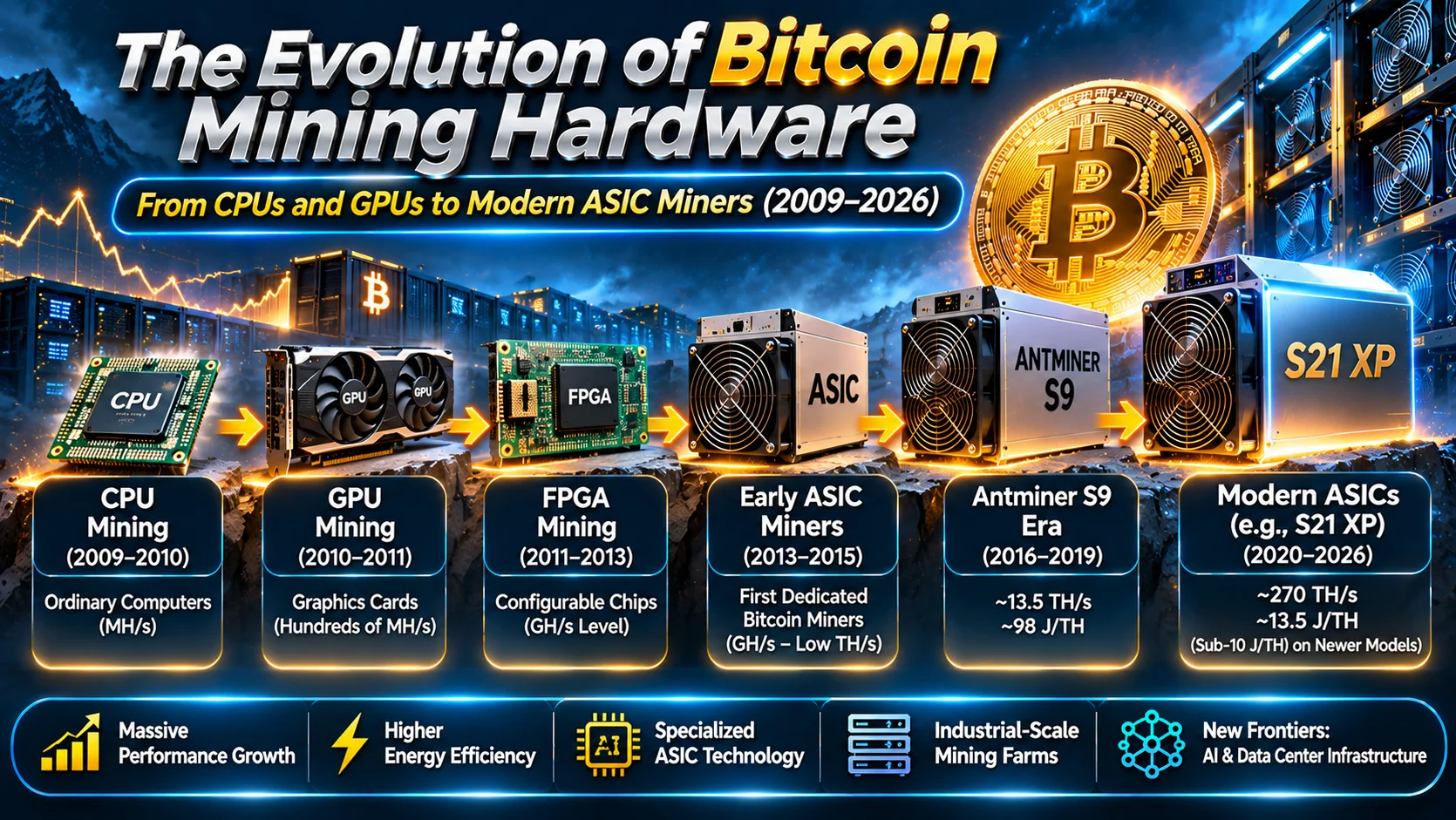
Graphics cards had already transformed the network. Programmable FPGA hardware offered another step toward improved efficiency. Yet both technologies were approaching a new challenge: a chip designed specifically for Bitcoin's hashing algorithm could potentially outperform them by a substantial margin.
That chip was the ASIC.
ASIC stands for Application-Specific Integrated Circuit. Unlike a conventional processor that handles many kinds of instructions, an ASIC is designed to perform a particular set of operations efficiently.
For Bitcoin, that meant building silicon specifically for the repetitive SHA-256 calculations used in Proof-of-Work mining.
The difference was enormous.
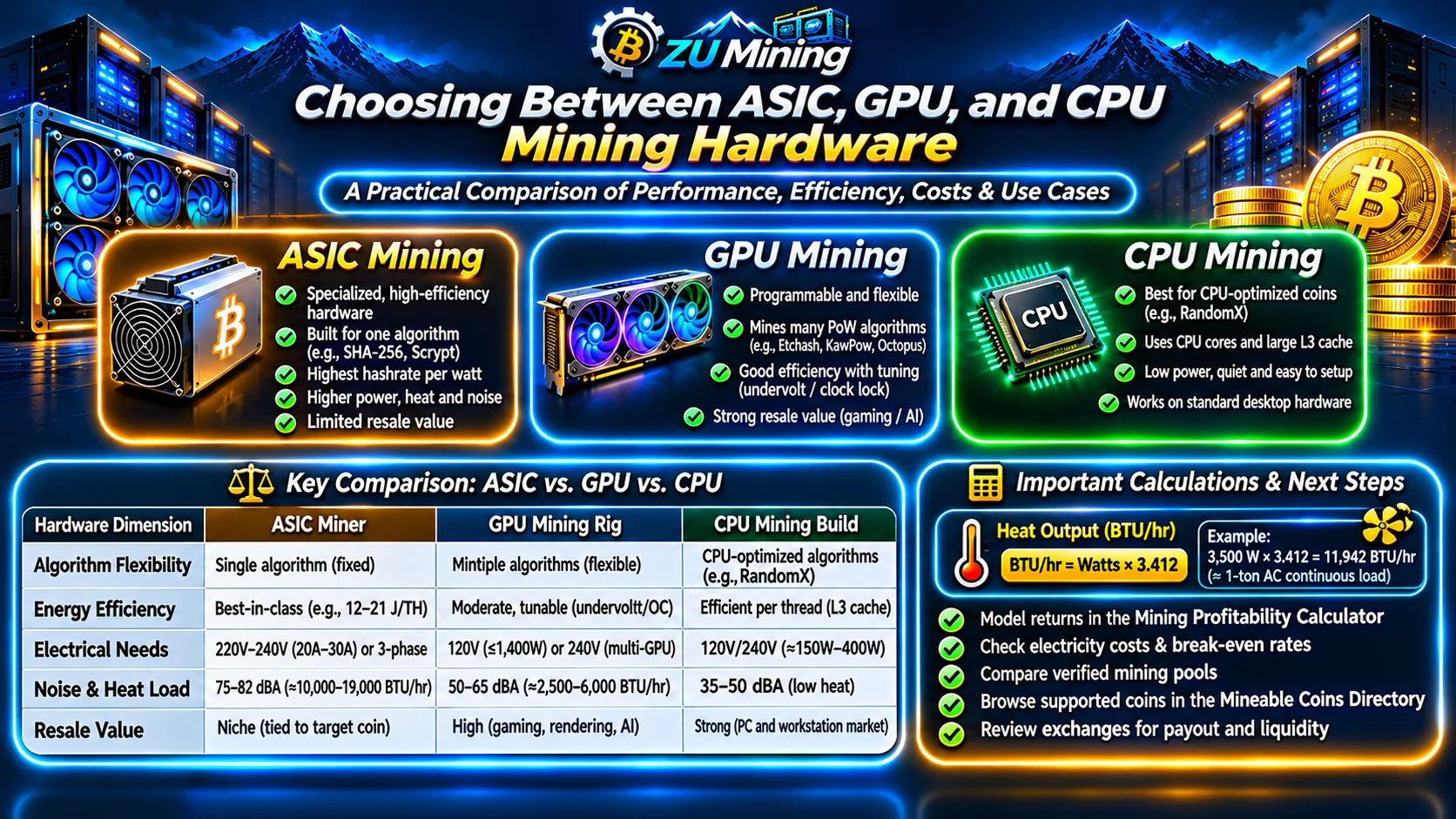
A GPU might be useful for gaming, rendering, scientific computing, and several mining algorithms. A Bitcoin mining ASIC had a much narrower purpose. It was built to calculate hashes as efficiently as possible.
Between 2013 and 2016, this specialization reshaped the entire mining ecosystem.
It created new hardware manufacturers, increased the importance of electricity pricing, accelerated mining difficulty growth, and laid the groundwork for large commercial mining facilities.
It also raised a difficult question that remains relevant today.
If Bitcoin was designed as an open network, what happens when participating in its mining economy requires increasingly specialized and expensive equipment?
1. What Exactly Is an ASIC Miner?
An Application-Specific Integrated Circuit is a semiconductor chip developed for a defined application.
The concept was not invented for Bitcoin. ASICs had been used for years in electronics, telecommunications, and other specialized computing applications.
Bitcoin mining created a new commercial opportunity for this technology.
Instead of using a general-purpose processor to execute hashing software, engineers could build a circuit optimized around the calculations miners perform repeatedly.
How Bitcoin ASICs perform mining work
Bitcoin miners construct candidate blocks and repeatedly calculate the double SHA-256 hash of the block header.
A successful result must satisfy the current network target.
ASIC chips implement this hashing workload directly in hardware, with designs that can process large numbers of attempts efficiently.
The miner still needs supporting components, including a controller, power delivery, cooling, and communication with mining software or a pool.
But the computational work is handled by specialized chips.
This architecture makes a major difference in both throughput and energy consumption.
Why ASICs were more efficient
A GPU contains hardware for a wide range of graphics and parallel computing tasks.
A Bitcoin ASIC does not need most of those capabilities.
Its designers can dedicate silicon area and power consumption to the operations required by Bitcoin's mining algorithm.
That specialization reduces unnecessary overhead.
The result is a machine that can perform substantially more SHA-256 hashing work per unit of electrical energy than general-purpose hardware.
The trade-off is flexibility.
A Bitcoin SHA-256 ASIC cannot simply switch to an unrelated mining algorithm because a different cryptocurrency becomes more profitable.
Its capabilities are determined by its hardware design.
2. The First Commercial Bitcoin ASIC Miners Arrive in 2013
The beginning of 2013 marked an important turning point.
Commercial ASIC mining equipment began reaching customers, demonstrating that purpose-built Bitcoin hardware was no longer merely a theoretical possibility.
One of the earliest prominent products was the Avalon ASIC miner developed by the team associated with Canaan.
Avalon's early machines helped establish the commercial viability of Bitcoin ASIC mining.
For miners who had spent the previous years improving GPU configurations and experimenting with FPGA hardware, the new machines represented a fundamentally different level of competition.
The importance of the Avalon project
The Avalon project was significant because it helped move Bitcoin ASIC development from experimental designs into commercially delivered hardware.
Early Avalon systems were capable of hash rates far beyond what ordinary CPUs could provide.
They also demonstrated that building a competitive Bitcoin mining machine required expertise extending beyond software development.
Chip design, manufacturing, assembly, cooling, logistics, and customer delivery had become essential parts of the business.
This was the beginning of a new hardware industry.
Butterfly Labs and the difficulty of early ASIC manufacturing
Butterfly Labs was another highly visible company during the early ASIC era.
It announced mining hardware and accepted orders, but became associated with major delivery delays and customer disputes.
In 2014, the United States Federal Trade Commission took action against Butterfly Labs over allegations involving deceptive marketing and delayed delivery of mining equipment.
The episode highlighted a risk that was particularly serious for Bitcoin miners.
A mining machine can lose much of its expected economic value before it ever reaches the buyer.
If network difficulty rises substantially while equipment is delayed, the machine may produce fewer bitcoins than originally anticipated.
The Butterfly Labs controversy became an early warning about the importance of manufacturer reliability and realistic delivery schedules.
3. Why ASIC Mining Made GPU Bitcoin Mining Uncompetitive
The arrival of ASICs did not make GPUs technically incapable of calculating Bitcoin hashes.
A graphics card could still perform the algorithm.
The problem was economic.
A specialized ASIC could perform vastly more hashing work for the electricity it consumed.
That advantage changed the competitive landscape.
The network does not reward effort equally
Bitcoin's mining process does not distinguish between a miner using a GPU and one using an ASIC.
The network evaluates whether a submitted block satisfies its consensus rules.
A miner with a larger share of total hash rate has a greater expected chance of discovering valid blocks.
As ASICs contributed increasing amounts of computational power, the network's total hash rate grew.
Difficulty adjustments then made block discovery more challenging for everyone.
A GPU miner could continue operating, but its relative share of rewards became extremely small.
Why the transition happened so quickly
Three forces accelerated the shift.
First, ASICs offered major improvements in hashing performance.
Second, miners competed for the same stream of block rewards.
Third, network difficulty responded to changes in total computational power.
These forces reinforced one another.
More efficient equipment attracted miners. Increased hash rate contributed to rising difficulty. Rising difficulty made older equipment less competitive.
This cycle became a defining characteristic of Bitcoin mining economics.
What happened to GPU miners?
Some GPU miners stopped mining Bitcoin.
Others explored alternative cryptocurrencies that used different Proof-of-Work algorithms.
This helped expand interest in mining hardware beyond Bitcoin itself.
It also contributed to the development of a broader cryptocurrency mining ecosystem in which different coins had different hardware requirements.
The distinction between ASIC-friendly and GPU-oriented mining algorithms would become increasingly important in later years.
4. Bitmain Enters the Market and the Antminer Era Begins
Another major development occurred in 2013 with the emergence of Bitmain.
The company introduced its Antminer product line and became an influential participant in the Bitcoin mining hardware industry.
Early Antminer products helped establish a recognizable category of dedicated mining machines that combined specialized chips with supporting electronics, cooling, and network connectivity.
Over the following years, Bitmain expanded its hardware offerings and became one of the most prominent names in cryptocurrency mining.
Why integrated miners mattered
Early mining enthusiasts often assembled systems from separate components.
A commercial ASIC miner increasingly arrived as a purpose-built device.
It typically included:
Dedicated SHA-256 hashing chips.
A controller for managing mining operations.
Cooling fans and heatsinks.
Network connectivity.
Power connections.
Firmware for configuration and monitoring.
This made deployment more standardized.
Operators no longer needed to build every part of a mining system around consumer graphics cards.
However, the equipment still required technical knowledge.
Power requirements, heat output, firmware compatibility, pool configuration, and operating conditions all affected reliability and performance.
5. ASIC Performance: Why Hash Rate Alone Was Not Enough
As manufacturers competed, marketing often emphasized hash rate.
A miner capable of producing more hashes per second appeared more powerful.
But experienced operators quickly learned that hash rate was only one part of the equation.
Electricity consumption could determine whether a machine was economically useful.
Understanding joules per terahash
Mining efficiency is commonly expressed in joules per terahash, abbreviated J/TH.
This measurement describes the energy required to perform one trillion hashes.
A lower J/TH value indicates greater energy efficiency for the measured workload.
The relationship can be calculated using:
Efficiency (J/TH) = Power Consumption (W) ÷ Hash Rate (TH/s)
Consider two hypothetical machines using our GPU Mining Profitability Calculator and ASIC Mining Profitability Calculator
Miner A produces 1 TH/s while consuming 1,000 watts.
Its efficiency is:
1,000 W ÷ 1 TH/s = 1,000 J/TH
Miner B produces 1 TH/s while consuming 500 watts.
Its efficiency is:
500 W ÷ 1 TH/s = 500 J/TH
Both machines provide the same hash rate.
But Miner B requires half as much electricity.
Over thousands of operating hours, that difference can have a major financial impact.
Electricity cost example
Suppose a machine consumes 1,000 watts continuously.
That equals 1 kilowatt.
Over 24 hours, it consumes:
1 kW × 24 hours = 24 kWh
At an electricity price of $0.10 per kWh, the daily electricity cost is:
24 kWh × $0.10 = $2.40
Over 30 days, the electricity cost would be approximately $72.
These calculations exclude cooling, power supply losses, maintenance, and other operating expenses.
The example demonstrates why comparing mining equipment using only advertised hash rate can lead to poor decisions.
A miner's efficiency, purchase price, reliability, and expected operating conditions must also be considered.
6. Mining Difficulty Became a Major Business Risk
During the ASIC transition, Bitcoin's network hash rate increased dramatically.
This made mining difficulty one of the most important variables in equipment purchasing decisions.
A miner's expected revenue depends partly on its share of total network computational power.
If that share decreases, its expected proportion of block rewards also decreases.
Why historical profitability could be misleading
Imagine a miner reviewing an ASIC advertisement in early 2013.
The advertised hash rate looks impressive.
Using current network conditions, the buyer calculates an attractive estimated return.
But the machine will not arrive immediately.
During manufacturing and shipping, additional ASIC miners may join the network.
By the time the buyer receives the equipment, difficulty may have increased significantly.
The original revenue estimate is no longer realistic.
This was one of the central economic challenges of the early ASIC era.
A more realistic approach to profitability
A useful mining estimate needs to account for several changing variables.
These include:
Current network difficulty.
Expected future difficulty changes.
Hardware hash rate.
Electricity consumption.
Electricity price.
Pool fees.
Bitcoin market price.
Equipment purchase cost.
Shipping and import expenses.
Maintenance and downtime.
Even a detailed model cannot predict future revenue with certainty.
However, it can help identify whether a proposed operation is highly sensitive to changing conditions.
For further reading, see ZU Mining's guide to Understanding Mining Electricity Costs and Break-Even Rates.
7. The Rise of Professional Mining Facilities
As mining hardware became more specialized, the physical requirements of mining operations changed.
A single ASIC could generate substantial heat and noise.
Operating many ASICs together required more than a spare bedroom and a power strip.
Commercial operators began paying closer attention to electrical infrastructure, ventilation, equipment density, and maintenance.
Why electricity location became important
Electricity prices vary significantly between regions.
For an operation running equipment continuously, even a small difference in the cost per kilowatt-hour can materially affect operating expenses.
This encouraged miners to evaluate locations based on electricity availability, pricing, and infrastructure.
Some operators pursued arrangements involving industrial power supplies or facilities near suitable energy resources.
However, cheap electricity alone was not enough.
A location also needed reliable infrastructure, acceptable operating conditions, and the ability to support equipment maintenance.
Cooling became an engineering problem
ASIC miners convert most of their consumed electrical energy into heat.
A facility containing many machines must remove that heat effectively.
Poor thermal management can reduce equipment reliability and increase maintenance requirements.
Operators therefore began designing airflow arrangements around the needs of mining hardware.
Industrial fans, controlled ventilation, equipment spacing, and environmental monitoring became increasingly important.
These requirements helped transform mining from an individual computer activity into a specialized infrastructure business.
8. Manufacturing Competition and the Race for Better Chips
Between 2013 and 2016, mining manufacturers competed to improve chip performance.
This competition involved several engineering challenges.
Semiconductor manufacturing
ASIC designs must be fabricated using semiconductor manufacturing processes.
Advances in chip technology can improve performance and energy efficiency, but designing and manufacturing chips requires significant investment.
Smaller semiconductor process nodes can offer advantages, although actual results depend on the design, manufacturing quality, and operating conditions.
Power delivery
A mining machine needs stable electrical power.
Poor power delivery can create reliability problems, especially when equipment operates continuously.
Cooling design
Improved hashing performance is not useful if a machine cannot maintain safe operating temperatures.
Manufacturers needed to balance computational output with thermal performance.
Firmware and control systems
Mining hardware also requires software for communication, configuration, and monitoring.
Firmware determines how a device manages its hardware and interacts with mining pools.
A reliable miner is therefore a combination of semiconductor design, electrical engineering, mechanical cooling, and software.
The early ASIC era established the importance of all these disciplines.
9. Mining Pools Became Even More Important
The ASIC revolution also strengthened the role of mining pools.
As network difficulty increased, discovering a block independently became increasingly unpredictable for smaller operators.
Mining pools allowed participants to combine their hash rate and receive payouts according to the pool's reward distribution system.
Why pools mattered to ASIC owners
A miner purchasing expensive equipment often wanted a more predictable stream of revenue.
Solo mining could produce long periods without any block rewards.
Pool participation reduced payout variability by distributing rewards from blocks found by the pool.
This did not guarantee profitability.
A pool could not eliminate electricity costs, hardware failures, market volatility, or network difficulty changes.
But pooling made mining income easier to estimate over shorter periods.
The centralization debate
Mining pools also introduced concerns about concentration.
A pool operator can coordinate block construction and mining work for many participants.
If a small number of pools controls a large proportion of network hash rate, questions arise about censorship resistance and transaction selection.
It is important to distinguish between ownership of physical mining hardware and the coordination of mining work.
Many miners can contribute hash rate to a pool without the pool owning their machines.
Nevertheless, pool concentration became an important subject of discussion during Bitcoin's development.
10. The Antminer S5 and S7 Generation
By 2014 and 2015, the Antminer product line had become an important reference point in Bitcoin mining hardware.
The Antminer S5, introduced in the 2014 period, was widely used by mining enthusiasts and operators.
It represented a generation of relatively accessible integrated ASIC hardware.
The Antminer S7, released in 2015, brought further improvements in performance and efficiency.
These machines illustrate how quickly ASIC mining technology evolved.
A device that appeared competitive at launch could become less attractive as newer models entered the market.
Why hardware generations mattered
Mining hardware does not become obsolete because it suddenly stops working.
It becomes economically outdated when its operating costs are too high relative to the rewards it can reasonably earn.
An older machine might remain useful in a location with inexpensive electricity.
The same machine might operate at a loss in a region with higher energy prices.
This is why mining profitability depends on operating conditions rather than model names alone.
The importance of total cost
A low purchase price can make an older ASIC appear attractive.
However, the buyer must also consider:
Power consumption.
Expected revenue.
Cooling costs.
Noise.
Reliability.
Availability of replacement parts.
Expected useful life.
Potential resale value.
A cheap machine can become expensive if its electricity consumption is excessive.
This principle remains relevant when evaluating mining hardware today.
11. The Antminer S9 and a New Efficiency Benchmark
In 2016, Bitmain introduced the Antminer S9.
The S9 became one of the most recognizable Bitcoin mining machines of its generation.
It used a more advanced semiconductor design than earlier Antminer models and offered substantial improvements in performance and energy efficiency.
Typical early S9 specifications were around 13.5 TH/s with power consumption near 1,300 watts, although exact values varied by model, configuration, and operating conditions.
That corresponds to an efficiency of approximately 96 J/TH.
The S9's importance was not limited to its advertised specifications.
It represented the growing maturity of Bitcoin mining hardware.
ASIC development was becoming a serious engineering competition involving chip design, manufacturing capacity, and large-scale deployment.
Why the S9 mattered historically
The S9 demonstrated how rapidly specialized mining technology could improve.
It also showed that mining hardware manufacturers could develop products suitable for both smaller operators and large commercial facilities.
Its widespread adoption helped make the Antminer name familiar throughout the Bitcoin mining industry.
The S9 would remain relevant well beyond its initial release, particularly where electricity costs allowed older equipment to operate economically.
12. The 2016 Bitcoin Halving Adds More Pressure
Another important event occurred on July 9, 2016.
Bitcoin completed its second halving at block height 420,000.
The block subsidy declined from 25 BTC to 12.5 BTC.
For miners, this reduced the number of newly issued bitcoins available per block.
The halving did not automatically reduce every miner's revenue by exactly 50% in fiat currency.
Revenue also depended on transaction fees, Bitcoin's market price, network difficulty, and the miner's share of total hash rate.
Nevertheless, the event increased pressure on mining operations with high electricity costs or inefficient hardware.
The importance of operating margins
Consider two mining businesses earning similar gross revenue.
One operates efficient ASICs with relatively low electricity costs.
The other operates older hardware in a location with expensive electricity.
A reduction in mining rewards can affect both businesses, but the second may have much less room to absorb the change.
This illustrates why efficiency and cost control became increasingly important.
By 2016, mining success depended on far more than simply owning a powerful machine.
13. Did ASIC Mining Make Bitcoin More Centralized?
The rise of ASIC mining created a debate that continues today.
On one side, specialized hardware greatly increased the computational resources devoted to Bitcoin mining.
Supporters argue that this contributes to the cost of attacking the network through Proof-of-Work.
On the other side, ASIC development requires substantial capital, technical expertise, and access to semiconductor manufacturing.
This can create barriers for smaller participants.
Hardware manufacturing concentration
If only a limited number of companies manufacture competitive ASICs, miners become dependent on those suppliers.
Manufacturing concentration can influence hardware availability, pricing, and technological competition.
Mining facility concentration
Large mining operations can benefit from economies of scale.
They may obtain more favorable electricity contracts, manage equipment more efficiently, and negotiate bulk hardware purchases.
Smaller operators may struggle to match these advantages.
Pool concentration
Mining pools introduce a separate form of coordination.
Even when physical hardware ownership is distributed, mining work may be directed through a smaller number of pool operators.
These forms of concentration should not be treated as identical.
Bitcoin's decentralization involves several layers, including miners, pools, nodes, developers, and users.
The ASIC revolution affected some of these layers more directly than others.
Understanding those distinctions is essential when evaluating the network's security and governance.
14. What the ASIC Revolution Changed Permanently
By the end of 2016, several important changes had become clear.
Bitcoin mining was now a specialized hardware industry.
General-purpose CPUs and GPUs could no longer compete economically with modern SHA-256 ASICs under typical conditions.
Energy efficiency had become a central performance metric.
Manufacturers increasingly competed on the amount of hashing work their machines could perform per unit of electricity.
Hardware delivery and manufacturing quality mattered.
Mining equipment could lose economic value during production delays or periods of rapid difficulty growth.
Mining operations required infrastructure planning.
Electricity, cooling, maintenance, and equipment reliability had become essential business considerations.
Mining pools were a major part of the ecosystem.
Pool participation helped miners manage reward variability but also raised questions about concentration.
ASIC manufacturing created new economic barriers.
Competitive mining increasingly depended on access to specialized equipment and suitable operating conditions.
These developments helped define the structure of Bitcoin mining for the following decade.
15. What Modern Miners Can Learn From 2013–2016
The early ASIC era offers practical lessons for anyone studying mining economics.
Evaluate efficiency, not just advertised hash rate
A machine with impressive performance may still be a poor choice if it consumes too much electricity.
Treat delivery dates as an economic variable
A delayed miner may arrive under very different network conditions from those used in the original profitability estimate.
Model several difficulty scenarios
Mining revenue projections should account for uncertainty rather than assuming that current conditions will remain unchanged.
Include the complete operating cost
Electricity is important, but so are cooling, maintenance, downtime, and hardware depreciation.
Understand manufacturer and supplier risks
Reliable hardware delivery and support can matter as much as advertised specifications.
Recognize that technology evolves
A profitable machine today may become less competitive when more efficient hardware enters the market.
These principles are not limited to Bitcoin.
They apply broadly to evaluating specialized mining equipment and other capital-intensive computing operations.
For readers researching available mining hardware categories, explore the ZU Mining Hardware Directory.
Conclusion: How ASICs Created the Modern Mining Industry
The years from 2013 to 2016 changed Bitcoin mining more profoundly than almost any previous hardware development.
Commercial ASIC miners transformed a competitive computing hobby into an increasingly specialized industry.
Companies such as Canaan and Bitmain helped establish dedicated mining hardware as a commercial product category.
The emergence of integrated ASIC machines increased hash rates, improved energy efficiency, and accelerated competition.
At the same time, the industry encountered new challenges involving manufacturing delays, electricity costs, hardware depreciation, and mining concentration.
By 2016, machines such as the Antminer S9 demonstrated how far specialized hardware had progressed.
Bitcoin mining had entered a new phase.
The next stage would involve larger mining facilities, more sophisticated energy strategies, global regulatory challenges, and increasingly competitive industrial operations.
The ASIC revolution was not simply a story about faster computers.
It was the moment Bitcoin mining became a specialized global hardware business.
Frequently Asked Questions
What does ASIC mean in Bitcoin mining?
ASIC stands for Application-Specific Integrated Circuit. In Bitcoin mining, it refers to specialized semiconductor hardware designed to perform SHA-256 hashing efficiently.
When did Bitcoin ASIC mining begin?
Commercial Bitcoin ASIC mining emerged in early 2013, when purpose-built machines began reaching customers.
Which companies were involved in early Bitcoin ASIC mining?
Early companies included Canaan's Avalon project, Butterfly Labs, and Bitmain. Their experiences helped shape the emerging mining hardware market.
Why did ASIC miners replace GPUs for Bitcoin?
ASIC miners performed SHA-256 hashing far more efficiently than general-purpose graphics cards, making GPU Bitcoin mining economically uncompetitive under typical conditions.
What is J/TH?
J/TH means joules per terahash. It measures the energy required to perform one trillion hashes. Lower values generally indicate better energy efficiency.
What was the Antminer S9?
The Antminer S9 was a Bitcoin ASIC miner introduced by Bitmain in 2016. It became a widely recognized model because of its performance and energy efficiency for that generation.
Did the 2016 halving affect ASIC miners?
Yes. The second Bitcoin halving reduced the block subsidy from 25 BTC to 12.5 BTC, increasing the importance of operating efficiency and cost management.
Are ASIC miners guaranteed to be profitable?
No. Profitability depends on hardware efficiency, electricity prices, network difficulty, transaction fees, Bitcoin's market value, and operating costs.
Historical References and Further Reading
Satoshi Nakamoto. Bitcoin: A Peer-to-Peer Electronic Cash System (2008). The original explanation of Bitcoin's Proof-of-Work design. https://bitcoin.org/bitcoin.pdf
Bitcoin Developer Documentation. Mining. Technical documentation covering block construction, mining targets, and mining operations. https://developer.bitcoin.org/devguide/mining.html
U.S. Federal Trade Commission. Butterfly Labs enforcement action (2014). Official regulatory materials concerning alleged deceptive practices in Bitcoin mining hardware sales. https://www.ftc.gov/
Cocco, S., and Marchesi, M. Modeling and Simulation of the Economics of Mining in the Bitcoin Market (2016). A research paper examining mining economics and hardware evolution. https://doi.org/10.1371/journal.pone.0164603
Bitcoin Wiki. Mining Hardware Comparison. Historical reference material on different generations of Bitcoin mining hardware. https://en.bitcoin.it/wiki/Mining_hardware_comparison
Bitcoin Core. Open-source Bitcoin software and technical development resources. https://bitcoincore.org/
Educational disclaimer: This article is intended for general technical and historical information. Mining profitability estimates are uncertain and should not be interpreted as guaranteed financial returns.